Department of Veterinary Sciences, Chair of Animal Welfare, Ethology, Animal Hygiene and Animal Husbandry, Faculty of Veterinary Medicine, LMU Munich, Veterinaerstrasse 13/R, 80539 Munich, Germany.
Statistical Consulting for Science and Research, Zimmerstr. 10, 76327 Pfinztal, Germany.
Poult Sci. 2019 Jun 1;98(6):2474-2488. doi: 10.3382/ps/pez024.
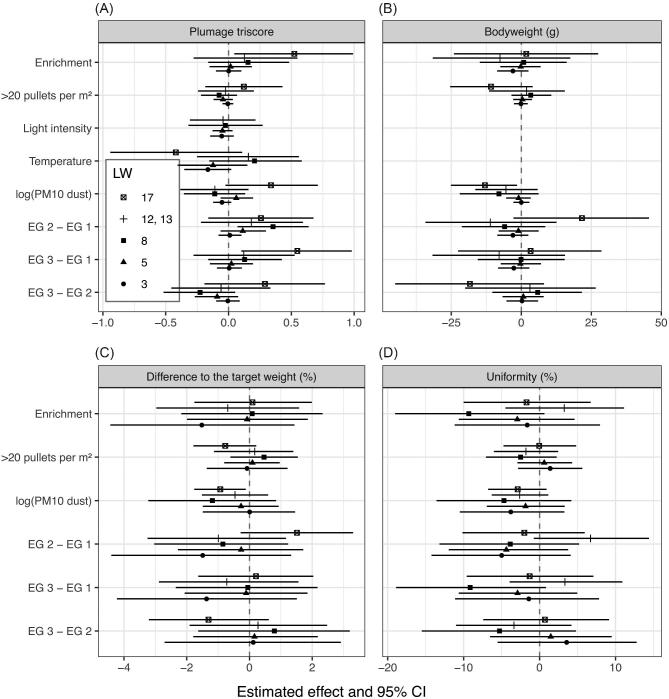
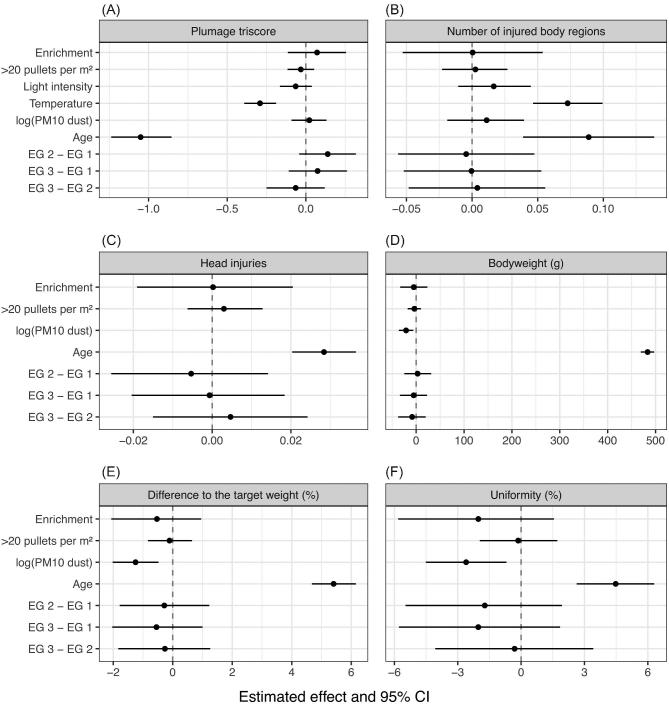
In this study, the effects of environmental enrichment, stocking density, and microclimate on feather condition, skin injuries, and other health parameters were investigated. During 2 rearing periods (RP), non-beak-trimmed Lohmann Brown hybrid pullets were housed in an aviary system for rearing with cages and from week 5 of age onwards with access to a litter area. All pullets were reared in the same barn and under practical conditions. In total, 9,187 (RP 1) and 9,090 (RP 2) pullets were distributed in 9 units, and each unit was assigned to 1 of 3 experimental groups (EG). In the control group (EG 1), the pullets were kept without environmental enrichment and at a commonly used stocking density (22 to 23 pullets per m²). Each unit of the 2 treatment groups was provided with 3 types of environmental enrichment simultaneously (pecking stones, pecking blocks, and lucerne bales), and the pullets were kept at a lower than usual (18 pullets per m²) (EG 2) or commonly used stocking density (EG 3). In each RP, the plumage condition, injuries and health of the pullets, and the microclimate of the housing system were examined 5 times. The statistical relationships of enrichment, stocking density, and microclimate with animal health were estimated via regression models. We found that the provision of environmental enrichment had a significant increasing effect on the plumage quality in week 17. Furthermore, significant relationships were found between several predictors (temperature in the housing system, dust concentration, and age of the pullets) and response variables (plumage condition, body injuries, head injuries, bodyweight, difference to the target weight and uniformity). The results of this study showed that increasing temperature in the housing system and increasing age of the pullets are significantly associated with the occurrence of feather damage and skin injuries during rearing. With stocking densities as high as we used (all > 17 pullets per m²), no significant positive effect of a reduced stocking density could be observed.
在这项研究中,研究了环境丰容、饲养密度和小气候对羽毛状况、皮肤损伤和其他健康参数的影响。在 2 个育雏期(RP)中,未修剪喙的洛曼棕色杂交雏鸡被饲养在一个带有笼舍的禽类系统中,从第 5 周龄开始,可以进入垫料区。所有雏鸡都在同一个畜舍中,在实际条件下饲养。共有 9187 只(RP1)和 9090 只(RP2)雏鸡被分配到 9 个单元中,每个单元被分配到 3 个实验组(EG)之一。在对照组(EG1)中,雏鸡没有环境丰容,饲养密度为常用的 22-23 只/平方米。2 个处理组的每个单元同时提供 3 种类型的环境丰容(啄石、啄块和紫花苜蓿捆),饲养密度低于常用水平(18 只/平方米)(EG2)或常用饲养密度(EG3)。在每个 RP 中,5 次检查羽毛状况、雏鸡的损伤和健康状况以及饲养系统的小气候。通过回归模型估计了丰容、饲养密度和小气候与动物健康的统计关系。我们发现,提供环境丰容对第 17 周的羽毛质量有显著的正向影响。此外,还发现几个预测因子(饲养系统中的温度、灰尘浓度和雏鸡的年龄)与响应变量(羽毛状况、身体损伤、头部损伤、体重、与目标体重的差异和均匀性)之间存在显著关系。这项研究的结果表明,饲养系统中温度的升高和雏鸡年龄的增加与育雏期间羽毛损伤和皮肤损伤的发生显著相关。在我们使用的高密度饲养(所有>17 只/平方米)下,没有观察到降低饲养密度的显著正向效果。