• 文献检索
  • 文档翻译
  • 深度研究
  • 学术资讯
  • Suppr Zotero 插件Zotero 插件
  • 邀请有礼
  • 套餐&价格
  • 历史记录
应用&插件
Suppr Zotero 插件Zotero 插件浏览器插件Mac 客户端Windows 客户端微信小程序
定价
高级版会员购买积分包购买API积分包
服务
文献检索文档翻译深度研究API 文档MCP 服务
关于我们
关于 Suppr公司介绍联系我们用户协议隐私条款
关注我们

Suppr 超能文献

核心技术专利:CN118964589B侵权必究
粤ICP备2023148730 号-1Suppr @ 2026

文献检索

告别复杂PubMed语法,用中文像聊天一样搜索,搜遍4000万医学文献。AI智能推荐,让科研检索更轻松。

立即免费搜索

文件翻译

保留排版,准确专业,支持PDF/Word/PPT等文件格式,支持 12+语言互译。

免费翻译文档

深度研究

AI帮你快速写综述,25分钟生成高质量综述,智能提取关键信息,辅助科研写作。

立即免费体验

人口统计学变量对老年日本人群使用神经认知问卷(NCQ)的主观神经认知主诉的影响。

Effects of Demographic Variables on Subjective Neurocognitive Complaints Using the Neurocognitive Questionnaire (NCQ) in an Aged Japanese Population.

机构信息

Departments of Clinical Studies and Statistics, Radiation Effects Research Foundation, 5-2 Hijiyama Park, Minami-ku, Hiroshima 732-0815, Japan.

Department of Biostatistics, University of Arkansas for Medical Sciences, Little Rock, AR 72205, USA.

出版信息

Int J Environ Res Public Health. 2019 Feb 1;16(3):421. doi: 10.3390/ijerph16030421.

DOI:10.3390/ijerph16030421
PMID:30717137
原文链接:https://pmc.ncbi.nlm.nih.gov/articles/PMC6388377/
Abstract

OBJECTIVES

In an aged Japanese population, we investigated associations of demographic variables with subjective neurocognitive complaints using the Neurocognitive Questionnaire (NCQ).

METHODS

Participants ( = 649) provided answers to the NCQ in both 2011 and 2013. Using fully-completed NCQs from 503 participants in 2011, we identified latent factors of subjective neurocognitive complaints using exploratory factor analysis; then examined associations of demographic variables with the identified factors for all 649 participants over the two years. We also examined changes in factor scores over the 2-year period.

RESULTS

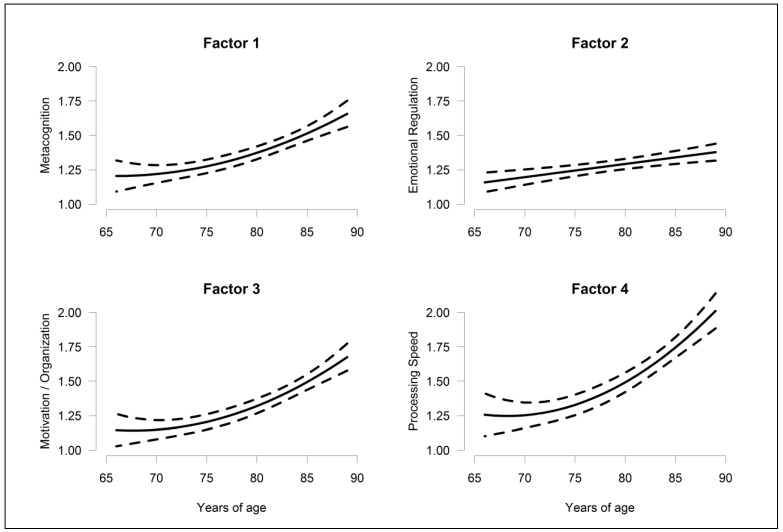
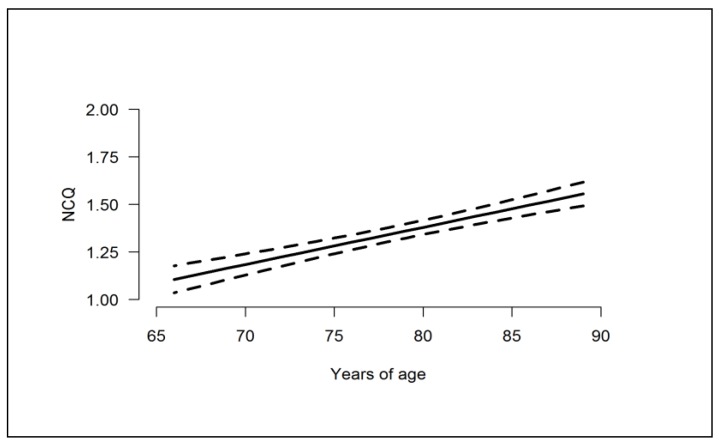
We identified four factors representing 20 of the 25 NCQ items and labelled them metacognition, emotional regulation, motivation/organization, and processing speed. In a regression model using all participants, we observed linear deterioration with age on emotional regulation and linear-quadratic deterioration with age on the other factors. Less education was associated with more problems for all factors, but we detected no evidence of interaction between age and education. In 314 participants completing both assessments, paired -tests comparing the 2013 to 2011 responses corroborated the regression results, except for emotional regulation.

CONCLUSIONS

On the NCQ, older age and less education were associated with more subjective neurocognitive complaints. This is compatible with the association of the same factors with objective cognition and suggests that subjective cognitive complaints complement objective cognition as a prodrome of non-normative cognitive decline.

摘要

目的

在日本老年人群中,我们使用神经认知问卷(Neurocognitive Questionnaire,NCQ)调查了人口统计学变量与主观神经认知主诉之间的关联。

方法

参与者(n=649)在 2011 年和 2013 年都回答了 NCQ。我们使用 2011 年 503 名参与者完整填写的 NCQ,通过探索性因子分析确定主观神经认知主诉的潜在因子;然后,在两年内对所有 649 名参与者,考察人口统计学变量与识别出的因子之间的关联。我们还检查了因子分数在 2 年期间的变化。

结果

我们确定了四个因子,代表 25 个 NCQ 项目中的 20 个项目,并将其命名为元认知、情绪调节、动机/组织和处理速度。在使用所有参与者的回归模型中,我们观察到情绪调节与年龄呈线性恶化,而其他因子呈线性二次恶化。受教育程度较低与所有因子的问题较多有关,但我们没有发现年龄和教育程度之间存在交互作用的证据。在完成两次评估的 314 名参与者中,比较 2013 年和 2011 年的配对 t 检验结果与回归结果一致,除了情绪调节。

结论

在 NCQ 上,年龄较大和受教育程度较低与更多的主观神经认知主诉有关。这与相同因素与客观认知的关联一致,表明主观认知主诉作为非规范认知衰退的前驱症状,与客观认知相辅相成。
https://cdn.ncbi.nlm.nih.gov/pmc/blobs/7e3d/6388377/a89f2e44b5e3/ijerph-16-00421-g002.jpg
https://cdn.ncbi.nlm.nih.gov/pmc/blobs/7e3d/6388377/d63ee4544eb4/ijerph-16-00421-g001.jpg
https://cdn.ncbi.nlm.nih.gov/pmc/blobs/7e3d/6388377/a89f2e44b5e3/ijerph-16-00421-g002.jpg
https://cdn.ncbi.nlm.nih.gov/pmc/blobs/7e3d/6388377/d63ee4544eb4/ijerph-16-00421-g001.jpg
https://cdn.ncbi.nlm.nih.gov/pmc/blobs/7e3d/6388377/a89f2e44b5e3/ijerph-16-00421-g002.jpg

相似文献

1
Effects of Demographic Variables on Subjective Neurocognitive Complaints Using the Neurocognitive Questionnaire (NCQ) in an Aged Japanese Population.人口统计学变量对老年日本人群使用神经认知问卷(NCQ)的主观神经认知主诉的影响。
Int J Environ Res Public Health. 2019 Feb 1;16(3):421. doi: 10.3390/ijerph16030421.
2
Self-report instruments of cognitive failures as screening tools for Subjective Cognitive Impairment in older adults.将认知失误的自我报告工具作为老年人主观认知障碍的筛查工具。
Hell J Nucl Med. 2017 Sep-Dec;20 Suppl:58-70.
3
International neurocognitive normative study: neurocognitive comparison data in diverse resource-limited settings: AIDS Clinical Trials Group A5271.国际神经认知规范研究:不同资源受限环境下的神经认知比较数据:艾滋病临床试验组A5271
J Neurovirol. 2016 Aug;22(4):472-8. doi: 10.1007/s13365-015-0415-2. Epub 2016 Jan 5.
4
The Childhood Cancer Survivor Study-Neurocognitive Questionnaire (CCSS-NCQ) revised: item response analysis and concurrent validity.儿童癌症幸存者研究-神经认知问卷(CCSS-NCQ)修订版:项目反应分析与同时效度
Neuropsychology. 2015 Jan;29(1):31-44. doi: 10.1037/neu0000095. Epub 2014 Jun 16.
5
Differences in quantitative methods for measuring subjective cognitive decline - results from a prospective memory clinic study.测量主观认知衰退的定量方法差异——一项前瞻性记忆门诊研究的结果
Int Psychogeriatr. 2016 Sep;28(9):1513-20. doi: 10.1017/S1041610216000272. Epub 2016 Apr 7.
6
Frequency and Correlates of Subjective Cognitive Impairment in HIV Disease.HIV 疾病中主观认知障碍的频率及相关因素。
AIDS Behav. 2019 Mar;23(3):617-626. doi: 10.1007/s10461-018-2297-9.
7
Radiation Effects on Late-life Neurocognitive Function in Childhood Atomic Bomb Survivors: A Radiation Effects Research Foundation Adult Health Study.辐射对童年时期遭受原子弹爆炸幸存者晚年神经认知功能的影响:一项辐射影响研究基金会成人健康研究。
Radiat Res. 2022 Apr 1;197(4):403-407. doi: 10.1667/RADE-21-00122.1.
8
Subjective Cognitive Decline, Objective Cognition, and Depression in Older Hispanics Screened for Memory Impairment.老年人主观认知下降、客观认知与抑郁在接受记忆障碍筛查的西班牙裔人群中的研究
J Alzheimers Dis. 2018;63(3):949-956. doi: 10.3233/JAD-170865.
9
Subjective Spatial Navigation Complaints - A Frequent Symptom Reported by Patients with Subjective Cognitive Decline, Mild Cognitive Impairment and Alzheimer's Disease.主观空间导航障碍——主观认知下降、轻度认知障碍和阿尔茨海默病患者报告的常见症状
Curr Alzheimer Res. 2018;15(3):219-228. doi: 10.2174/1567205014666171120145349.
10
Increased reporting of subjective cognitive complaints over time predicts cognitive decline and incident dementia.随着时间的推移,对主观认知抱怨的报告增加预示着认知能力下降和痴呆症的发生。
Int J Geriatr Psychiatry. 2021 Nov;36(11):1739-1747. doi: 10.1002/gps.5594. Epub 2021 Jul 6.

引用本文的文献

1
AI-assisted neurocognitive assessment protocol for older adults with psychiatric disorders.针对患有精神疾病的老年人的人工智能辅助神经认知评估方案。
Front Psychiatry. 2025 Jan 13;15:1516065. doi: 10.3389/fpsyt.2024.1516065. eCollection 2024.
2
Gender differences in cognitive reserve: implication for subjective cognitive decline in women.性别差异与认知储备:对女性主观认知下降的影响。
Neurol Sci. 2022 Apr;43(4):2499-2508. doi: 10.1007/s10072-021-05644-x. Epub 2021 Oct 8.
3
Demographic characteristics and neuropsychological assessments of subjective cognitive decline (SCD) (plus).

本文引用的文献

1
Memory-related subjective cognitive symptoms in the adult population: prevalence and associated factors - results of the LIFE-Adult-Study.成年人与记忆相关的主观认知症状:患病率及相关因素 - LIFE-Adult-Study 研究结果。
BMC Psychol. 2018 May 21;6(1):23. doi: 10.1186/s40359-018-0236-1.
2
Cross Sectional Associations between Socio-Demographic Factors and Cognitive Performance in an Older British Population: The European Investigation of Cancer in Norfolk (EPIC-Norfolk) Study.英国老年人群社会人口学因素与认知能力的横断面关联:诺福克欧洲癌症调查(EPIC - 诺福克)研究
PLoS One. 2016 Dec 8;11(12):e0166779. doi: 10.1371/journal.pone.0166779. eCollection 2016.
3
主观认知下降(SCD)(plus)的人口统计学特征和神经心理学评估。
Ann Clin Transl Neurol. 2020 Jun;7(6):1002-1012. doi: 10.1002/acn3.51068.
The interactive effects of age, education, and BMI on cognitive functioning.
年龄、教育程度和体重指数对认知功能的交互作用。
Neuropsychol Dev Cogn B Aging Neuropsychol Cogn. 2016;23(2):253-62. doi: 10.1080/13825585.2015.1082531. Epub 2015 Sep 1.
4
Subjective Cognitive Decline in Older Adults: An Overview of Self-Report Measures Used Across 19 International Research Studies.老年人的主观认知衰退:19项国际研究中使用的自我报告测量方法综述
J Alzheimers Dis. 2015 Sep 24;48 Suppl 1(0 1):S63-86. doi: 10.3233/JAD-150154.
5
Characterising the Profile of Everyday Executive Functioning and Relation to IQ in Adults with Williams Syndrome: Is the BRIEF Adult Version a Valid Rating Scale?刻画威廉姆斯综合征成年人日常执行功能概况及其与智商的关系:《成人版简明精神状态检查表》是有效的评定量表吗?
PLoS One. 2015 Sep 10;10(9):e0137628. doi: 10.1371/journal.pone.0137628. eCollection 2015.
6
Self-Reported Memory Failures: Associations with Future Dementia in a Population-Based Study with Long-Term Follow-Up.自我报告的记忆失误:在一项具有长期随访的基于人群的研究中与未来痴呆症的关联。
J Am Geriatr Soc. 2015 Sep;63(9):1766-73. doi: 10.1111/jgs.13611. Epub 2015 Aug 17.
7
Latent Structure of the Behavior Rating Inventory of Executive Function-Adult Version (BRIEF-A) After Mild Traumatic Brain Injury.轻度创伤性脑损伤后成人版执行功能行为评定量表(BRIEF-A)的潜在结构
Arch Clin Neuropsychol. 2016 Feb;31(1):29-36. doi: 10.1093/arclin/acv048. Epub 2015 Jul 23.
8
Trajectories of cognitive function in dementia-free subjects: Radiation Effects Research Foundation Adult Health Study.无痴呆症受试者的认知功能轨迹:放射效应研究基金会成人健康研究
J Neurol Sci. 2015 Apr 15;351(1-2):115-119. doi: 10.1016/j.jns.2015.02.050. Epub 2015 Mar 5.
9
Efficacy and safety of atomoxetine hydrochloride in Korean adults with attention-deficit hyperactivity disorder.盐酸托莫西汀在韩国成人注意力缺陷多动障碍患者中的疗效与安全性
Asia Pac Psychiatry. 2014 Dec;6(4):386-96. doi: 10.1111/appy.12160. Epub 2014 Oct 27.
10
Risk of dementia and mild cognitive impairment in older people with subjective memory complaints: meta-analysis.有主观记忆主诉的老年人患痴呆症和轻度认知障碍的风险:荟萃分析
Acta Psychiatr Scand. 2014 Dec;130(6):439-51. doi: 10.1111/acps.12336. Epub 2014 Sep 13.