Zhou Sha, Zhao Lei, Liang Zhaohui, Liu Songran, Li Yong, Liu Shiliang, Yang Hong, Liu Mengzhong, Xi Mian
Department of Radiation Oncology, Sun Yat-sen University Cancer Center, State Key Laboratory of Oncology in South China, Collaborative Innovation Centre for Cancer Medicine, Guangdong Esophageal Cancer Institute, Guangzhou 510060, China.
Department of Pathology, Sun Yat-sen University Cancer Center, State Key Laboratory of Oncology in South China, Collaborative Innovation Centre for Cancer Medicine, Guangdong Esophageal Cancer Institute, Guangzhou 510060, China.
Cancers (Basel). 2019 Feb 1;11(2):169. doi: 10.3390/cancers11020169.
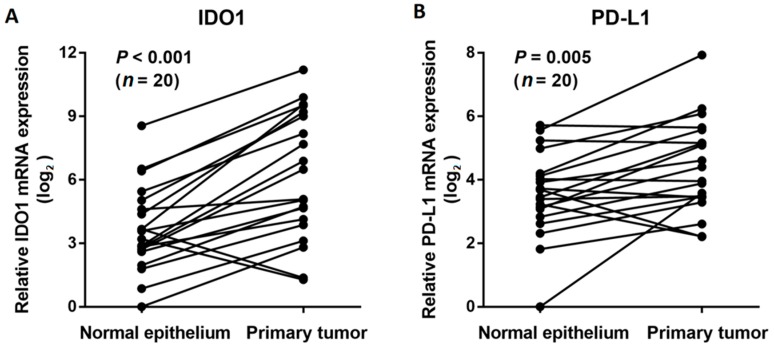
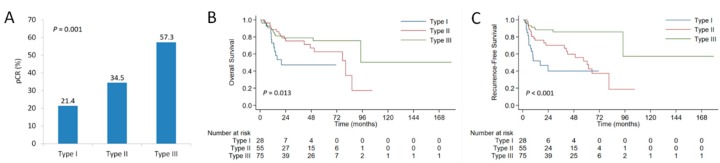
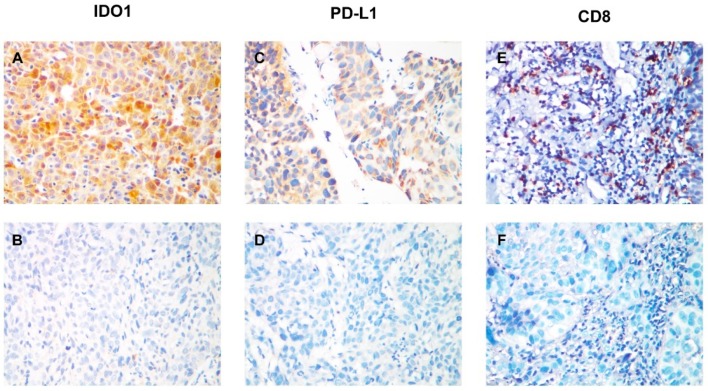
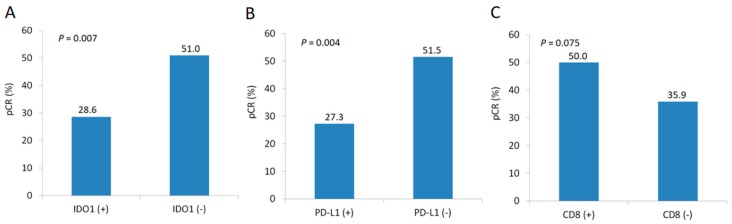
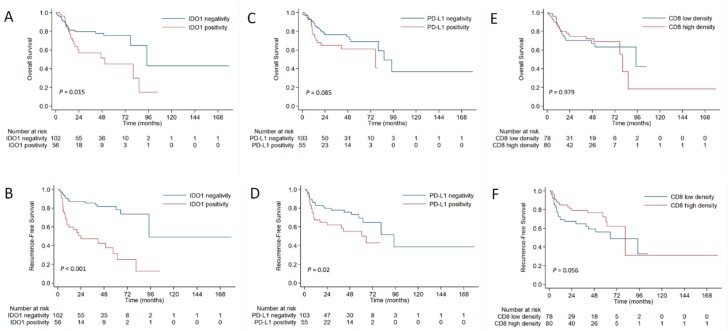
This study aimed to investigate the impact of indoleamine 2,3-dioxygenase 1 (IDO1) expression, programmed cell death-ligand 1 (PD-L1) expression, CD8+ tumor-infiltrating lymphocyte (TIL) status, and their combination on pathologic complete response (pCR) and recurrence in esophageal squamous cell carcinoma (ESCC) treated with neoadjuvant chemoradiotherapy (CRT). Indoleamine 2,3-dioxygenase 1, PD-L1, and CD8+ TIL statuses were evaluated by immunohistochemical analysis on pre-CRT biopsies of 158 patients. Sixty-eight patients (43.0%) achieved pCR after neoadjuvant CRT and 48 patients (30.4%) developed recurrences after surgery. IDO1 and PD-L1 proteins were co-expressed in 28 patients (17.7%). Indoleamine 2,3-dioxygenase 1 positive patients showed a significantly lower pCR rate than IDO1 negative patients (28.6% vs. 51.0%, = 0.007). Similarly, PD-L1 high expression was significantly negatively correlated with pCR rate (27.3% vs. 51.5%, = 0.004). On multivariate analysis, IDO1 expression was an independent prognostic factor for developing recurrences. Stratification analysis revealed that patients with co-expression of IDO1 and PD-L1 were significantly associated with a lower pCR rate and worse recurrence-free survival than those with one or none positive protein. In conclusion, IDO1 and PD-L1 co-expression could predict poor pathologic response and high risk of recurrence in ESCC after neoadjuvant CRT, indicating a subset of patients who may benefit from CRT combined with immunotherapy.
本研究旨在探讨吲哚胺2,3-双加氧酶1(IDO1)表达、程序性细胞死亡配体1(PD-L1)表达、CD8 +肿瘤浸润淋巴细胞(TIL)状态及其组合对接受新辅助放化疗(CRT)的食管鳞状细胞癌(ESCC)患者病理完全缓解(pCR)和复发的影响。通过免疫组织化学分析对158例患者新辅助CRT前活检标本评估IDO1、PD-L1和CD8 + TIL状态。68例患者(43.0%)新辅助CRT后达到pCR,48例患者(30.4%)术后复发。28例患者(17.7%)IDO1和PD-L1蛋白共表达。IDO1阳性患者的pCR率显著低于IDO1阴性患者(28.6%对51.0%,P = 0.007)。同样,PD-L1高表达与pCR率显著负相关(27.3%对51.5%,P = 0.004)。多因素分析显示,IDO1表达是复发的独立预后因素。分层分析显示,与一种或无阳性蛋白的患者相比,IDO1和PD-L1共表达的患者pCR率显著降低,无复发生存期更差。总之,IDO1和PD-L1共表达可预测新辅助CRT后ESCC患者病理反应差和复发风险高,提示这部分患者可能从CRT联合免疫治疗中获益。