Molecular and Cellular Biology Program, University of Washington School of Medicine, Seattle, WA 98195, USA; Department of Neurology, University of Washington School of Medicine, Seattle, WA 98195, USA; Senator Paul D. Wellstone Muscular Dystrophy Specialized Research Center, Seattle, WA 98195, USA.
Department of Neurology, University of Washington School of Medicine, Seattle, WA 98195, USA; Senator Paul D. Wellstone Muscular Dystrophy Specialized Research Center, Seattle, WA 98195, USA.
Mol Ther. 2019 Mar 6;27(3):623-635. doi: 10.1016/j.ymthe.2019.01.002. Epub 2019 Feb 1.
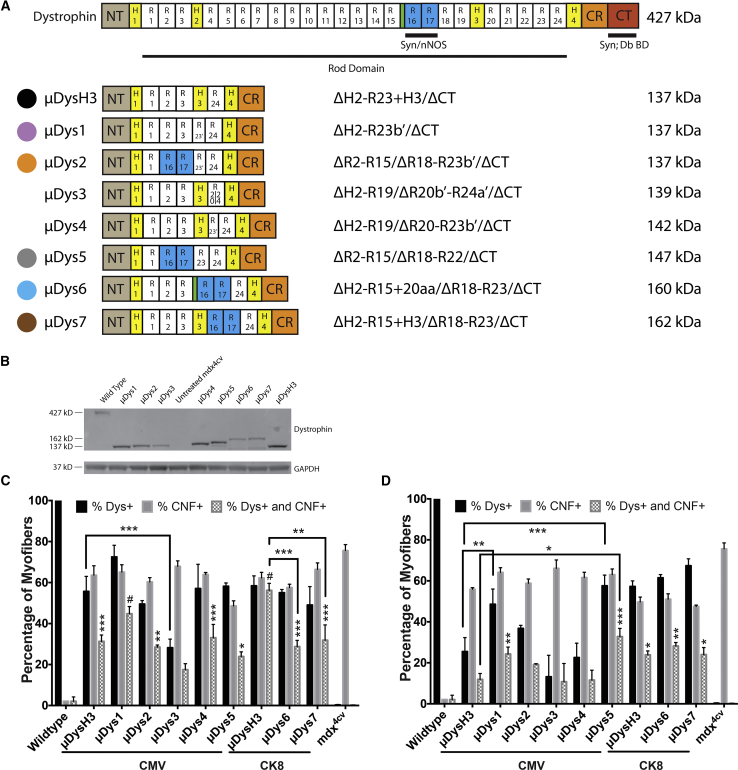
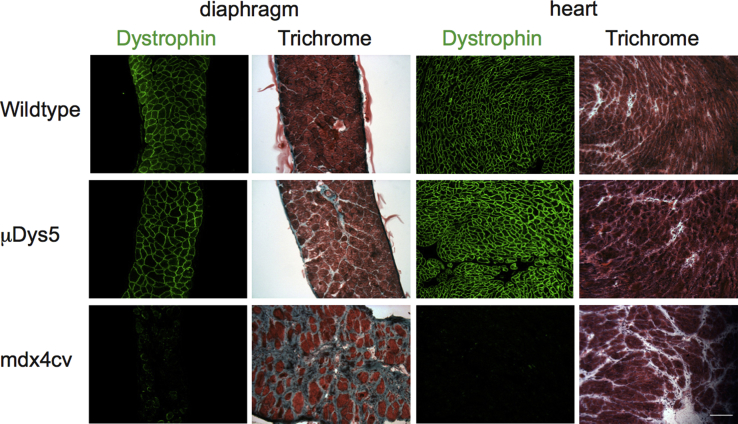
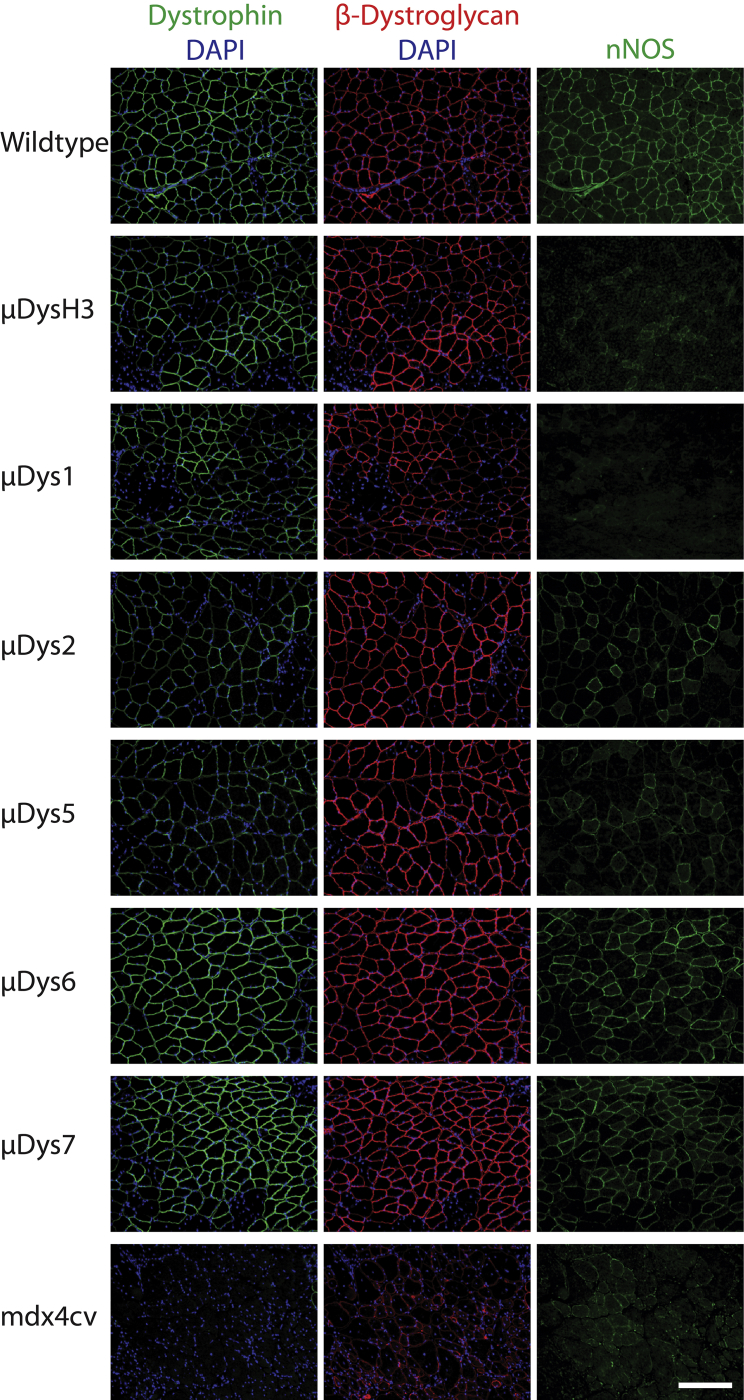
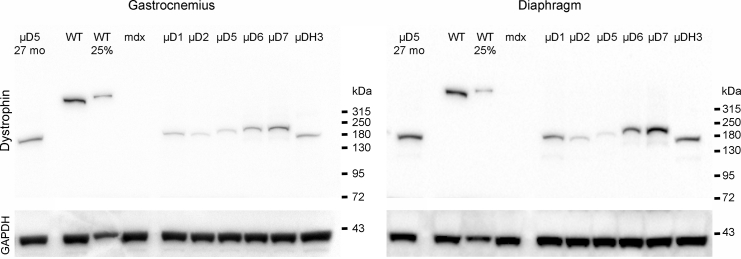
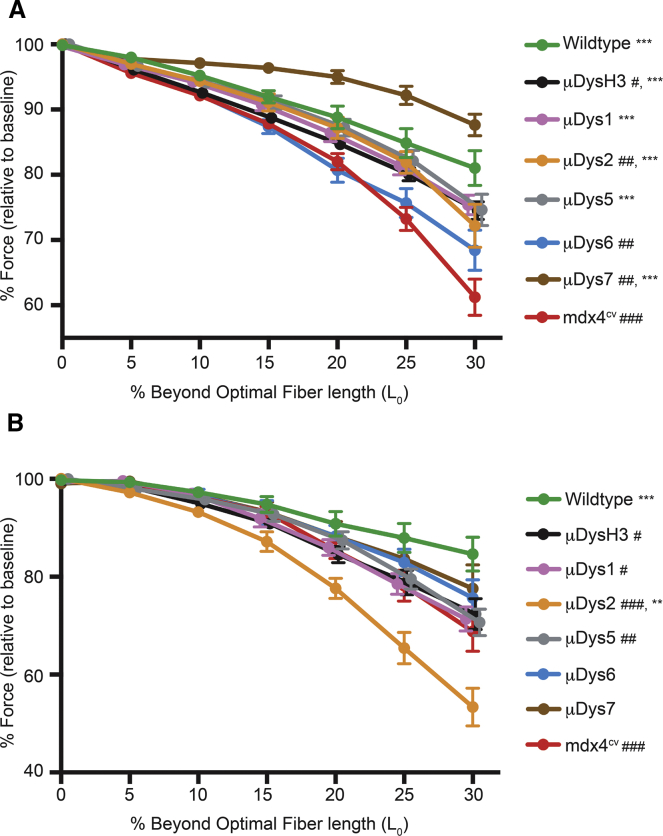
Gene therapies using adeno-associated viral (AAV) vectors have advanced into clinical trials for several diseases, including Duchenne muscular dystrophy (DMD). A limitation of AAV is the carrying capacity (∼5 kb) available for genes and regulatory cassettes (RCs). These size constraints are problematic for the 2.2-Mb dystrophin gene. We previously designed a variety of miniaturized micro-dystrophins (μDys) that displayed significant, albeit incomplete, function in striated muscles. To develop μDys proteins with improved performance, we explored structural modifications of the dystrophin central rod domain. Eight μDys variants were studied that carried unique combinations of between four and six of the 24 spectrin-like repeats present in the full-length protein, as well as various hinge domains. Expression of μDys was regulated by a strong but compact muscle-restricted RC (CK8e) or by the ubiquitously active cytomegalovirus (CMV) RC. Vectors were evaluated by intramuscular injection and systemic delivery to dystrophic mdx mice, followed by analysis of skeletal muscle pathophysiology. Two μDys designs were identified that led to increased force generation compared with previous μDys while also localizing neuronal nitric oxide synthase to the sarcolemma. An AAV vector expressing the smaller of these (μDys5) from the CK8e RC is currently being evaluated in a DMD clinical trial.
腺相关病毒(AAV)载体的基因治疗已经进入了多种疾病的临床试验,包括杜氏肌营养不良症(DMD)。AAV 的一个限制是可用于基因和调控盒(RCs)的携带能力(约 5 kb)。这些大小限制对于 2.2 Mb 的肌营养不良蛋白基因来说是个问题。我们之前设计了各种微型微肌营养不良蛋白(μDys),它们在横纹肌中显示出显著的、尽管不完整的功能。为了开发具有改进性能的 μDys 蛋白,我们探索了肌营养不良蛋白中心杆域的结构修饰。研究了八个携带独特组合的 μDys 变体,这些变体携带全长蛋白中存在的 24 个 spectrin 样重复中的四到六个,以及各种铰链域。μDys 的表达受强但紧凑的肌肉特异性 RC(CK8e)或普遍活跃的巨细胞病毒(CMV)RC 调控。通过肌肉内注射和系统递送至肌营养不良症 mdx 小鼠来评估载体,然后分析骨骼肌病理生理学。确定了两种 μDys 设计,与以前的 μDys 相比,它们导致了力的产生增加,同时也将神经元型一氧化氮合酶定位到肌膜。目前正在从 CK8e RC 表达这些较小的 μDys5 的 AAV 载体正在进行 DMD 的临床试验。