Instituto de Hortofruticultura Subtropical y Mediterránea "La Mayora", Consejo Superior de Investigaciones Científicas - Universidad de Málaga (IHSM-CSIC-UMA), Avenida Dr. Wienberg s/n, 29750, Algarrobo-Costa, Málaga, Spain.
Instituto Nacional dos Recursos Biológicos (INRB), Quinta do Marquês, Oeiras, Portugal.
Sci Rep. 2019 Feb 4;9(1):1332. doi: 10.1038/s41598-018-37971-z.
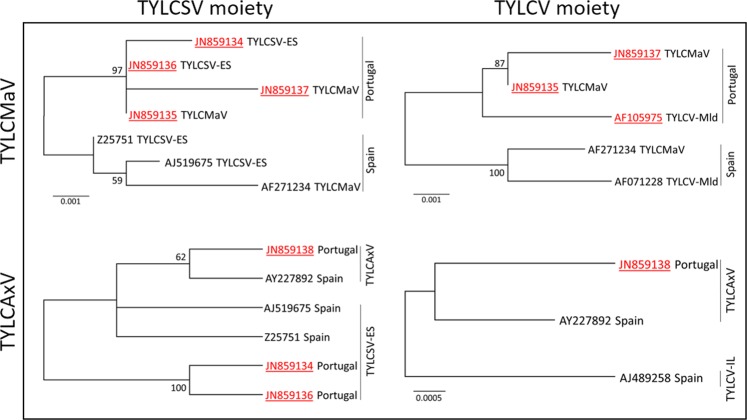
Recurrent evolution can involve interspecific interactions, recognized to play a primary role in the diversification and organization of life. Both in the plant and animal kingdoms, the recurrent formation of allopolyploid species has been described. In the virosphere, recombination between isolates of different species has been shown to be a source of speciation. In this work, complete genome analysis showed that speciation through recombination of an emergent DNA plant virus, tomato yellow leaf curl Malaga virus (genus Begomovirus, family Geminiviridae), has occurred independently in Portugal and Spain, confirming previous observations with tomato yellow leaf curl Axarquia virus, also originated independently in Spain and Italy. These results will guide future research to discover new cases of recurrent emergence of recombinant virus species in geographical areas where the putative parents co-exist or can be introduced. This will reveal the role that recurrent speciation through recombination plays in the evolution of the virosphere and will help to understand the consequences of this phenomenon on the diversification of life.
反复进化可能涉及种间相互作用,这些相互作用被认为在生物的多样化和组织中起着主要作用。在植物和动物王国中,已经描述了异源多倍体物种的反复形成。在病毒圈中,已经表明不同物种之间的重组是物种形成的一个来源。在这项工作中,完整的基因组分析表明,通过新兴的 DNA 植物病毒——番茄黄卷叶 Málaga 病毒(属 Begomovirus,双生病毒科)的重组而产生的物种形成,在葡萄牙和西班牙独立发生,这证实了先前对番茄黄卷叶 Axarquia 病毒的观察结果,该病毒也在西班牙和意大利独立起源。这些结果将指导未来的研究,以发现假定亲本共存或可引入的地理区域中重组病毒物种反复出现的新情况。这将揭示通过重组反复产生的物种形成在病毒圈进化中的作用,并有助于了解这种现象对生命多样化的影响。