Department of Clinical Rehabilitation, University of Physical Education in Krakow, Poland.
Oleksy Physiotherapy Clinic, Lancut, Poland.
Biomed Res Int. 2019 Jan 2;2019:6947273. doi: 10.1155/2019/6947273. eCollection 2019.
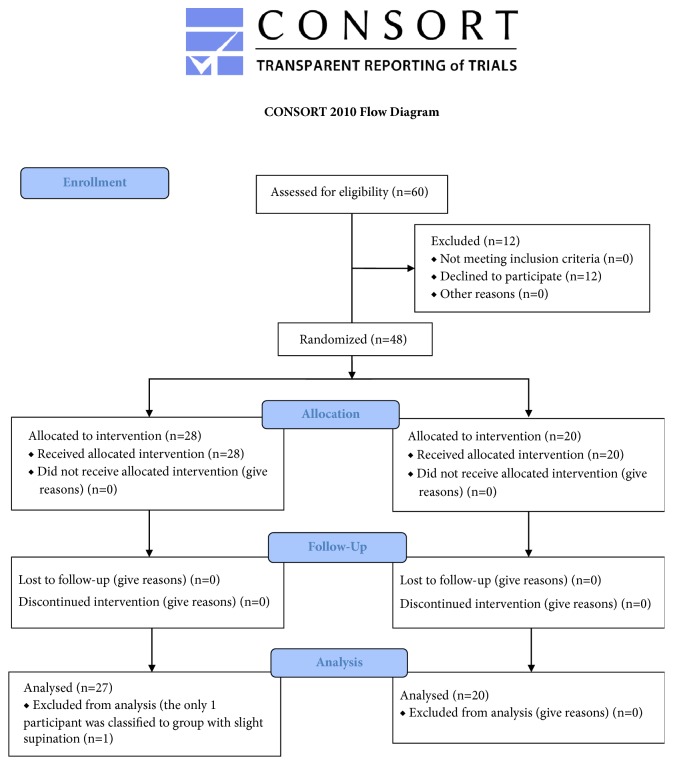
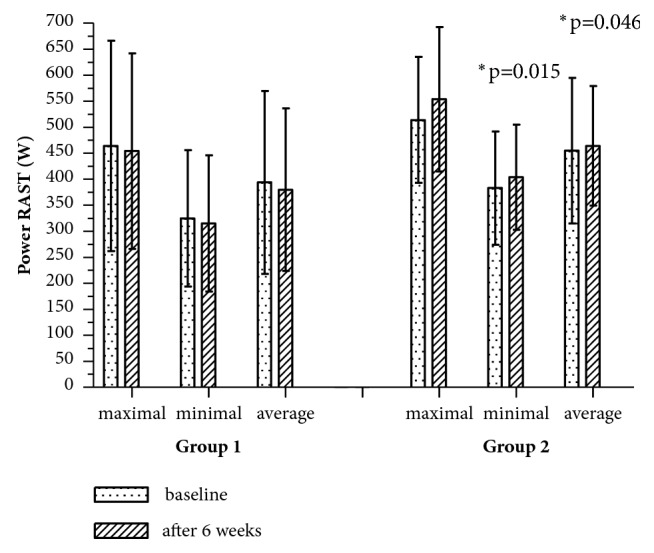
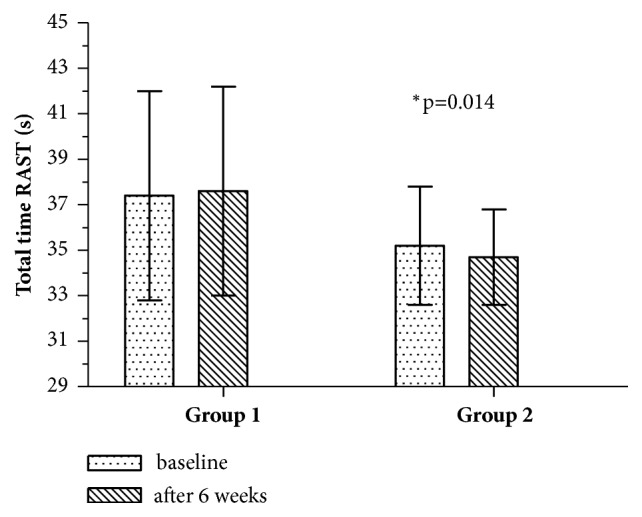
The aim of this study was to evaluate the influence of plantar short foot muscles exercises on the performance of lower extremities in long-distance runners. 47 long-distance runners aged 21-45 years took part in this study. The participants were divided into two groups based on baseline measurement of Foot Posture Index: Group 1 (n=27) with neutral foot and Group 2 (n=20) with slight and increased pronation. The participants performed the exercises daily for 6 weeks. The knee flexors and extensors torque, work, and power on Isokinetic Dynamometer and Running-Based Anaerobic Sprint Test (RAST) were checked at baseline and after 6 weeks of exercises. Higher values of peak torque of knee flexors were observed. This change was statistically significant at high load with angular velocity 90°/s (73.55 Nm at baseline and 89.05 Nm after 6 weeks) and 160°/s (69.40 Nm at baseline and 79.00 Nm after 6 weeks) in Group 2. In both groups higher values of maximum power were noted. Participants in Group 2 achieved lower values in each 35-metre run time and higher values of power. In Group 2 there was significant improvement of total time (35.26 s at baseline and 34.79 s after 6 weeks) compared to Group 1 (37.33 s at baseline and 37.56 s after 6 weeks). Exercises strengthening short foot muscles may improve energy transfer through body segments and increase strength and values of generated power. They should be included as a part of daily training programme of runners. This study was registered in the Australian New Zealand Clinical Trials Registry (ANZCTR). Registration number: ACTRN12615001200572.
本研究旨在评估足底短缩肌训练对长跑运动员下肢表现的影响。47 名 21-45 岁的长跑运动员参与了本研究。根据足部姿势指数的基线测量,参与者被分为两组:第 1 组(n=27)为中立足,第 2 组(n=20)为轻度和中度内旋。参与者每天进行练习,持续 6 周。在等速测力计和基于跑步的无氧冲刺测试(RAST)上检查膝关节屈肌和伸肌的扭矩、功和功率。观察到膝关节屈肌的峰值扭矩值更高。第 2 组在高负荷(角速度 90°/s 时为 73.55 Nm,6 周后为 89.05 Nm;角速度 160°/s 时为 69.40 Nm,6 周后为 79.00 Nm)时,这种变化具有统计学意义。在两组中,最大功率的数值都更高。第 2 组的每位 35 米跑的时间都更短,功率更高。与第 1 组相比(第 1 组在基线时为 37.33 秒,6 周后为 37.56 秒),第 2 组的总时间(基线时为 35.26 秒,6 周后为 34.79 秒)显著改善。强化足底短缩肌的练习可以改善身体各部位的能量传递,增强力量和产生的功率。这些练习应该作为跑步运动员日常训练计划的一部分。本研究已在澳大利亚和新西兰临床试验注册中心(ANZCTR)注册。注册号:ACTRN12615001200572。