Department of Urology, Tianjin Institute of Urology, The Second Hospital of Tianjin Medical University, Hexi, Tianjin 300211, P.R. China.
Department of Radiology, The Second Hospital of Tianjin Medical University, Hexi, Tianjin 300211, P.R. China.
Int J Mol Med. 2019 Apr;43(4):1611-1622. doi: 10.3892/ijmm.2019.4084. Epub 2019 Jan 30.
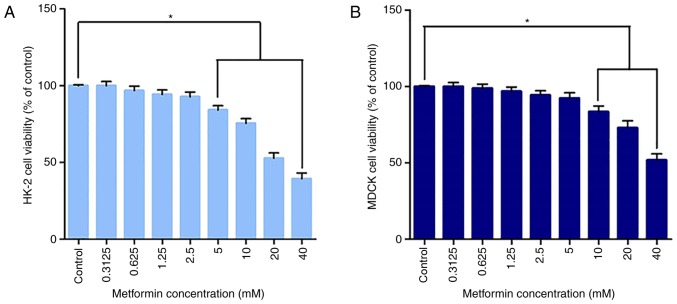
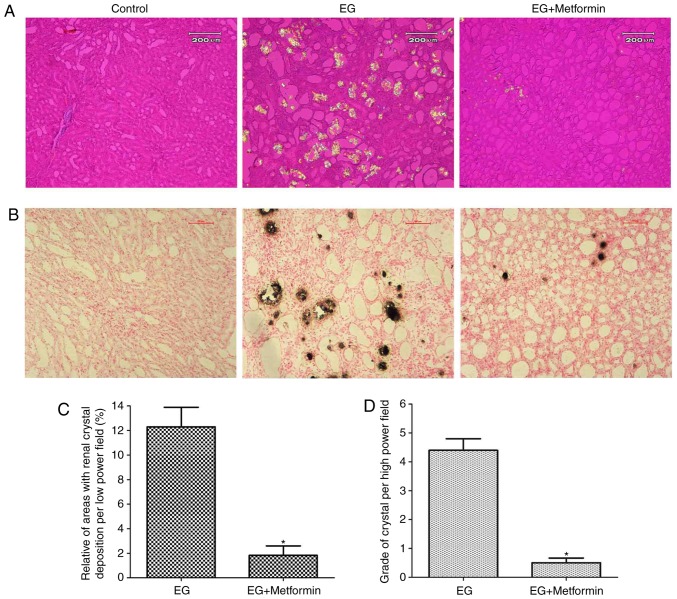
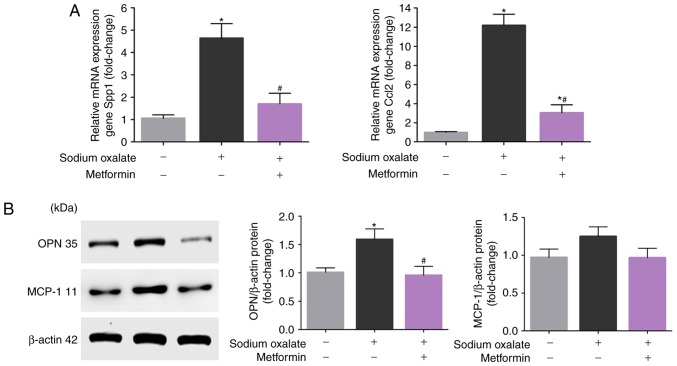
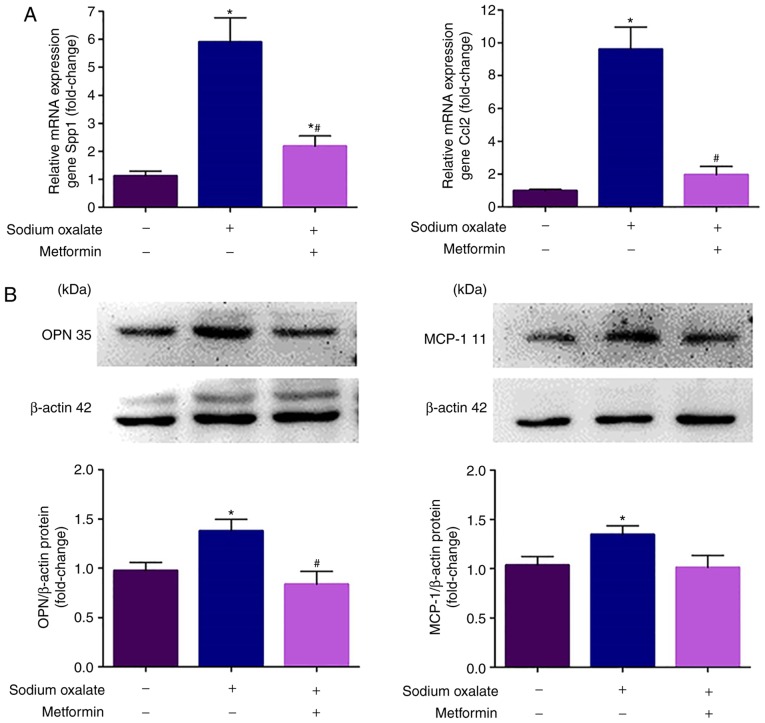
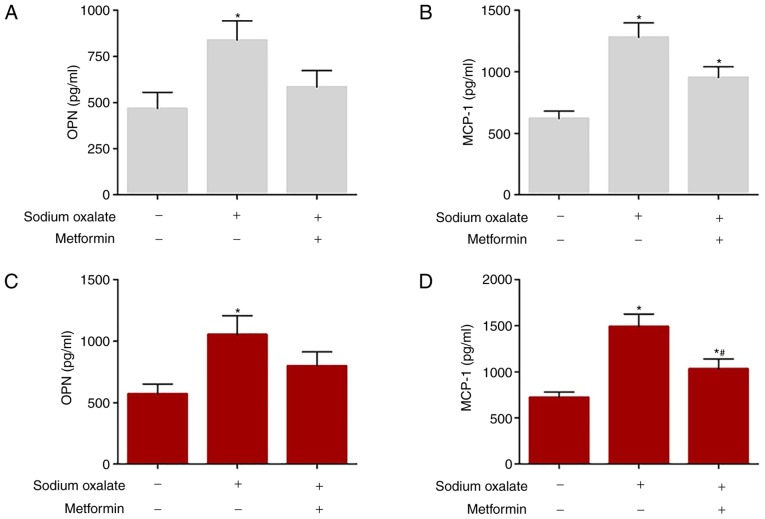
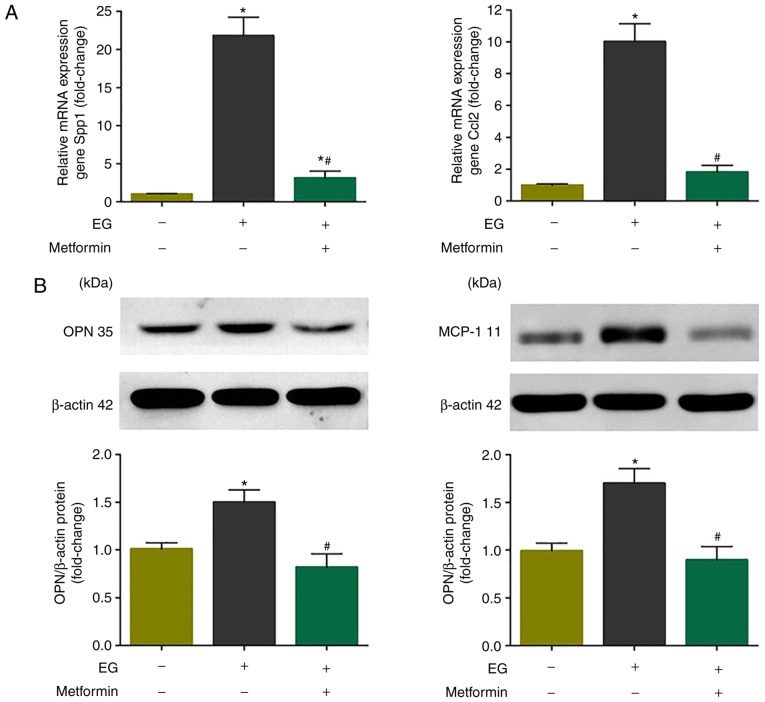
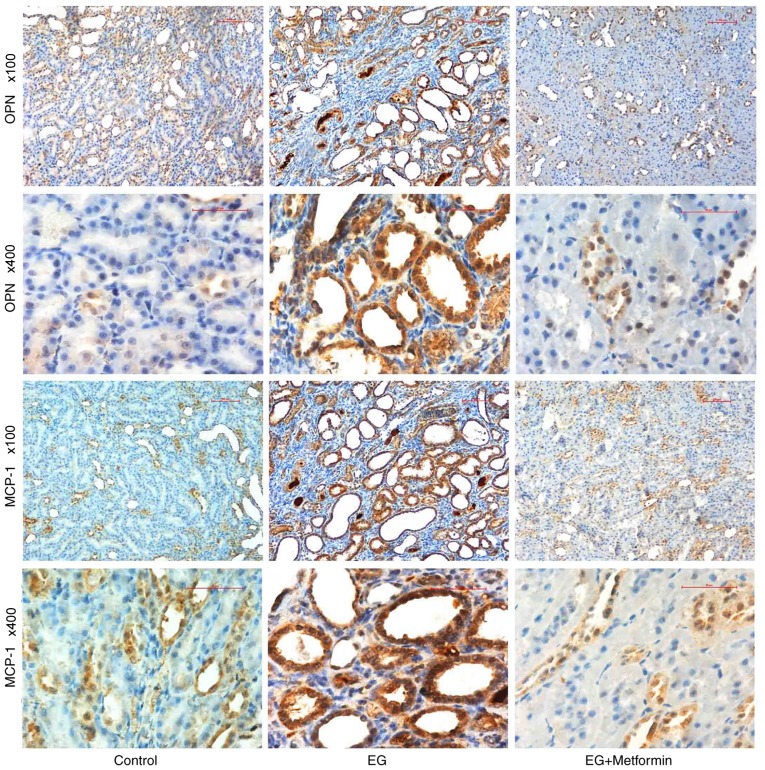
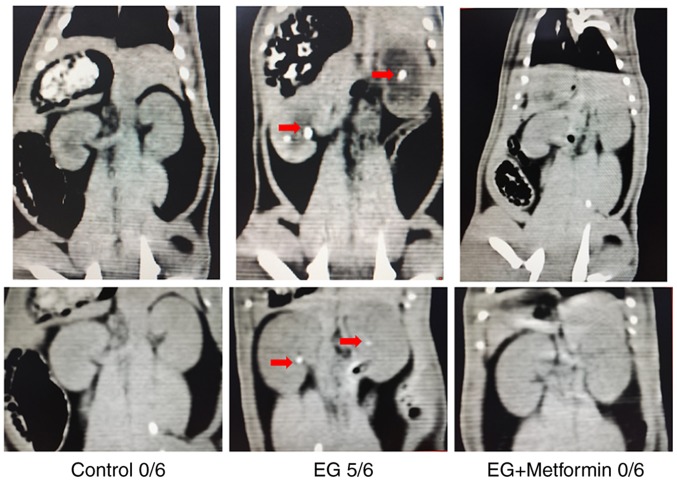
Treatment targeting osteopontin (OPN) and monocyte chemoattractant protein 1 (MCP‑1) has been recognized as a novel approach in renal crystal formation. The present study was designed to investigate the suppressive effects of metformin on nephrolithiasis formation and its potential mechanism. The cytotoxicity of metformin on MDCK and HK‑2 cells was determined using a Cell Counting Kit‑8 assay in vitro. Subsequently, the mRNA transcription and protein expression levels of MCP‑1 and OPN were detected by reverse transcription‑quantitative‑polymerase chain reaction analysis, western blot analysis and ELISA. Male Sprague‑Dawley rats were divided into a control group, ethylene glycol (EG) group and EG + metformin group. The expression levels of MCP‑1 and OPN and crystal formations were evaluated in renal tissues following an 8‑week treatment period. In vitro, metformin significantly inhibited the production of MCP‑1 and OPN induced by oxalate at the mRNA and protein expression levels. In vivo, increased expression levels of MCP‑1 and OPN were detected in the EG group compared with the controls, and this upregulation was reversed in the EG + metformin group. Renal crystal deposition in the EG + metformin group was markedly decreased compared with that in the EG group. Therefore, the results of the study suggest that metformin suppressed urinary crystal deposit formation, possibly by mediating the expression of inflammatory mediators OPN and MCP‑1.
靶向骨桥蛋白(OPN)和单核细胞趋化蛋白 1(MCP-1)的治疗已被认为是一种治疗肾脏晶体形成的新方法。本研究旨在探讨二甲双胍对肾结石形成的抑制作用及其潜在机制。采用细胞计数试剂盒-8 法体外检测二甲双胍对 MDCK 和 HK-2 细胞的细胞毒性。随后,通过逆转录-定量-聚合酶链反应分析、western blot 分析和 ELISA 检测 MCP-1 和 OPN 的 mRNA 转录和蛋白表达水平。雄性 Sprague-Dawley 大鼠分为对照组、乙二醇(EG)组和 EG+二甲双胍组。经过 8 周的治疗后,评估肾脏组织中 MCP-1 和 OPN 的表达水平和晶体形成情况。在体外,二甲双胍显著抑制草酸盐诱导的 MCP-1 和 OPN 的产生,在 mRNA 和蛋白表达水平上均有抑制作用。在体内,与对照组相比,EG 组中 MCP-1 和 OPN 的表达水平升高,而在 EG+二甲双胍组中,这种上调得到逆转。与 EG 组相比,EG+二甲双胍组肾内晶体沉积明显减少。因此,研究结果表明,二甲双胍抑制尿晶体沉积形成,可能通过调节炎症介质 OPN 和 MCP-1 的表达。