Division of Pediatric Critical Care Medicine, Department of Pediatrics, University of Washington, Seattle, WA.
Harborview Injury Prevention & Research Center, Seattle, WA.
Pediatr Crit Care Med. 2019 Jun;20(6):501-509. doi: 10.1097/PCC.0000000000001886.
Mortality from pediatric sepsis has steadily declined over the past several decades; however, little is known about morbidity among survivors. We aimed to determine the prevalence of and risk factors for failure to recover to baseline health-related quality of life following community-acquired pediatric sepsis.
Retrospective cohort study.
Seattle Children's Hospital.
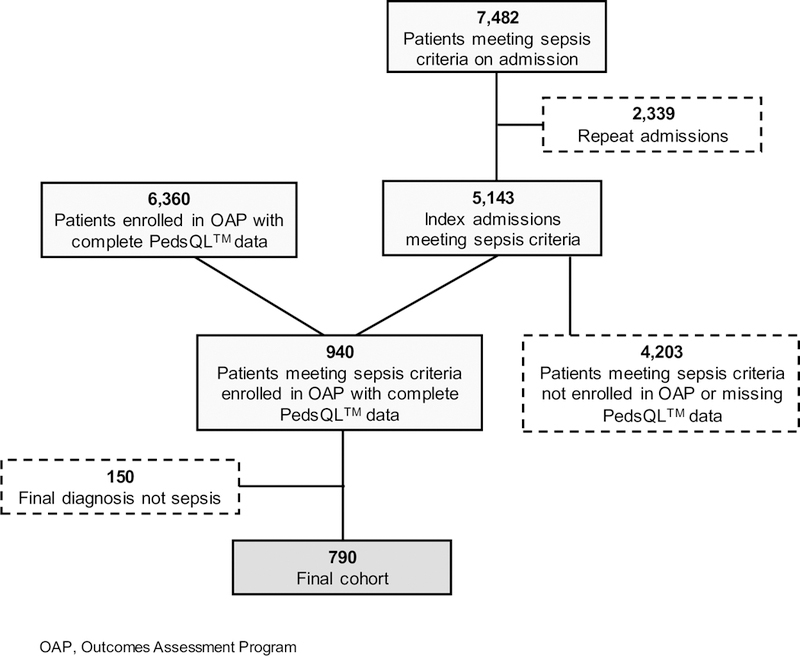
Children aged 1 month to 21 years admitted to the inpatient wards or ICUs from 2012 to 2015 who met 2005 consensus sepsis criteria within 4 hours of hospitalization and were enrolled in the hospital's Outcomes Assessment Program with baseline, admission, and post-discharge health-related quality of life data available.
None.
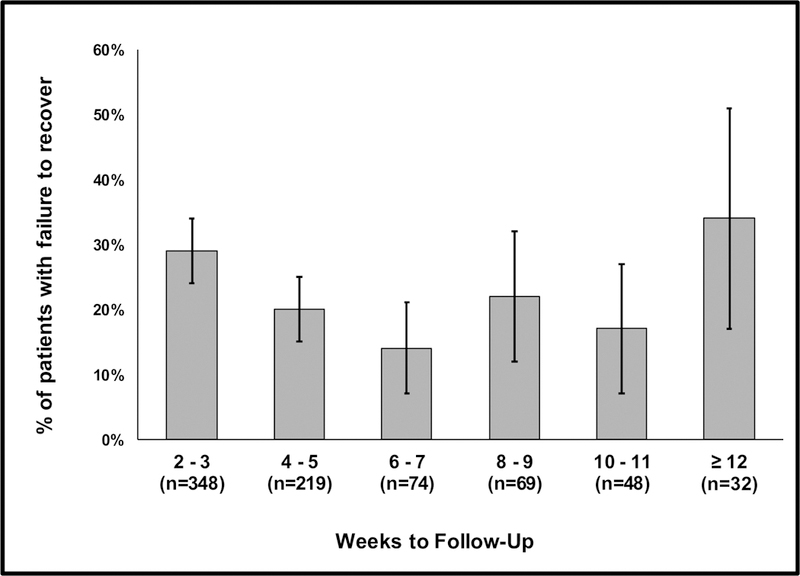
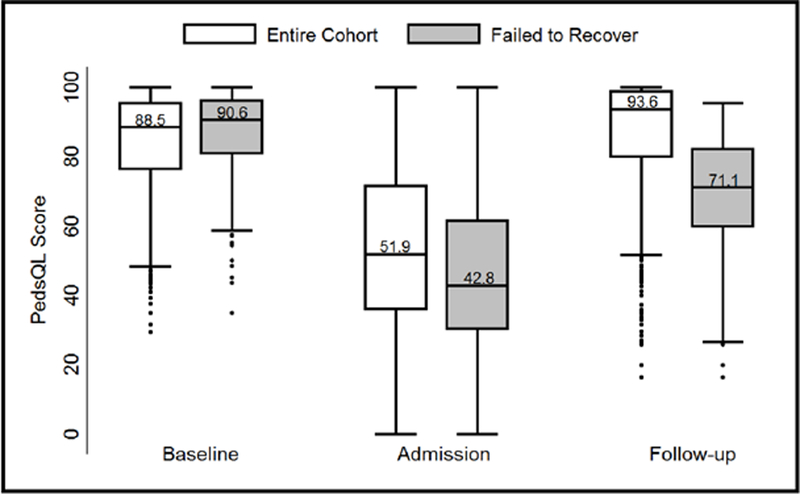
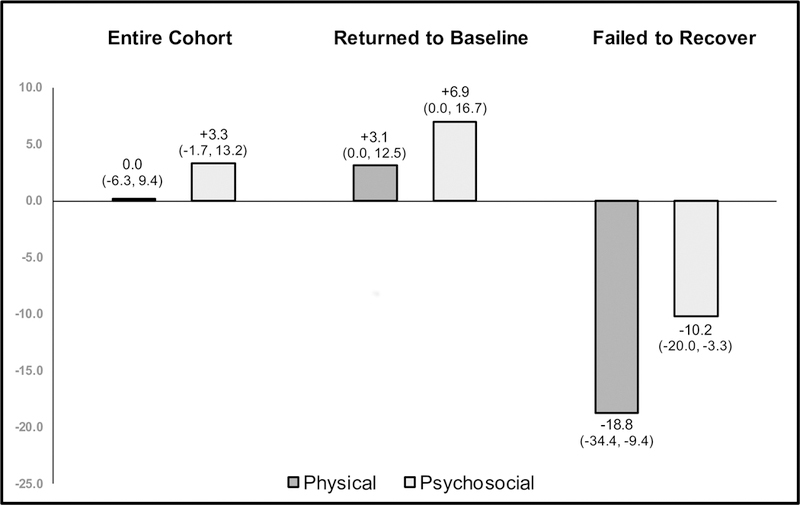
We assessed health-related quality of life with the Pediatric Quality of Life Inventory for pre-admission baseline, admission, and post-discharge (median, 31 d) status. We determined associations between patient and illness characteristics with failure to recover within 4.5 points of baseline at follow-up (the minimum clinically significant difference between two scores). Of 790 patients, 23.8% failed to recover to baseline health-related quality of life at follow-up. Factors associated with failure to recover were septic shock, older age, private insurance, complex chronic disease, immune compromise, CNS infection or bacteremia, ICU admission, and longer length of stay. On multivariable analysis controlling for time to follow-up, failure to recover was independently associated with septic shock (relative risk, 1.79; 95% CI, 1.24-2.58), older age (relative risk, 1.02/yr; 95% CI, 1.01-1.05), immune compromise (relative risk, 1.83; 95% CI, 1.40-2.40), and length of stay (relative risk, 1.03/d; 95% CI, 1.01-1.04).
Nearly one-quarter of children surviving hospitalization for community-acquired sepsis experienced a clinically significant deterioration in health-related quality of life. We identify risk factors for poor outcomes following sepsis and highlight the need for ongoing evaluation and treatment by primary and specialty care providers for pediatric sepsis survivors after hospital discharge.
在过去几十年中,儿科脓毒症的死亡率稳步下降;然而,对于幸存者的发病率知之甚少。我们旨在确定社区获得性儿科脓毒症后无法恢复基线健康相关生活质量的患病率和危险因素。
回顾性队列研究。
西雅图儿童医院。
2012 年至 2015 年期间,1 个月至 21 岁的儿童因符合 2005 年脓毒症共识标准而在住院后 4 小时内入住住院病房或 ICU,并在医院的结局评估计划中登记,可获得基线、入院和出院后健康相关生活质量数据。
无。
我们使用儿科生活质量问卷评估了入院前基线、入院时和出院后(中位数为 31 天)的健康相关生活质量。我们确定了患者和疾病特征与随访时无法恢复 4.5 分基线之间的关联(两个评分之间的最小临床显著差异)。在 790 名患者中,23.8%的患者在随访时未能恢复到基线健康相关生活质量。与无法恢复相关的因素是感染性休克、年龄较大、私人保险、复杂的慢性疾病、免疫功能受损、CNS 感染或菌血症、入住 ICU 和住院时间延长。在控制随访时间的多变量分析中,无法恢复与感染性休克(相对风险,1.79;95%置信区间,1.24-2.58)、年龄较大(相对风险,1.02/年;95%置信区间,1.01-1.05)、免疫功能受损(相对风险,1.83;95%置信区间,1.40-2.40)和住院时间(相对风险,1.03/天;95%置信区间,1.01-1.04)独立相关。
近四分之一的因社区获得性脓毒症住院的儿童经历了健康相关生活质量的显著恶化。我们确定了脓毒症后不良结局的危险因素,并强调需要由初级保健和专科保健提供者在出院后对儿科脓毒症幸存者进行持续评估和治疗。