Schmidt Konrad, Worrack Susanne, Von Korff Michael, Davydow Dimitry, Brunkhorst Frank, Ehlert Ulrike, Pausch Christine, Mehlhorn Juliane, Schneider Nico, Scherag André, Freytag Antje, Reinhart Konrad, Wensing Michel, Gensichen Jochen
Institute of General Practice and Family Medicine, Jena University Hospital, Jena, Germany2Center of Sepsis Control and Care (CSCC), Jena University Hospital, Jena, Germany.
Group Health Research Institute, Group Health Cooperative, Seattle, Washington.
JAMA. 2016 Jun 28;315(24):2703-11. doi: 10.1001/jama.2016.7207.
Survivors of sepsis face long-term sequelae that diminish health-related quality of life and result in increased care needs in the primary care setting, such as medication, physiotherapy, or mental health care.
To examine if a primary care-based intervention improves mental health-related quality of life.
DESIGN, SETTING, AND PARTICIPANTS: Randomized clinical trial conducted between February 2011 and December 2014, enrolling 291 patients 18 years or older who survived sepsis (including septic shock), recruited from 9 intensive care units (ICUs) across Germany.
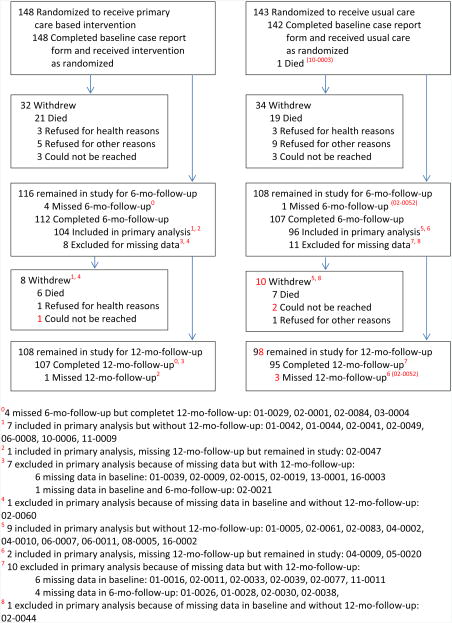
Participants were randomized to usual care (n = 143) or to a 12-month intervention (n = 148). Usual care was provided by their primary care physician (PCP) and included periodic contacts, referrals to specialists, and prescription of medication, other treatment, or both. The intervention additionally included PCP and patient training, case management provided by trained nurses, and clinical decision support for PCPs by consulting physicians.
The primary outcome was change in mental health-related quality of life between ICU discharge and 6 months after ICU discharge using the Mental Component Summary (MCS) of the 36-Item Short-Form Health Survey (SF-36 [range, 0-100; higher ratings indicate lower impairment; minimal clinically important difference, 5 score points]).
The mean age of the 291 patients was 61.6 years (SD, 14.4); 66.2% (n = 192) were men, and 84.4% (n = 244) required mechanical ventilation during their ICU stay (median duration of ventilation, 12 days [range, 0-134]). At 6 and 12 months after ICU discharge, 75.3% (n = 219 [112 intervention, 107 control]) and 69.4% (n = 202 [107 intervention, 95 control]), respectively, completed follow-up. Overall mortality was 13.7% at 6 months (40 deaths [21 intervention, 19 control]) and 18.2% at 12 months (53 deaths [27 intervention, 26 control]). Among patients in the intervention group, 104 (70.3%) received the intervention at high levels of integrity. There was no significant difference in change of mean MCS scores (intervention group mean at baseline, 49.1; at 6 months, 52.9; change, 3.79 score points [95% CI, 1.05 to 6.54] vs control group mean at baseline, 49.3; at 6 months, 51.0; change, 1.64 score points [95% CI, -1.22 to 4.51]; mean treatment effect, 2.15 [95% CI, -1.79 to 6.09]; P = .28).
Among survivors of sepsis and septic shock, the use of a primary care-focused team-based intervention, compared with usual care, did not improve mental health-related quality of life 6 months after ICU discharge. Further research is needed to determine if modified approaches to primary care management may be more effective.
isrctn.org Identifier: ISRCTN61744782.
脓毒症幸存者面临长期后遗症,这会降低与健康相关的生活质量,并导致在初级保健环境中护理需求增加,如药物治疗、物理治疗或心理健康护理。
研究基于初级保健的干预措施是否能改善与心理健康相关的生活质量。
设计、设置和参与者:2011年2月至2014年12月进行的随机临床试验,招募了291名18岁及以上的脓毒症(包括脓毒性休克)幸存者,他们来自德国9个重症监护病房(ICU)。
参与者被随机分为常规护理组(n = 143)或为期12个月的干预组(n = 148)。常规护理由他们的初级保健医生(PCP)提供,包括定期联系、转诊至专科医生以及药物、其他治疗或两者的处方。干预措施还包括PCP和患者培训、由经过培训的护士提供的病例管理以及咨询医生为PCP提供的临床决策支持。
主要结局是使用36项简短健康调查(SF - 36 [范围,0 - 100;评分越高表明损伤越小;最小临床重要差异,5分])的心理成分总结(MCS)来衡量从ICU出院至出院后6个月与心理健康相关的生活质量变化。
291名患者的平均年龄为61.6岁(标准差,14.4);66.2%(n = 192)为男性,84.4%(n = 244)在ICU住院期间需要机械通气(通气中位数持续时间,12天[范围,0 - 134])。在ICU出院后6个月和12个月时,分别有75.3%(n = 219 [112名干预组,107名对照组])和69.4%(n = 202 [107名干预组,95名对照组])完成了随访。6个月时总死亡率为13.7%(40例死亡[21例干预组,19例对照组]),12个月时为18.2%(53例死亡[27例干预组, 26例对照组])。在干预组患者中,104名(70.3%)接受了高度完整的干预。平均MCS评分变化无显著差异(干预组基线时平均为49.1;6个月时为52.9;变化,3.79分[95%置信区间,1.05至6.54],而对照组基线时平均为49.3;6个月时为51.0;变化,1.64分[95%置信区间, - 1.22至4.51];平均治疗效果,2.15 [95%置信区间, - 1.79至6.09];P = 0.28)。
在脓毒症和脓毒性休克幸存者中,与常规护理相比,采用以初级保健为重点的团队干预措施在ICU出院6个月后并未改善与心理健康相关的生活质量。需要进一步研究以确定对初级保健管理的改进方法是否可能更有效。
isrctn.org标识符:ISRCTN61744782。