Department of Orthopedics and Rehabilitation, University of Wisconsin, Madison, Wisconsin, USA.
Department of Medicine, University of Wisconsin, Madison, Wisconsin, USA.
Stem Cells. 2019 May;37(5):652-662. doi: 10.1002/stem.2988. Epub 2019 Feb 22.
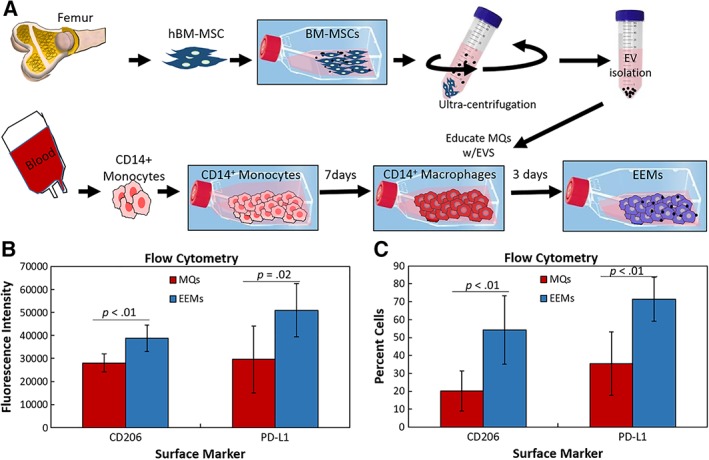
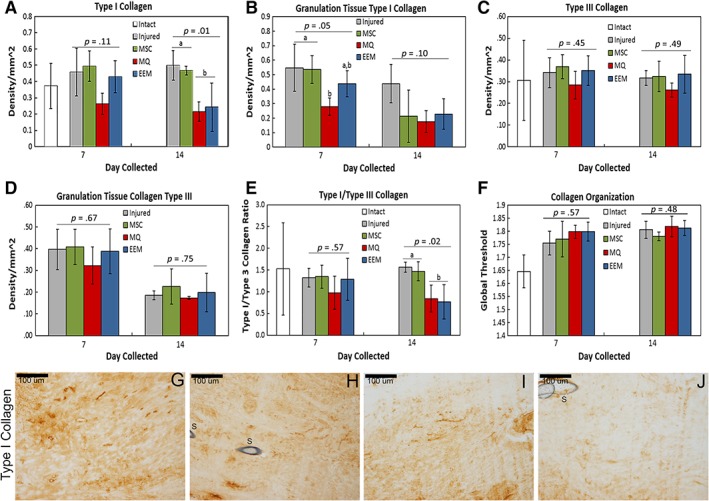
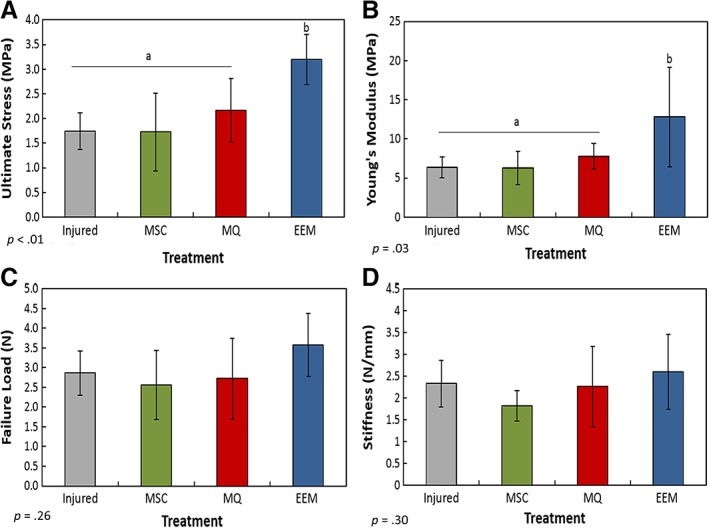
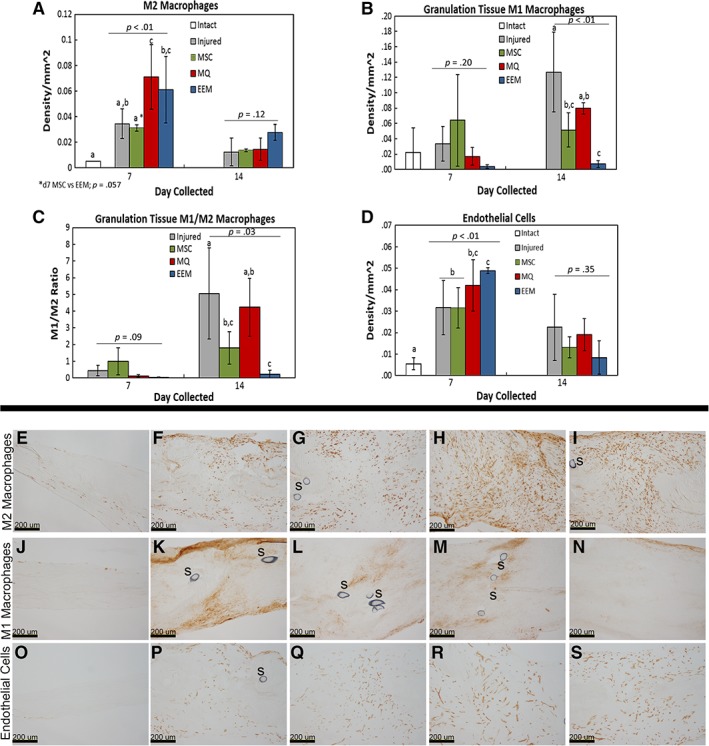
Tendon healing follows a complex series of coordinated events, which ultimately produces a mechanically inferior tissue more scar-like than native tendon. More regenerative healing occurs when anti-inflammatory M2 macrophages play a more dominant role. Mesenchymal stromal/stem cells (MSCs) are able to polarize macrophages to an M2 immunophenotype via paracrine mechanisms. We previously reported that coculture of CD14+ macrophages (MQs) with MSCs resulted in a unique M2-like macrophage. More recently, we generated M2-like macrophages using only extracellular vesicles (EVs) isolated from MSCs creating "EV-educated macrophages" (also called exosome-educated macrophages [EEMs]), thereby foregoing direct use of MSCs. For the current study, we hypothesized that cell therapy with EEMs would improve in vivo tendon healing by modulating tissue inflammation and endogenous macrophage immunophenotypes. We evaluated effects of EEMs using a mouse Achilles tendon rupture model and compared results to normal tendon healing (without any biologic intervention), MSCs, MQs, or EVs. We found that exogenous administration of EEMs directly into the wound promoted a healing response that was significantly more functional and more regenerative. Injured tendons treated with exogenous EEMs exhibited (a) improved mechanical properties, (b) reduced inflammation, and (c) earlier angiogenesis. Treatment with MSC-derived EVs alone were less effective functionally but stimulated a biological response as evidenced by an increased number of endothelial cells and decreased M1/M2 ratio. Because of their regenerative and immunomodulatory effects, EEM treament could provide a novel strategy to promote wound healing in this and various other musculoskeletal injuries or pathologies where inflammation and inadequate healing is problematic. Stem Cells 2019;37:652-662.
肌腱愈合遵循一系列复杂的协调事件,最终产生一种机械性能较差的组织,比天然肌腱更具瘢痕样。当抗炎 M2 巨噬细胞发挥更主导作用时,会发生更多的再生性愈合。间充质基质/干细胞 (MSCs) 能够通过旁分泌机制将巨噬细胞极化到 M2 免疫表型。我们之前报道过,CD14+巨噬细胞 (MQs) 与 MSCs 共培养会导致独特的 M2 样巨噬细胞。最近,我们仅使用从 MSCs 分离的细胞外囊泡 (EVs) 产生 M2 样巨噬细胞,从而创建了“EV 教育的巨噬细胞”(也称为外泌体教育的巨噬细胞 [EEMs]),从而避免直接使用 MSCs。在目前的研究中,我们假设通过调节组织炎症和内源性巨噬细胞免疫表型,用 EEMs 进行细胞治疗会改善体内肌腱愈合。我们使用小鼠跟腱断裂模型评估了 EEMs 的作用,并将结果与正常肌腱愈合(无任何生物学干预)、MSCs、MQs 或 EVs 进行了比较。我们发现,将 EEMs 直接施用于伤口可促进功能更强大、再生能力更强的愈合反应。用外源性 EEMs 处理的受伤肌腱表现出:(a) 机械性能改善,(b) 炎症减少,(c) 血管生成更早。单独使用 MSC 衍生的 EV 治疗在功能上效果较差,但刺激了生物学反应,表现为内皮细胞数量增加和 M1/M2 比值降低。由于其再生和免疫调节作用,EEM 治疗可能为促进这种和各种其他肌肉骨骼损伤或病理学中的伤口愈合提供一种新策略,在这些损伤或病理学中炎症和愈合不足是问题。Stem Cells 2019;37:652-662.