Stem Cell and Neurotherapies Laboratory, Division of Cell Matrix Biology and Regenerative Medicine, School of Biological Sciences, Faculty of Biology, Medicine and Health, University of Manchester, Manchester, UK.
Department of Neurosurgery, Salford Royal Hospital, Salford, UK.
J Neuroinflammation. 2019 Feb 5;16(1):25. doi: 10.1186/s12974-019-1410-y.
Chimeric mouse models generated via adoptive bone marrow transfer are the foundation for immune cell tracking in neuroinflammation. Chimeras that exhibit low chimerism levels, blood-brain barrier disruption and pro-inflammatory effects prior to the progression of the pathological phenotype, make it difficult to distinguish the role of immune cells in neuroinflammatory conditions. Head-shielded irradiation overcomes many of the issues described and replaces the recipient bone marrow system with donor haematopoietic cells expressing a reporter gene or different pan-leukocyte antigen, whilst leaving the blood-brain barrier intact. However, our previous work with full body irradiation suggests that this may generate a pro-inflammatory peripheral environment which could impact on the brain's immune microenvironment. Our aim was to compare non-myeloablative busulfan conditioning against head-shielded irradiation bone marrow chimeras prior to implantation of glioblastoma, a malignant brain tumour with a pro-inflammatory phenotype.
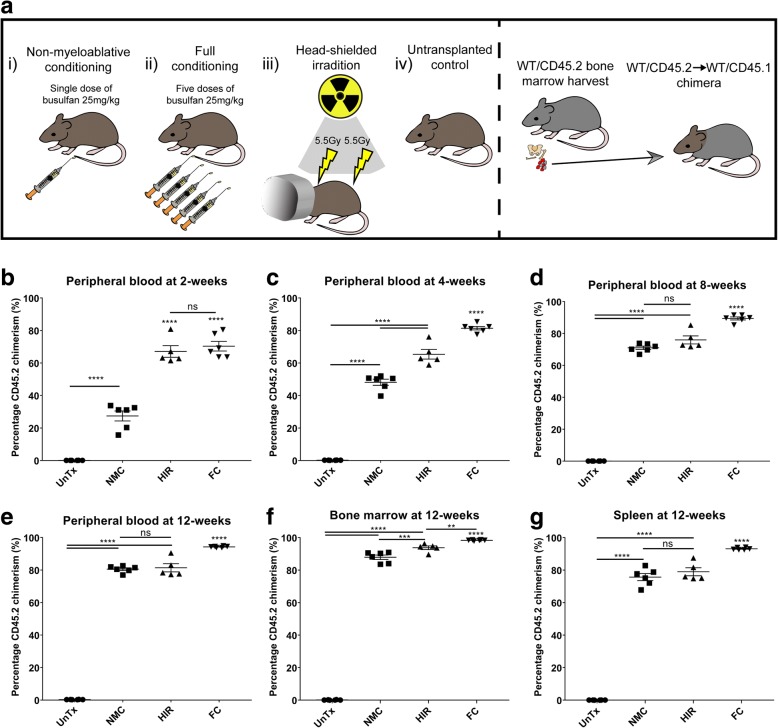
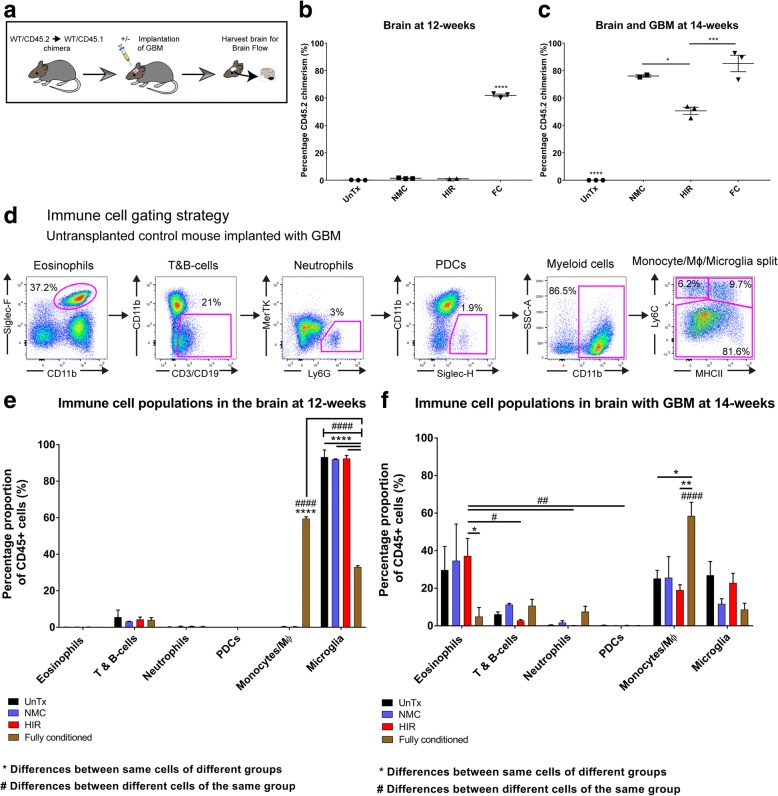
Recipient wild-type/CD45.1 mice received non-myeloablative busulfan conditioning (25 mg/kg), full intensity head-shielded irradiation, full intensity busulfan conditioning (125 mg/kg) prior to transplant with whole bone marrow from CD45.2 donors and were compared against untransplanted controls. Half the mice from each group were orthotopically implanted with syngeneic GL-261 glioblastoma cells. We assessed peripheral blood, bone marrow and spleen chimerism, multi-organ pro-inflammatory cytokine profiles at 12 weeks and brain chimerism and immune cell infiltration by whole brain flow cytometry before and after implantation of glioblastoma at 12 and 14 weeks respectively.
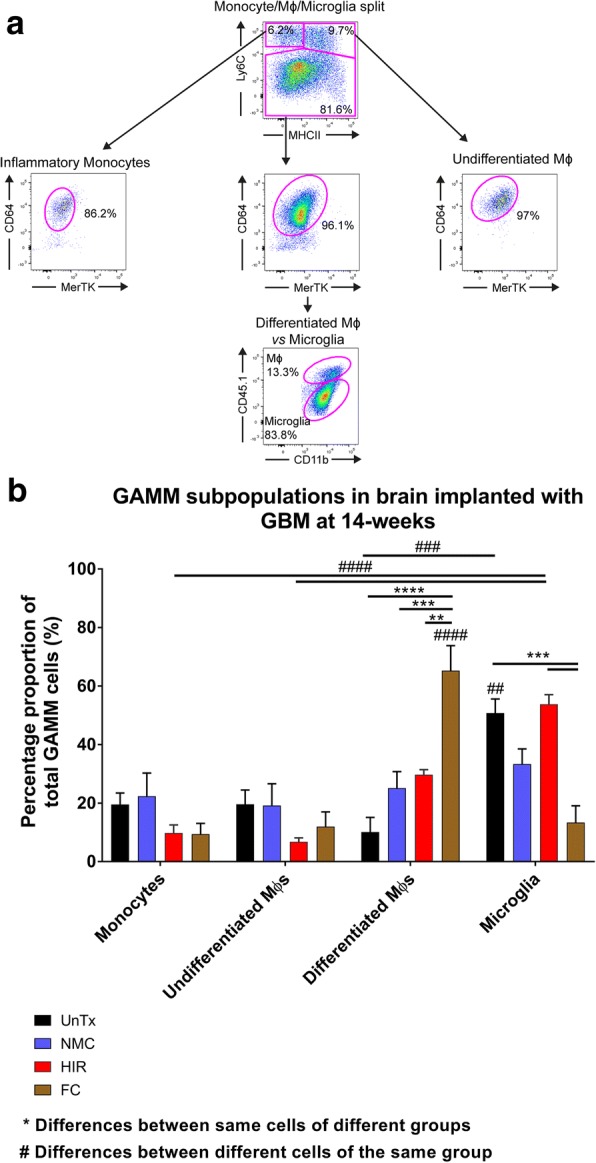
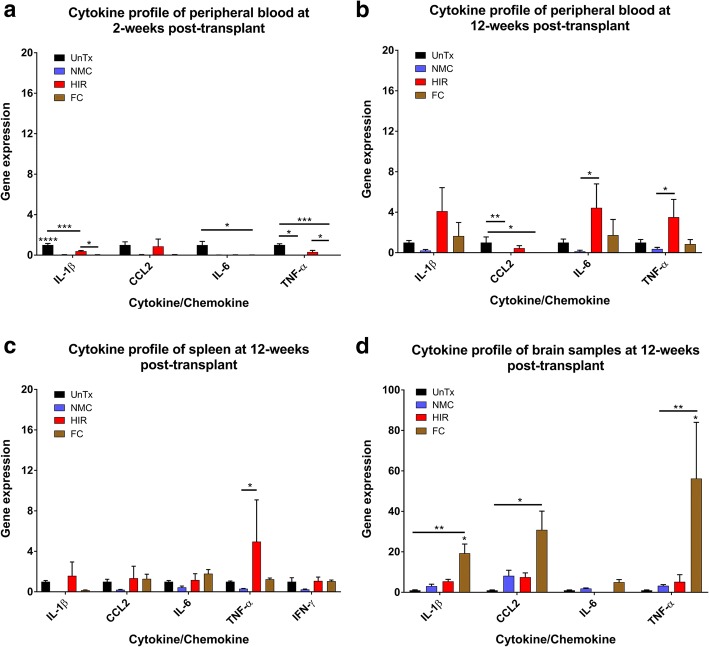
Both non-myeloablative conditioning and head-shielded irradiation achieve equivalent blood and spleen chimerism of approximately 80%, although bone marrow engraftment is higher in the head-shielded irradiation group and highest in the fully conditioned group. Head-shielded irradiation stimulated pro-inflammatory cytokines in the blood and spleen but not in the brain, suggesting a systemic response to irradiation, whilst non-myeloablative conditioning showed no cytokine elevation. Non-myeloablative conditioning achieved higher donor chimerism in the brain after glioblastoma implantation than head-shielded irradiation with an altered immune cell profile.
Our data suggest that non-myeloablative conditioning generates a more homeostatic peripheral inflammatory environment than head-shielded irradiation to allow a more consistent evaluation of immune cells in glioblastoma and can be used to investigate the roles of peripheral immune cells and bone marrow-derived subsets in other neurological diseases.
通过过继性骨髓转移生成嵌合鼠模型是神经炎症中免疫细胞追踪的基础。在病理表型进展之前表现出低嵌合率、血脑屏障破坏和促炎作用的嵌合体,使得难以区分免疫细胞在神经炎症中的作用。头部屏蔽照射克服了许多描述的问题,并以表达报告基因或不同全白细胞抗原的供体造血细胞替代受体骨髓系统,同时保持血脑屏障完整。然而,我们之前使用全身照射的工作表明,这可能会产生促炎的外周环境,这可能会影响大脑的免疫微环境。我们的目的是比较非清髓性白消安预处理与头部屏蔽照射骨髓嵌合体在植入胶质母细胞瘤(一种具有促炎表型的恶性脑肿瘤)之前。
受体野生型/CD45.1 小鼠接受非清髓性白消安预处理(25mg/kg)、全强度头部屏蔽照射、全强度白消安预处理(125mg/kg),然后移植来自 CD45.2 供体的全骨髓,并与未移植对照进行比较。每组一半的小鼠接受同源 GL-261 胶质母细胞瘤细胞的原位植入。我们评估了外周血、骨髓和脾脏嵌合率、12 周时多器官促炎细胞因子谱,以及分别在 12 周和 14 周胶质母细胞瘤植入前后通过全脑流式细胞术评估脑嵌合率和免疫细胞浸润。
非清髓性预处理和头部屏蔽照射均达到约 80%的血液和脾脏嵌合率,尽管头部屏蔽照射组的骨髓植入率更高,完全预处理组的骨髓植入率最高。头部屏蔽照射刺激血液和脾脏中的促炎细胞因子,但不刺激大脑中的细胞因子,提示对辐射的全身反应,而非清髓性预处理则没有细胞因子升高。胶质母细胞瘤植入后,非清髓性预处理在大脑中的供体嵌合率高于头部屏蔽照射,且免疫细胞谱发生改变。
我们的数据表明,非清髓性预处理比头部屏蔽照射产生更稳态的外周炎症环境,从而可以更一致地评估胶质母细胞瘤中的免疫细胞,并且可用于研究外周免疫细胞和骨髓来源亚群在其他神经疾病中的作用。