Department of Clinical Analysis and Biomedicine, State University of Maringá, Av Colombo 5790, Maringá, Paraná, CEP 87020-900, Brazil.
Department of Pathology, Clinical and Toxicological Analysis, State University of Londrina, Londrina, Brazil.
AIDS Res Ther. 2019 Feb 5;16(1):4. doi: 10.1186/s12981-019-0219-1.
Despite the advances in therapy, the occurrence of drug-resistant human immunodeficiency virus type 1 (HIV-1) is a major obstacle to successful treatment. This study aimed to characterize the genetic diversity and to determine the prevalence of transmitted drug resistance mutations (TDRM) between individuals recently or chronically diagnosed with HIV-1 from Paraná, Brazil.
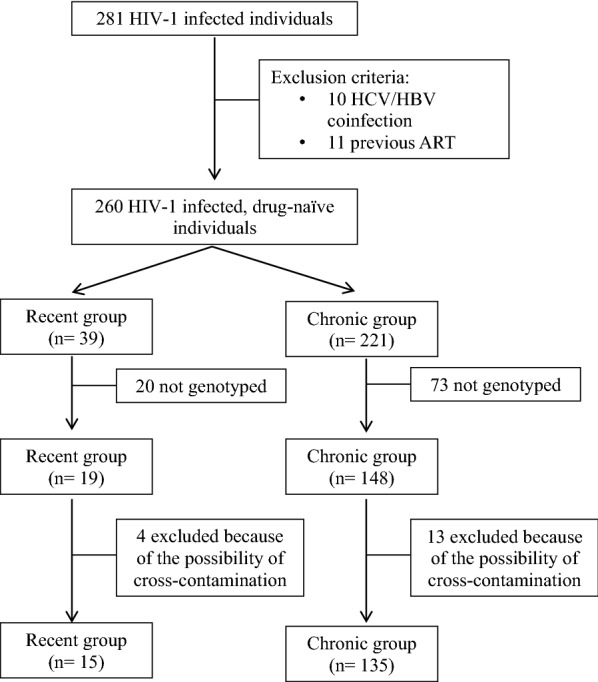
A total of 260 HIV-1 positive antiretroviral therapy-naïve patients were recruited to participate on the study, of which 39 were recently diagnosed. HIV-1 genotyping was performed using sequencing reaction followed by phylogenetic analyses to determine the HIV-1 subtype. TDRM were defined using the Calibrated Population Resistance Tool program.
The HIV-1 subtypes frequency found in the studied population were 54.0% of subtype B, 26.7% subtype C, 6.7% subtype F1 and 12.7% recombinant forms. The overall prevalence of TDRM was 6.7%, including 13.3% for recently diagnosed subjects and 5.9% for the chronic group.
The prevalence of resistance mutations found in this study is considered moderate, thus to perform genotyping tests before the initiation of antiretroviral therapy may be important to define the first line therapy and contribute for the improvement of regional prevention strategies for epidemic control.
尽管治疗方法不断进步,但人类免疫缺陷病毒 1 型(HIV-1)耐药的发生仍是成功治疗的主要障碍。本研究旨在对巴西 Paraná 地区近期或慢性感染 HIV-1 的个体之间的遗传多样性和传播耐药突变(TDRM)的流行情况进行特征描述。
共招募了 260 名未经抗逆转录病毒治疗的 HIV-1 阳性初治患者参与本研究,其中 39 例为近期诊断。使用测序反应进行 HIV-1 基因分型,然后进行系统进化分析以确定 HIV-1 亚型。使用校准人群耐药性工具程序(Calibrated Population Resistance Tool program)定义 TDRM。
在所研究的人群中,HIV-1 亚型的频率为:54.0%为 B 亚型,26.7%为 C 亚型,6.7%为 F1 亚型,12.7%为重组形式。总耐药突变率为 6.7%,其中近期诊断组为 13.3%,慢性组为 5.9%。
本研究发现的耐药突变率处于中等水平,因此在开始抗逆转录病毒治疗之前进行基因分型检测可能很重要,这有助于确定一线治疗方案,并有助于改善区域流行控制的预防策略。