Sadeghi Navid G, Sabetazad Bardia, Rassaian Nayer, Sadeghi Soroush G
Department of Physiology, Shahid Beheshti University of Medical Sciences and Health Services, Tehran, Iran.
Audiology and Dizziness Center, Day General Hospital, Tehran, Iran.
Front Neurol. 2019 Jan 22;9:1196. doi: 10.3389/fneur.2018.01196. eCollection 2018.
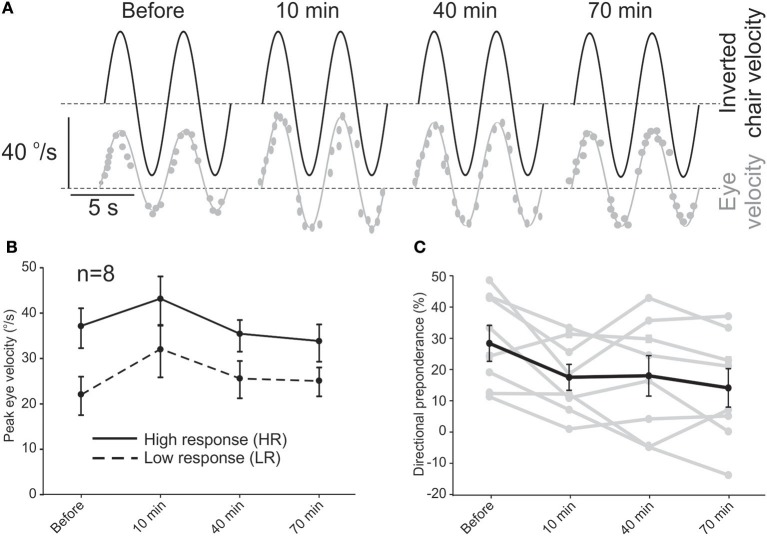
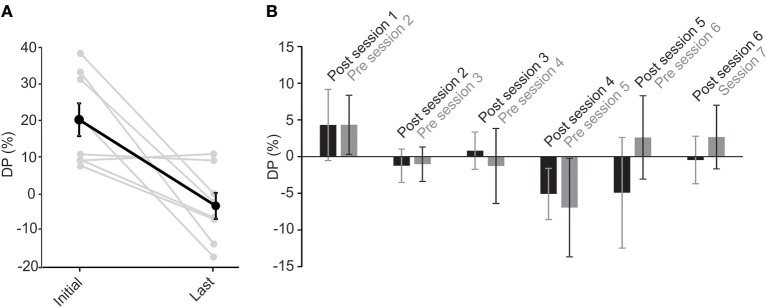
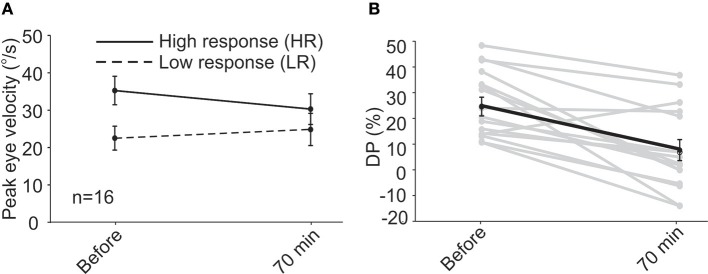
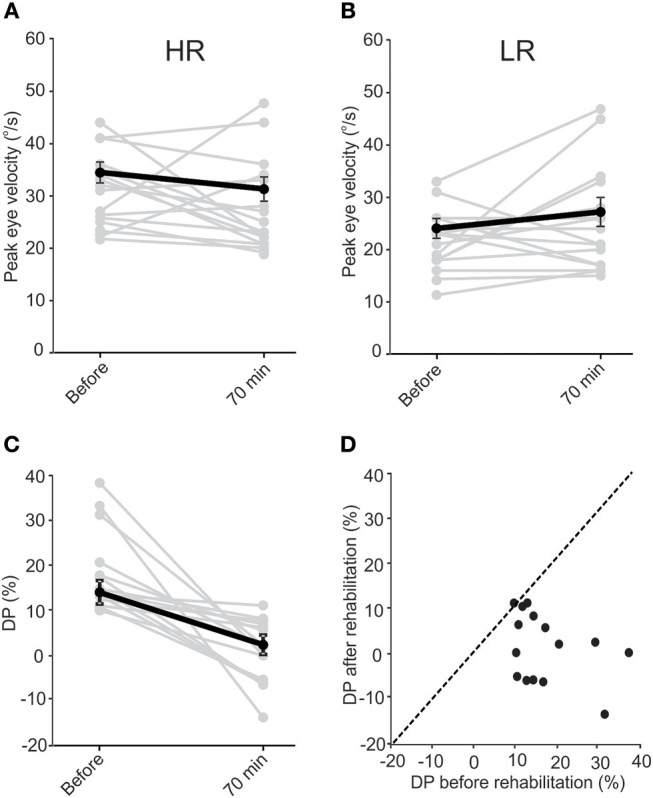
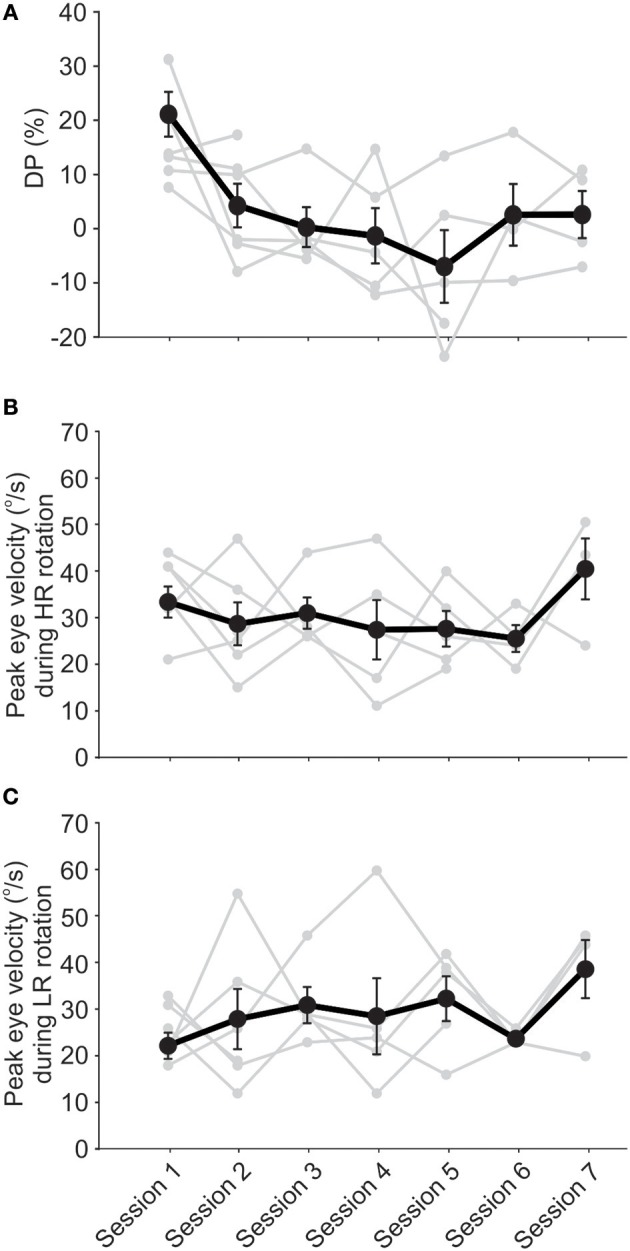
Vestibular dysfunction is a common disorder that results in debilitating symptoms. Even after full compensation, the vestibulo-ocular reflex (VOR) could be further improved by using rehabilitation exercises and visual-vestibular adaptation. We hypothesized that in patients with asymmetric vestibular function, the system could be rebalanced by unidirectional rotations toward the weaker side (i.e., a pure vestibular stimulation). Sixteen subjects (5 female and 11 male, 43.2 ± 17.0 years old) with chronic vestibular dysfunction that was non-responsive to other types of medical treatment were recruited for the study (ClinicalTrials.gov Identifier: NCT01080430). Subjects had VOR asymmetry quantified by an abnormal directional preponderance (DP) with rotation test and no previous history of central vestibular problems or fluctuating peripheral vestibular disorders. They participated either in the short-term study (one session) or the long-term study (7 visits over 5 weeks). Rehabilitation consisted of five trapezoid unidirectional rotations (peak velocity of 320°/s) toward the weaker side. Care was taken to slowly stop the rotation in order to avoid stimulation in the opposite direction during deceleration. To study the short-term effect, VOR responses were measured before and 10, 40, and 70 min after a single unidirectional rotational rehabilitation session. For long-term effects, the VOR gain was measured before and 70min after rehabilitation in each session. We observed a significant decrease in VOR asymmetry even 10 min after one rehabilitation session (short-term study). With consecutive rehabilitation sessions in the long-term study, DP further decreased to reach normal values during the first 2 sessions and only one subjects required further rehabilitation after week 4. This change in DP was due to an increase in responses during rotations toward the weaker side and a decrease in VOR responses during rotations in the other direction. Our results show that unidirectional rotation can reduce the VOR imbalance and asymmetry in patients with previously compensated vestibular dysfunction and could be used as an effective supervised method for vestibular rehabilitation even in patients with longstanding vestibular dysfunction.
前庭功能障碍是一种常见疾病,会导致使人衰弱的症状。即使在完全代偿之后,通过康复训练和视前庭适应,前庭眼反射(VOR)仍可进一步改善。我们假设,在前庭功能不对称的患者中,通过向较弱一侧进行单向旋转(即单纯的前庭刺激),该系统可以重新达到平衡。本研究招募了16名慢性前庭功能障碍患者(5名女性和11名男性,年龄43.2±17.0岁),这些患者对其他类型的医学治疗无反应(ClinicalTrials.gov标识符:NCT01080430)。通过旋转试验中异常的方向优势(DP)对受试者的VOR不对称性进行量化,且受试者既往无中枢前庭问题病史或波动性外周前庭疾病史。他们参与了短期研究(一次疗程)或长期研究(5周内进行7次就诊)。康复训练包括向较弱一侧进行五次梯形单向旋转(峰值速度为320°/秒)。注意缓慢停止旋转,以避免减速过程中向相反方向的刺激。为了研究短期效果,在单次单向旋转康复疗程前以及疗程后10、40和70分钟测量VOR反应。对于长期效果,在每个疗程康复前和康复后70分钟测量VOR增益。我们观察到,即使在一次康复疗程后10分钟(短期研究),VOR不对称性也显著降低。在长期研究中,随着连续的康复疗程,DP在前两个疗程中进一步降低至正常水平,第4周后只有一名受试者需要进一步康复治疗。DP的这种变化是由于向较弱一侧旋转时反应增加,以及向另一个方向旋转时VOR反应减少。我们的结果表明,单向旋转可以减少既往已代偿的前庭功能障碍患者的VOR失衡和不对称性,甚至对于长期存在前庭功能障碍的患者,也可作为一种有效的前庭康复监督方法。