Li Gu, Wu Amery D, Marshall Sheila K, Watson Ryan J, Adjei Jones K, Park Minjeong, Saewyc Elizabeth M
Stigma and Resilience Among Vulnerable Youth Centre, School of Nursing, University of British Columbia, T201 2211 Wesbrook Mall, Vancouver, BC, Canada V6T 2B5.
Social Health Lab, Department of Psychology, University of British Columbia, 2136 West Mall, Vancouver, BC, Canada V6T 1Z4.
SSM Popul Health. 2019 Jan 11;7:100350. doi: 10.1016/j.ssmph.2019.100350. eCollection 2019 Apr.
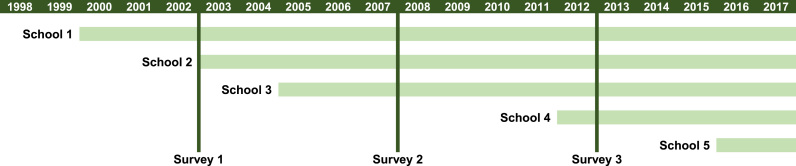
There is limited research on evaluating nonrandomized population health interventions. We aimed to introduce a new approach for assessing site-level longitudinal effects of population health interventions (SLEPHI) by innovatively applying multiple group multilevel (MG-ML) modeling to repeated cycles of cross-sectional data collected from different individuals of the same sites at different times, a design commonly employed in public health research. For illustration, we used this SLEPHI method to examine the influence of Gay-Straight Alliances (GSAs) on school-level perceived safety among lesbian, gay, and bisexual (LGB) and heterosexual (HET) adolescents. Individual-level data of perceived school safety came from 1625 LGB students (67.4% female; mean age, 15.7 years) and 37,597 HET students (50.2% female; mean age, 15.4 years) attending Grades 7-12 in 135 schools, which participated in 3 British Columbia Adolescent Health Surveys (BCAHS: 2003, 2008, 2013) in Canada. School-level data of GSA length since established were collected by telephone in 2008 and 2014. Nested MG-ML models suggested that after accounting for secular trend, cohort effects, measurement error, measurement equivalence, and student age, GSA length linearly related to increased school-level perceived safety among LGB students ( = 1.57, = 0.21, < .001, β = 0.32) and also among HET students (β = 0.34 in 2003 & 2013, β = 0.32 in 2008) although statistical differences between years for HET youth were likely due to the large sample size. By conducting MG-ML analysis on repeated cross-sectional surveys, this SLEPHI method accounted for many confounding factors and followed schools for a longer period than most longitudinal designs can follow individuals. Therefore, we drew a stronger conclusion than previous observational research about GSAs and LGB students' well-being. The SLEPHI method can be widely applied to other repeated cycles of cross-sectional data in public health research.
关于评估非随机人群健康干预措施的研究有限。我们旨在引入一种新方法来评估人群健康干预措施的场所层面纵向效应(SLEPHI),即通过创新性地将多组多层次(MG-ML)模型应用于从同一场所不同个体在不同时间收集的重复横断面数据周期,这是公共卫生研究中常用的一种设计。为了说明这一点,我们使用这种SLEPHI方法来检验同性恋异性恋联盟(GSA)对女同性恋、男同性恋和双性恋(LGB)青少年以及异性恋(HET)青少年学校层面感知安全的影响。学校安全感知的个体层面数据来自135所学校7至12年级的1625名LGB学生(67.4%为女性;平均年龄15.7岁)和37597名HET学生(50.2%为女性;平均年龄15.4岁),这些学校参与了加拿大不列颠哥伦比亚省的三次青少年健康调查(BCAHS:2003年、2008年、2013年)。2008年和2014年通过电话收集了GSA成立以来的学校层面时长数据。嵌套的MG-ML模型表明,在考虑了长期趋势、队列效应、测量误差、测量等效性和学生年龄后,GSA时长与LGB学生学校层面感知安全的增加呈线性相关(=1.57,=0.21,<.001,β = 0.32),在HET学生中也呈线性相关(2003年和2013年β = 0.34,2008年β = 0.32),尽管HET青少年不同年份之间的统计差异可能是由于样本量较大。通过对重复横断面调查进行MG-ML分析,这种SLEPHI方法考虑了许多混杂因素,并且跟踪学校的时间比大多数纵向设计跟踪个体的时间更长。因此,我们得出了比以往关于GSA和LGB学生福祉的观察性研究更强的结论。SLEPHI方法可广泛应用于公共卫生研究中的其他重复横断面数据周期。