Department of Psychology, City, University of London, London, UK.
Department of Clinical, Neuro and Developmental Psychology, Faculty of Behavioral and Movement Sciences, Institute for Brain and Behavior Amsterdam, Vrije Universiteit Amsterdam, Amsterdam, the Netherlands.
Curr Opin Psychiatry. 2019 May;32(3):232-241. doi: 10.1097/YCO.0000000000000486.
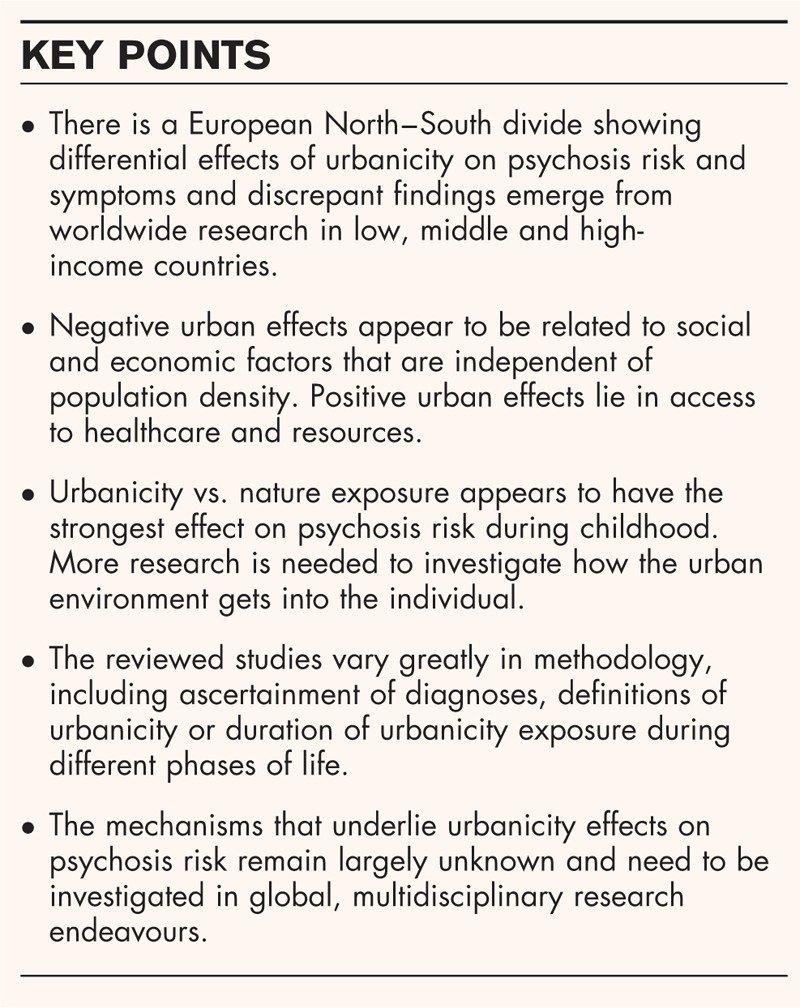
Epidemiological studies associate city living with an elevated psychosis risk. Urban (social/economic) stress and exposure to environmental toxins, pollution or disease agents have been proposed to underlie this association. This review provides an update on the recent evidence (May 2017 - November 2018).
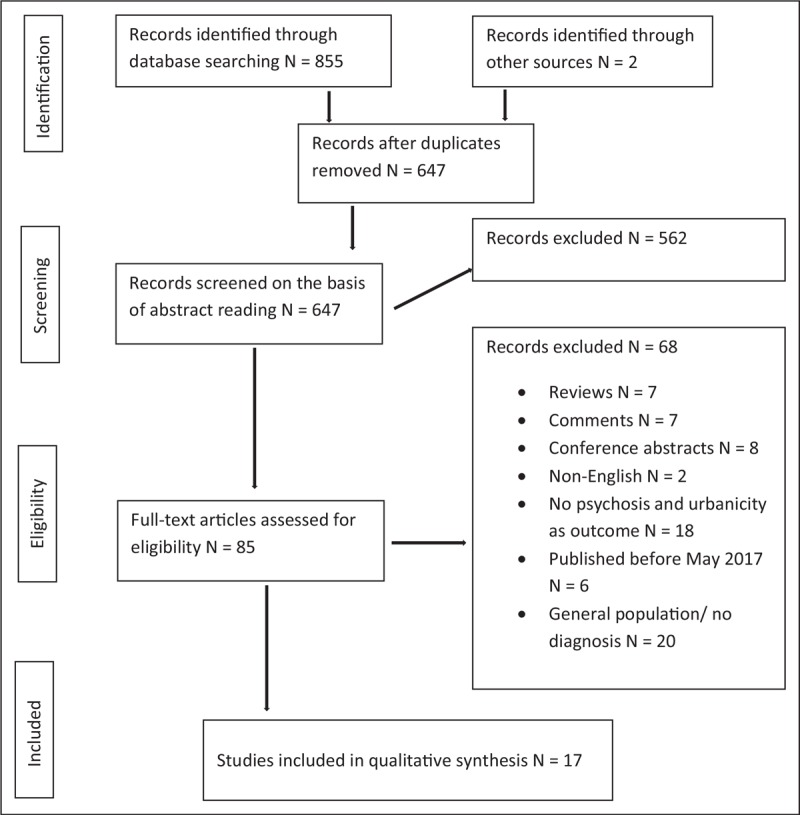
Of 647 screened studies, 17 on: urbanicity-psychosis associations in worldwide high, middle and low-income countries; explanatory mechanisms, including nature exposure, social and economic stressors and genetic risk; urbanicity effects on the brain and coping; and urbanicity and resources, were included. The reviewed evidence revealed complex patterns of urbanicity-psychosis associations with considerable international variation within Europe and between low, middle and high-income countries worldwide. Social and economic stressors (e.g. migration, ethnic density and economic deprivation), nature exposure and access to resources could only explain part of the urbanicity effects. Risk factors differed between countries and between affective and non-affective psychosis.
Urbanicity-psychosis associations are heterogeneous and driven by multiple risk and protective factors that seem to act differently in different ethnic groups and countries. Interdisciplinary research combining approaches, for example from experimental neuroscience and epidemiology, are needed to unravel specific urban mechanisms that increase or decrease psychosis risk.
流行病学研究表明城市生活与精神分裂症风险增加有关。城市(社会/经济)压力以及接触环境毒素、污染或疾病因子被认为是这种关联的基础。本综述提供了 2017 年 5 月至 2018 年 11 月期间的最新证据。
在筛选出的 647 项研究中,有 17 项研究涉及:世界各地高、中、低收入国家的城市性-精神分裂症关联;解释机制,包括自然暴露、社会和经济压力源以及遗传风险;城市性对大脑和应对方式的影响;以及城市性和资源。综述证据揭示了城市性-精神分裂症关联的复杂模式,欧洲内部和全球低、中、高收入国家之间存在相当大的国际差异。社会和经济压力源(例如移民、族裔密度和经济贫困)、自然暴露和资源获取只能解释部分城市效应。风险因素在不同国家和情感性与非情感性精神分裂症之间存在差异。
城市性-精神分裂症关联具有异质性,受多种风险和保护因素驱动,这些因素在不同种族群体和国家中的作用似乎不同。需要结合实验神经科学和流行病学等方法的跨学科研究,以揭示增加或降低精神分裂症风险的特定城市机制。