International Centre for Evidence in Disability, Department of Clinical Research, London School of Hygiene & Tropical Medicine, London, United Kingdom.
Environmental Health Group, Department of Clinical Research, London School of Hygiene & Tropical Medicine, London, United Kingdom.
PLoS One. 2019 Feb 6;14(2):e0210974. doi: 10.1371/journal.pone.0210974. eCollection 2019.
One quarter of the global population is of menstruating age, yet menstruation is shrouded in discrimination and taboos. Disability also carries stigma, so disabled people may face layers of discrimination when they are menstruating. The objective of the review is to assess the menstrual hygiene requirements of disabled people, the barriers they face, and the available interventions to help them manage their menstruation hygienically and with dignity.
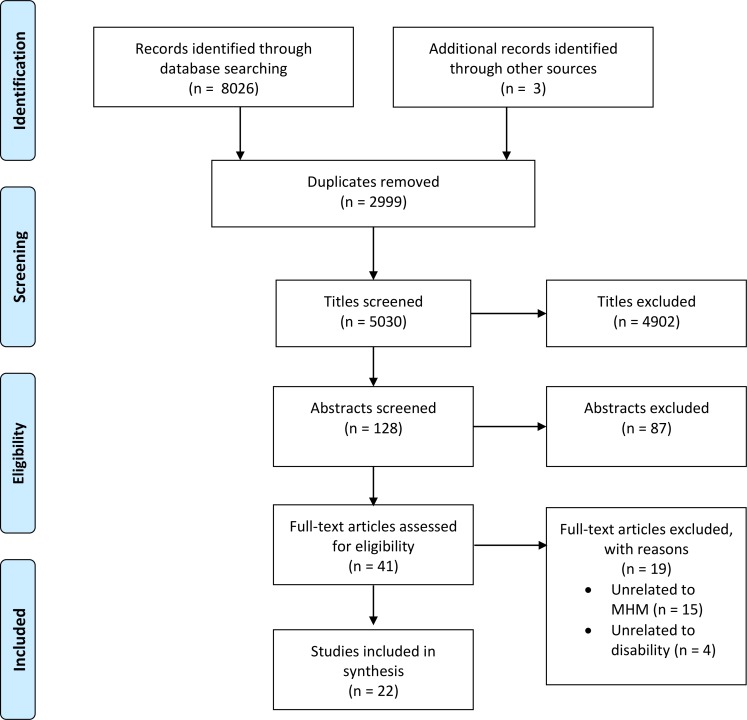
Eligible studies, gathered across all countries, were identified by conducting searches across four databases (MEDLINE, PubMed, EMBASE, Global Health) in May 2017, with alerts set on each database to highlight new titles added until April 2018. Eligible studies incorporated analyses relevant to menstruating disabled people and/or how their carers provide support during their menstrual cycle.
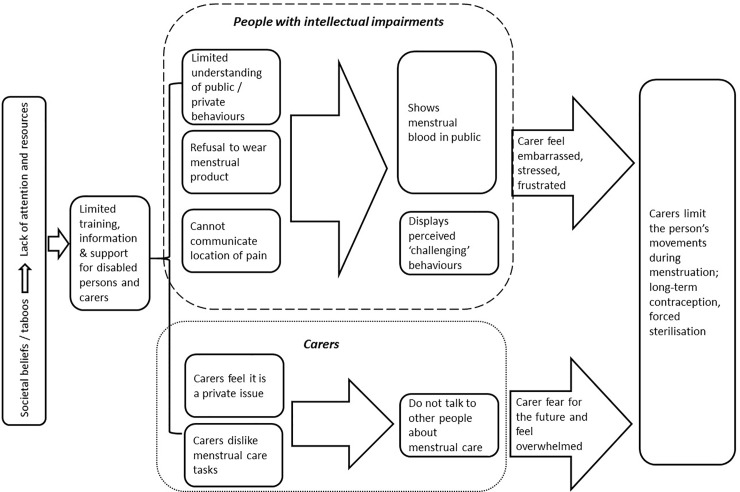
The 22 studies included were published since 1976; the majority after 2010 (n = 12; 55%). One study was a quasi-experiment; all others were observational. Most studies (n = 15; 68%) were from high income countries and most (n = 17; 77%) focused on people with intellectual impairments, so the review findings focus on this group and their carers. Outcomes investigated include choice and preference of menstrual product, ability to manage menstrual hygiene and coping strategies applied. Barriers faced included a lack of standardised guidance for professional carers; a lack of menstruation training, information and support provided to people with intellectual impairments and their carers; a lack of understanding of severity of symptoms experienced by people with intellectual impairments, the high cost of menstrual products and lack of appropriate options for people with physical impairments. Few interventions were found, and strategies for menstrual hygiene management applied by carers of persons with intellectual impairments include limiting the disabled person's movements when menstruating and suppressing their menstruation.
Little evidence was identified on the requirements of disabled people and their carers in managing their menstruation, and only one intervention, but a range of barriers were identified. This gap in evidence is important, as the consequences of failing to meet menstrual hygiene needs of disabled people includes shame, social isolation, and even sterilisation.
PROSPERO CRD42018095497.
全球四分之一的人口处于经期,然而经期却笼罩在歧视和禁忌之中。残疾也带有耻辱,因此残疾人在经期时可能会面临多层歧视。本综述的目的是评估残疾人士的经期卫生需求、他们面临的障碍,以及现有的干预措施,以帮助他们卫生、有尊严地管理经期。
在 2017 年 5 月,通过对四个数据库(MEDLINE、PubMed、EMBASE、全球卫生)进行检索,收集了来自所有国家的合格研究,并在每个数据库中设置了警报,以突出显示 2018 年 4 月之前添加的新标题。合格的研究纳入了与经期残疾人士相关的分析,或他们的护理人员如何在他们的月经周期中提供支持。
纳入的 22 项研究发表于 1976 年之后;2010 年以后发表的(n=12;55%)居多。一项研究为准实验;其余均为观察性研究。大多数研究(n=15;68%)来自高收入国家,大多数(n=17;77%)侧重于智力障碍人士,因此本综述的研究结果主要集中在这一群体及其护理人员。研究结果包括经期产品的选择和偏好、管理经期卫生的能力以及应用的应对策略。所面临的障碍包括专业护理人员缺乏标准化指导;智力障碍人士及其护理人员缺乏经期培训、信息和支持;对智力障碍人士所经历症状严重程度的理解不足、经期产品的高成本以及对身体障碍人士的适当选择有限。很少有干预措施被发现,智力障碍人士的护理人员应用的经期卫生管理策略包括限制残疾人在经期时的活动和抑制他们的经期。
关于残疾人士及其护理人员在管理经期方面的需求,几乎没有证据,只有一项干预措施,但发现了一系列障碍。这一证据空白很重要,因为未能满足残疾人士的经期卫生需求的后果包括羞耻、社会孤立,甚至绝育。
PROSPERO CRD42018095497。