Tanihara Fuminori, Hirata Maki, Nguyen Nhien Thi, LE Quynh Anh, Hirano Takayuki, Otoi Takeshige
Faculty of Bioscience and Bioindustry, Tokushima University, Tokushima 770-8513, Japan.
J Reprod Dev. 2019 Jun 14;65(3):209-214. doi: 10.1262/jrd.2018-116. Epub 2019 Feb 5.
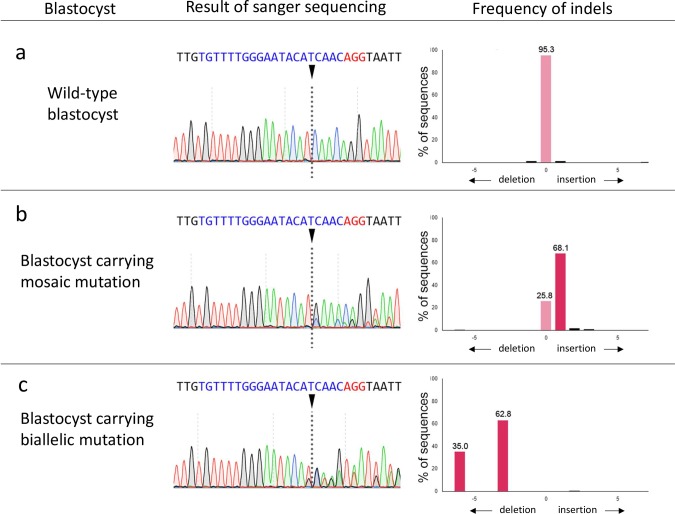
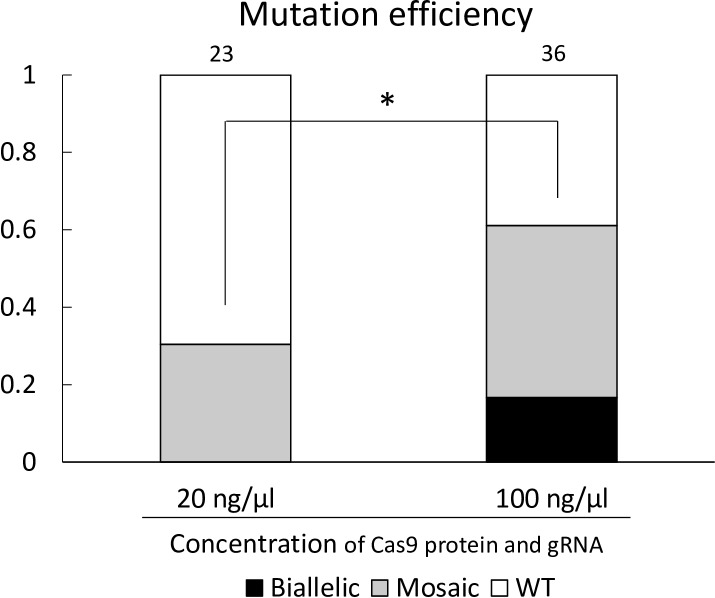
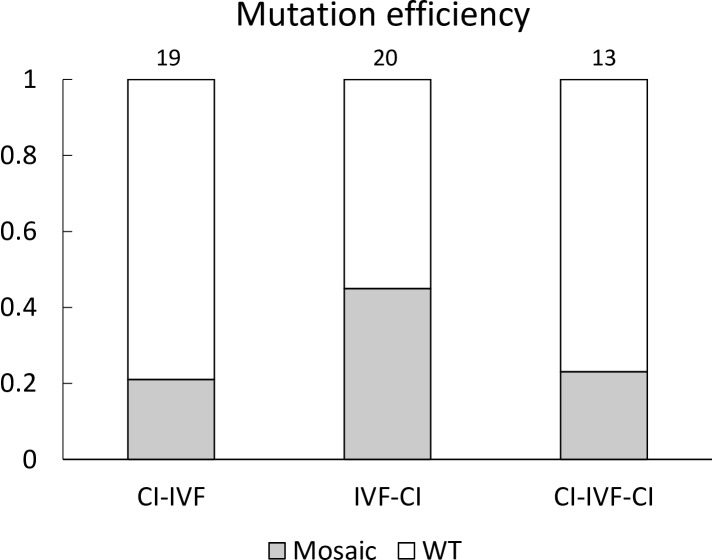
Cytoplasmic microinjection (CI) of the CRISPR/Cas9 system enabled the induction of site-specific mutations in porcine zygotes and resulting pigs. However, mosaicism is a serious problem for genetically modified pigs. In the present study, we investigated suitable timing and concentration of CRISPR/Cas9 components for introduction into oocytes/zygotes by CI, to reduce mosaicism in the resulting blastocysts. First, we introduced 20 ng/μl of Cas9 protein and guide RNA (gRNA), targeting the α-1,3-galactosyltransferase (GalT) gene in oocytes before in vitro fertilization (IVF), in zygotes after IVF, or in oocytes/zygotes before and after IVF, twice. CI treatment had no detrimental effects on blastocyst formation rates. The highest value of the rate of mutant blastocysts was observed in zygotes injected after IVF. Next, we injected Cas9 protein and gRNA into zygotes after IVF at a concentration of 20 ng/μl each (20 ng/μl group) or 100 ng/μl each (100 ng/μl group). The ratio of the number of blastocysts that carried mutations to the total number of blastocysts examined in the 100 ng/μl group was significantly higher (P < 0.05) than that in the 20 ng/μl group. Although no blastocysts from the 20 ng/μl group carried a biallelic mutation, 16.7% of blastocysts from the 100 ng/μl group carried a biallelic mutation. In conclusion, increasing the concentration of Cas9 protein and gRNA is effective in generating biallelic mutant blastocysts. To reduce mosaicism, however, further optimization of the timing of CI, and the concentration of CRISPR/Cas9 components, is needed.
将CRISPR/Cas9系统进行细胞质显微注射(CI)能够在猪的受精卵及由此产生的猪中诱导位点特异性突变。然而,嵌合体现象对于转基因猪来说是一个严重的问题。在本研究中,我们调查了通过CI将CRISPR/Cas9组件导入卵母细胞/受精卵的合适时间和浓度,以减少所得囊胚中的嵌合体现象。首先,我们在体外受精(IVF)前向卵母细胞中、IVF后向受精卵中或IVF前后向卵母细胞/受精卵中导入20 ng/μl的Cas9蛋白和靶向α-1,3-半乳糖基转移酶(GalT)基因的引导RNA(gRNA),共导入两次。CI处理对囊胚形成率没有不利影响。在IVF后注射的受精卵中观察到突变囊胚率的最高值。接下来,我们在IVF后以20 ng/μl(20 ng/μl组)或100 ng/μl(100 ng/μl组)的浓度将Cas9蛋白和gRNA注入受精卵。100 ng/μl组中携带突变的囊胚数量与所检查的囊胚总数的比例显著高于(P < 0.05)20 ng/μl组。虽然20 ng/μl组没有囊胚携带双等位基因突变,但100 ng/μl组有16.7%的囊胚携带双等位基因突变。总之,提高Cas9蛋白和gRNA的浓度对于产生双等位基因突变异种囊胚是有效的。然而,为了减少嵌合体现象,需要进一步优化CI的时间以及CRISPR/Cas9组件的浓度。