Cotton Fiber Bioscience Research Unit, United States Department of Agriculture (USDA), Agricultural Research Service (ARS), Southern Regional Research Center (SRRC), 1100 Robert E. Lee Blvd, New Orleans, LA, 70124, USA.
Cotton Chemistry and Utilization Research Unit, USDA-ARS-SRRC, 1100 Robert E. Lee Blvd, New Orleans, LA, 70124, USA.
BMC Genomics. 2019 Feb 6;20(1):112. doi: 10.1186/s12864-019-5427-5.
Improving cotton fiber length without reducing yield is one of the major goals of cotton breeding. However, genetic improvement of cotton fiber length by breeding has been a challenge due to the narrow genetic diversity of modern cotton cultivars and negative correlations between fiber quality and yield traits. A multi-parent advanced generation inter-cross (MAGIC) population developed through random mating provides an excellent genetic resource that allows quantitative trait loci (QTL) and causal genes to be identified.
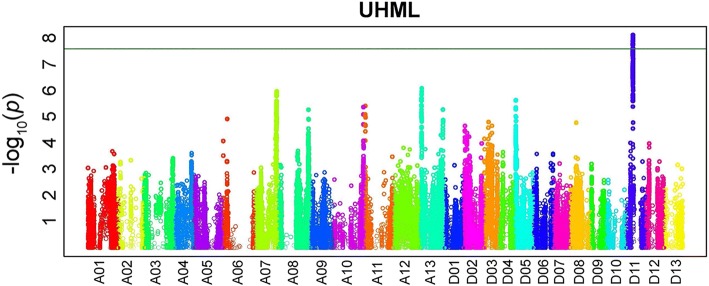
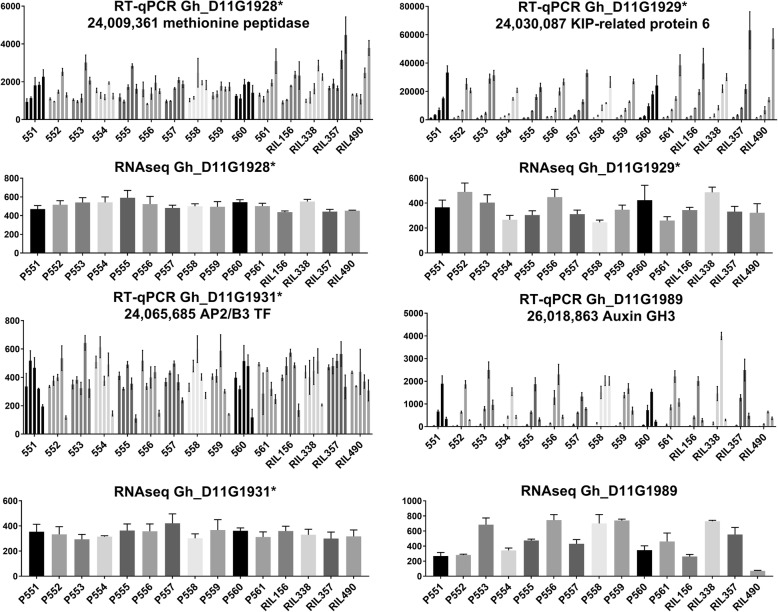
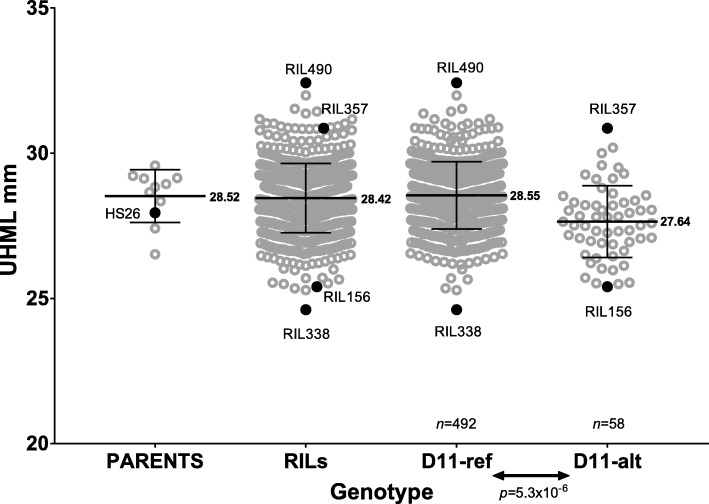
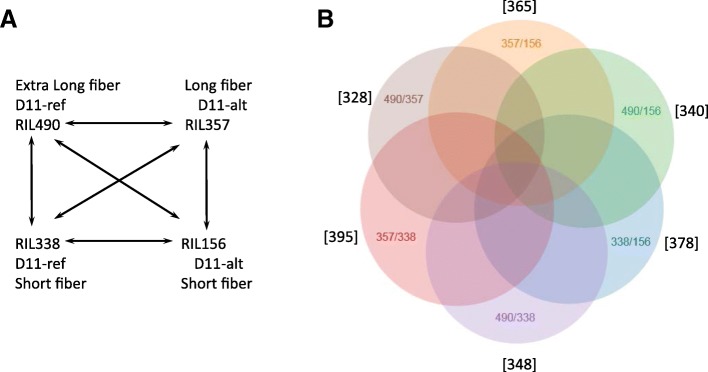
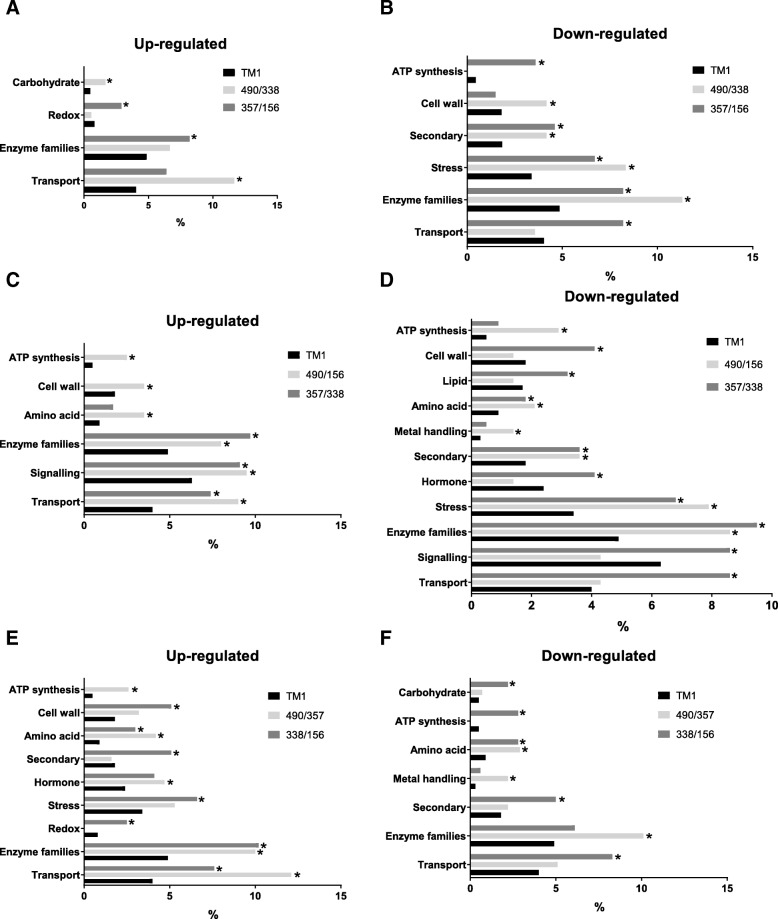
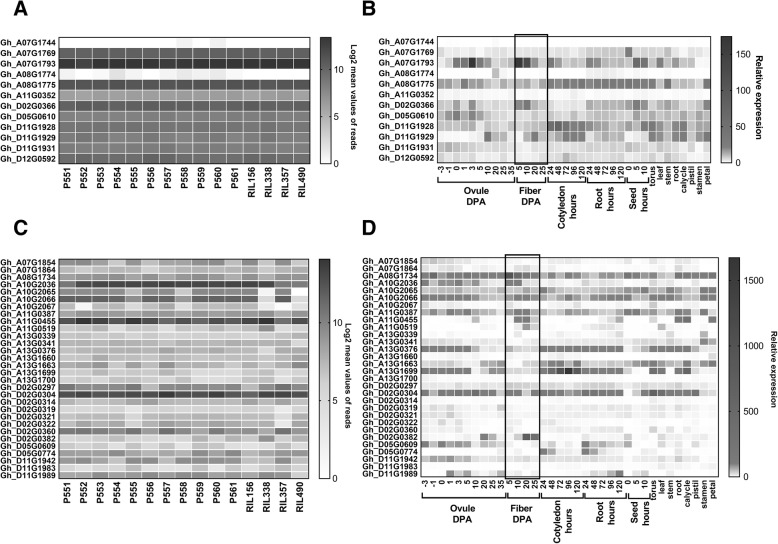
An Upland cotton MAGIC population, consisting of 550 recombinant inbred lines (RILs) derived from eleven different cultivars, was used to identify fiber length QTLs and potential genes that contribute to longer fibers. A genome wide association study (GWAS) identified a cluster of single nucleotide polymorphisms (SNPs) on chromosome (Chr.) D11 that is significantly associated with fiber length. Further evaluation of the Chr. D11 genomic region among lines of the MAGIC population detected that 90% of RILs have a D11 haplotype similar to the reference TM-1 genome (D11-ref), whereas 10% of RILs inherited an alternative haplotype from one of the parents (D11-alt). The average length of fibers of D11-alt RILs was significantly shorter compared to D11-ref RILs, suggesting that alleles in the D11-alt haplotype contributed to the inferior fiber quality. RNAseq analysis of the longest and shortest fiber length RILs from D11-ref and D11-alt populations identified 949 significantly differentially expressed genes (DEGs). Gene set enrichment analysis revealed that different functional categories of genes were over-represented during fiber elongation between the four selected RILs. We found 12 genes possessing non-synonymous SNPs (nsSNPs) significantly associated with the fiber length, and three that were highly significant and were clustered at D11:24-Mb, including D11G1928, D11G1929 and D11G1931.
The results of this study provide insights into molecular aspects of genetic variation in fiber length and suggests candidate genes for genetic manipulation for cotton improvement.
提高棉花纤维长度而不降低产量是棉花育种的主要目标之一。然而,由于现代棉花品种遗传多样性狭窄,以及纤维质量和产量性状之间存在负相关,通过育种来改善棉花纤维长度一直是一个挑战。通过随机交配开发的多亲本高级世代互交(MAGIC)群体提供了极好的遗传资源,允许鉴定数量性状位点(QTL)和因果基因。
利用由 11 个不同品种衍生的 550 个重组自交系(RIL)构建的陆地棉 MAGIC 群体,鉴定与纤维长度相关的 QTL 和潜在基因。全基因组关联研究(GWAS)在第 11 号染色体(Chr.)上鉴定出一个与纤维长度显著相关的单核苷酸多态性(SNP)簇。进一步评估 MAGIC 群体中这些 Chr. D11 基因组区域的线路发现,90%的 RIL 具有与参考 TM-1 基因组(D11-ref)相似的 D11 单倍型,而 10%的 RIL 从父母之一继承了替代单倍型(D11-alt)。与 D11-ref RIL 相比,D11-alt RIL 的纤维平均长度明显更短,表明 D11-alt 单倍型中的等位基因导致纤维质量较差。对来自 D11-ref 和 D11-alt 群体的最长和最短纤维长度 RIL 的 RNAseq 分析鉴定出 949 个显著差异表达基因(DEG)。基因集富集分析表明,在四个选定的 RIL 之间的纤维伸长过程中,不同功能类别的基因过度表达。我们发现 12 个具有与纤维长度显著相关的非同义 SNP(nsSNP)的基因,其中 3 个高度显著并聚集在 D11:24-Mb 上,包括 D11G1928、D11G1929 和 D11G1931。
本研究结果深入了解了纤维长度遗传变异的分子方面,并为棉花改良的遗传操作提供了候选基因。