Tóth Eszter, Faragó Péter, Király András, Szabó Nikoletta, Veréb Dániel, Kocsis Krisztián, Kincses Bálint, Sandi Dániel, Bencsik Krisztina, Vécsei László, Kincses Zsigmond Tamás
Department of Neurology, Albert Szent-Györgyi Clinical Centre, University of Szeged, Szeged, Hungary.
MTA-SZTE Neuroscience Research Group, University of Szeged, Szeged, Hungary.
Front Neurol. 2019 Jan 23;9:1172. doi: 10.3389/fneur.2018.01172. eCollection 2018.
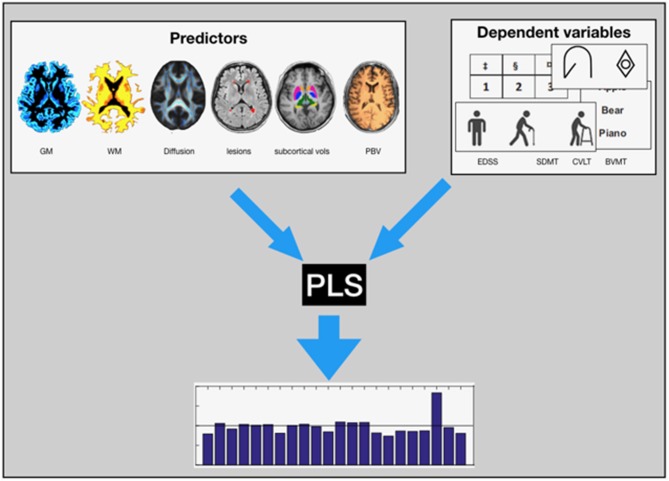
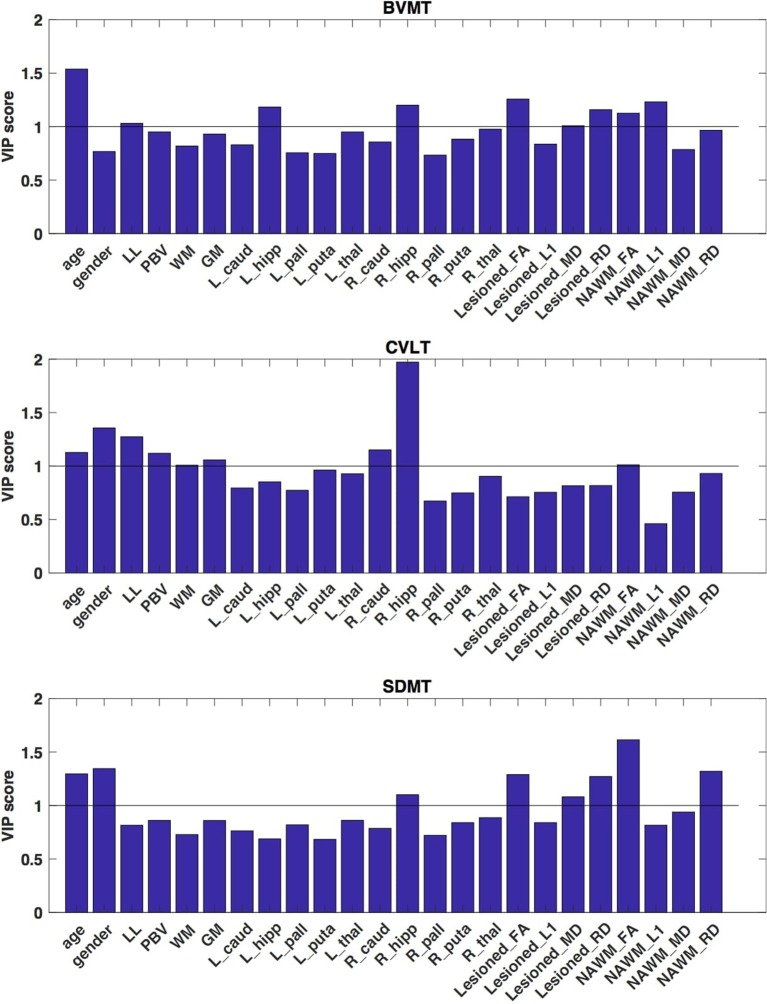
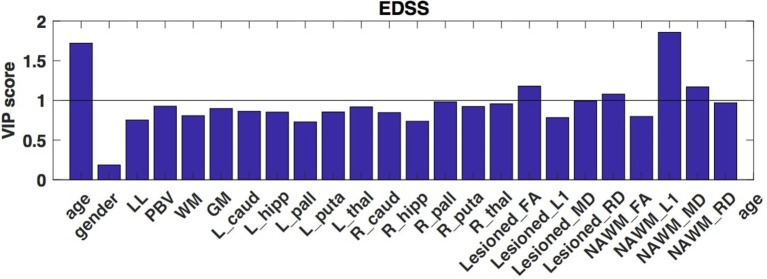
Next to the disseminated clinical symptoms, cognitive dysfunctions are common features of multiple sclerosis (MS). Over the recent years several different MRI measures became available representing the various features of the pathology, but the contribution to various clinical and cognitive functions is not yet fully understood. In this multiparametric MRI study we set out to identify the set of parameters that best predict the clinical and cognitive disability in MS. High resolution T1 weighted structural and high angular resolution diffusion MRI images were measured in 53 patients with relapsing remitting MS and 53 healthy controls. Clinical disability was inflicted by EDSS and cognitive functions were evaluated with the BICAMS tests. The contribution of lesion load, partial brain, white matter, gray matter and subcortical volumes as well as the diffusion parameters in the area of the lesions and the normal appearing white matter were examined by model free, partial least square (PLS) approach. Significance of the predictors was tested with Variable Importance in the Projection (VIP) score and 1 was used for threshold of significance. The PLS analysis indicated that the axial diffusivity of the NAWM contributed the most to the clinical disability (VIP score: 1.979). For the visuo-spatial working memory the most critical contributor was the size of the bilateral hippocampi (VIP scores: 1.183 and 1.2 left and right respectively). For the verbal memory the best predictors were the size of the right hippocampus (VIP score: 1.972), lesion load (VIP score: 1.274) and the partial brain volume (VIP score: 1.119). In case of the information processing speed the most significant contribution was from the diffusion parameters (fractional anisotropy, mean and radial diffusivity, VIP scores: 1.615, 1.321 respectively) of the normal appearing white matter. Our results indicate that various MRI measurable factors of MS pathology contribute differently to clinical and cognitive disability. These results point out the importance of the volumetry of the subcortical structures and the diffusion measures of the white matter in understanding the disability progression.
除了广泛的临床症状外,认知功能障碍是多发性硬化症(MS)的常见特征。近年来,出现了几种不同的MRI测量方法来呈现病理的各种特征,但它们对各种临床和认知功能的贡献尚未完全明确。在这项多参数MRI研究中,我们旨在确定最能预测MS临床和认知残疾的参数集。对53例复发缓解型MS患者和53名健康对照者进行了高分辨率T1加权结构和高角分辨率扩散MRI成像测量。临床残疾程度采用扩展残疾状态量表(EDSS)评估,认知功能通过BICAMS测试进行评估。通过无模型的偏最小二乘(PLS)方法,研究了病变负荷、部分脑区、白质、灰质和皮质下体积以及病变区域和正常白质区域的扩散参数的贡献。使用投影中变量重要性(VIP)评分测试预测因子的显著性,显著性阈值设为1。PLS分析表明,正常白质的轴向扩散率对临床残疾的贡献最大(VIP评分:1.979)。对于视觉空间工作记忆,最关键的因素是双侧海马体的大小(VIP评分:左侧为1.183,右侧为1.2)。对于言语记忆,最佳预测因子是右侧海马体的大小(VIP评分:1.972)、病变负荷(VIP评分:1.274)和部分脑体积(VIP评分:1.119)。在信息处理速度方面,最显著的贡献来自正常白质的扩散参数(分数各向异性、平均扩散率和径向扩散率,VIP评分分别为1.615、1.321)。我们的结果表明,MS病理的各种MRI可测量因素对临床和认知残疾的贡献各不相同。这些结果指出了皮质下结构容积测量和白质扩散测量在理解残疾进展中的重要性。