Koogler Andrew, Amusa Ganiyu, Kushelev Michael, Lawrence Alec, Carlson Laurah, Moran Kenneth
Wexner Medical Center, The Ohio State University, Columbus, OH, USA.
SAGE Open Med Case Rep. 2019 Jan 16;7:2050313X18823928. doi: 10.1177/2050313X18823928. eCollection 2019.
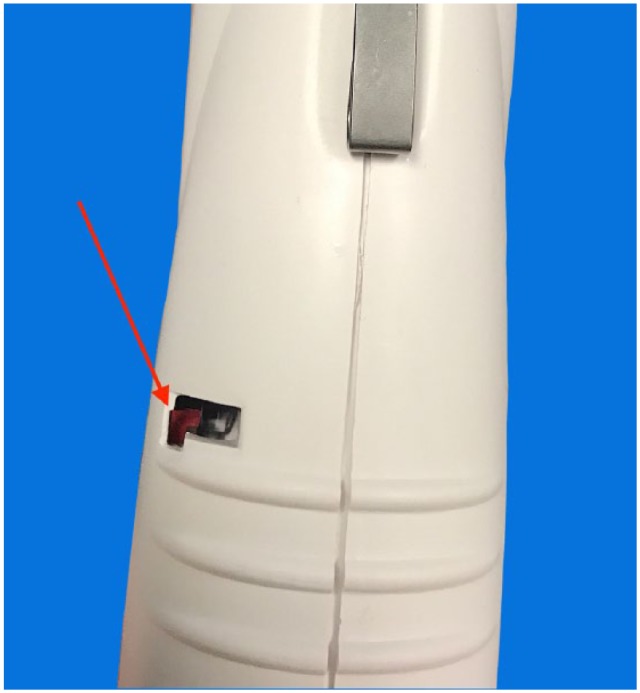
A 70 year-old female patient presented for a right humeral head replacement. Preoperatively an interscalene catheter was placed and postoperatively connected to an elastomeric pump for continuous infusion at 8 mL/h of Ropivacaine 0.2% with an additional 5 mL patient activated bolus available every 30 min. About 17 h after the elastomeric pump was connected to the catheter, the 550 mL reservoir was found to be empty, indicating the pump's infusion rate was more than 32 mL/h despite the pump still being set at an infusion rate of 8 mL/h with a possible 5 mL bolus every 30 min. There was no visible damage or leak in the pump system, and the insertion site was dry. The patient denied any changes to the pump settings. She was alert and oriented and denied any signs of local anesthetic toxicity. The catheter was immediately pulled and the manufacturer notified. The manufacturer found a red tab broken inside the patient-controlled bolus remote resulting in the over-infusion. Despite the dependability of elastomeric pumps, healthcare providers must be aware of their possible complications and malfunctions.
一名70岁女性患者前来接受右肱骨头置换术。术前放置了肌间沟导管,术后连接到一个弹性泵,以8毫升/小时的速度持续输注0.2%的罗哌卡因,每30分钟患者还可自行追加5毫升。在弹性泵与导管连接约17小时后,发现550毫升的储液器已空,这表明尽管泵仍设置为8毫升/小时的输注速度且每30分钟可追加5毫升,但实际输注速度超过了32毫升/小时。泵系统没有可见的损坏或泄漏,导管插入部位干燥。患者否认对泵的设置进行了任何更改。她神志清醒、定向力正常,否认有任何局部麻醉药中毒的迹象。导管立即被拔出,并通知了制造商。制造商发现患者自控追加剂量遥控器内的一个红色卡舌断裂,导致了过量输注。尽管弹性泵可靠性较高,但医护人员必须意识到其可能出现的并发症和故障。