UMR 7245 MCAM, Muséum National d'Histoire Naturelle - CNRS, 57 Rue Cuvier, CP 39, 75231, Paris Cedex 05, France.
UMR 9190 MARBEC, CNRS - Université de Montpellier - IRD - IFREMER, Place Eugène Bataillon, 34095, Montpellier Cedex 5, France.
Microb Ecol. 2019 Oct;78(3):603-617. doi: 10.1007/s00248-019-01332-8. Epub 2019 Feb 7.
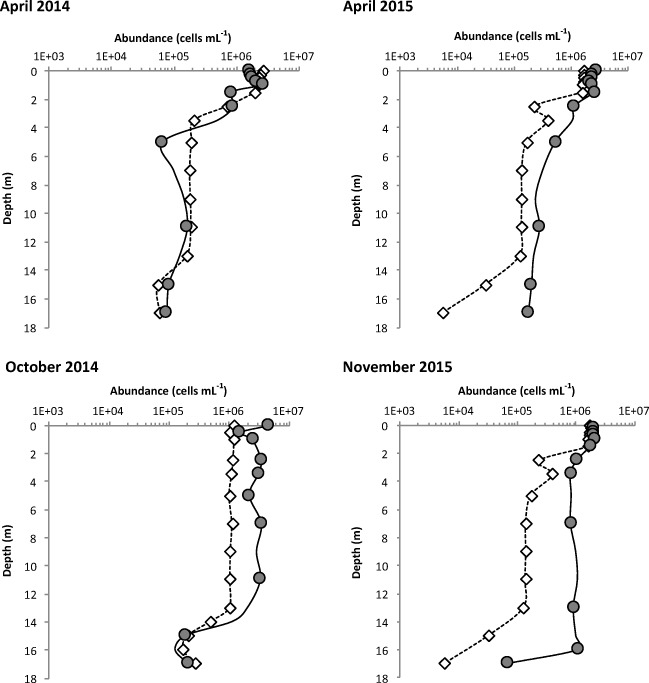
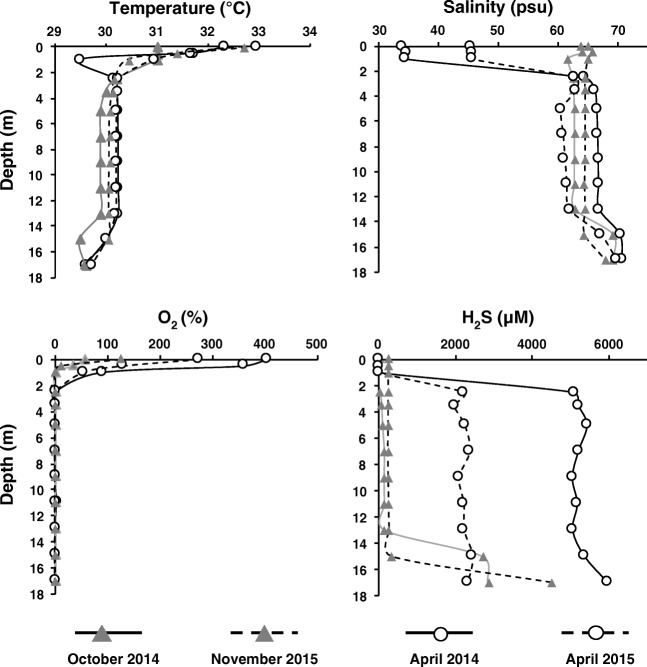
Lake Dziani Dzaha (Mayotte Island, Indian Ocean) is a tropical thalassohaline lake which geochemical and biological conditions make it a unique aquatic ecosystem considered as a modern analogue of Precambrian environments. In the present study, we focused on the diversity of phytoplanktonic communities, which produce very high and stable biomass (mean = 652 ± 179 μg chlorophyll a L). As predicted by classical community ecology paradigms, and as observed in similar environments, a single species is expected to dominate the phytoplanktonic communities. To test this hypothesis, we sampled water column in the deepest part of the lake (18 m) during rainy and dry seasons for two consecutive years. Phytoplanktonic communities were characterized using a combination of metagenomic, microscopy-based and flow cytometry approaches, and we used statistical modeling to identify the environmental factors determining the abundance of dominant organisms. As hypothesized, the overall diversity of the phytoplanktonic communities was very low (15 OTUs), but we observed a co-dominance of two, and not only one, OTUs, viz., Arthrospira fusiformis (Cyanobacteria) and Picocystis salinarum (Chlorophyta). We observed a decrease in the abundance of these co-dominant taxa along the depth profile and identified the adverse environmental factors driving this decline. The functional traits measured on isolated strains of these two taxa (i.e., size, pigment composition, and concentration) are then compared and discussed to explain their capacity to cope with the extreme environmental conditions encountered in the aphotic, anoxic, and sulfidic layers of the water column of Lake Dziani Dzaha.
扎亚尼扎哈湖(印度洋马约特岛)是一个热带盐湖,其地球化学和生物条件使其成为一个独特的水生生态系统,被认为是前寒武纪环境的现代类似物。在本研究中,我们专注于浮游植物群落的多样性,这些群落产生非常高且稳定的生物量(平均值为 652±179μg 叶绿素 a·L -1)。正如经典群落生态学范式所预测的,并且在类似的环境中观察到的,单一物种预计将主导浮游植物群落。为了检验这一假设,我们在连续两年的雨季和旱季在湖泊最深处(18 米)采集水柱样本。浮游植物群落的特征采用了组合的宏基因组学、基于显微镜和流式细胞术的方法,并使用统计模型来确定决定优势生物丰度的环境因素。正如假设的那样,浮游植物群落的总体多样性非常低(15 个 OTUs),但我们观察到两个而非一个 OTUs 的共同优势,即束丝藻(蓝藻)和盐沼盐藻(绿藻)。我们观察到这些共同优势类群的丰度沿着深度剖面下降,并确定了驱动这种下降的不利环境因素。然后比较和讨论了从这两个类群的分离株上测量的功能特征(即大小、色素组成和浓度),以解释它们在扎亚尼扎哈湖水柱的无光、缺氧和硫化层中遇到的极端环境条件下的适应能力。