Laboratory of Animal Sociology, Department of Biology and Geosciences, Osaka City University, Osaka, Japan.
Department of Biosphere-Geosphere Science, Okayama University of Science, Okayama, Japan.
PLoS Biol. 2019 Feb 7;17(2):e3000021. doi: 10.1371/journal.pbio.3000021. eCollection 2019 Feb.
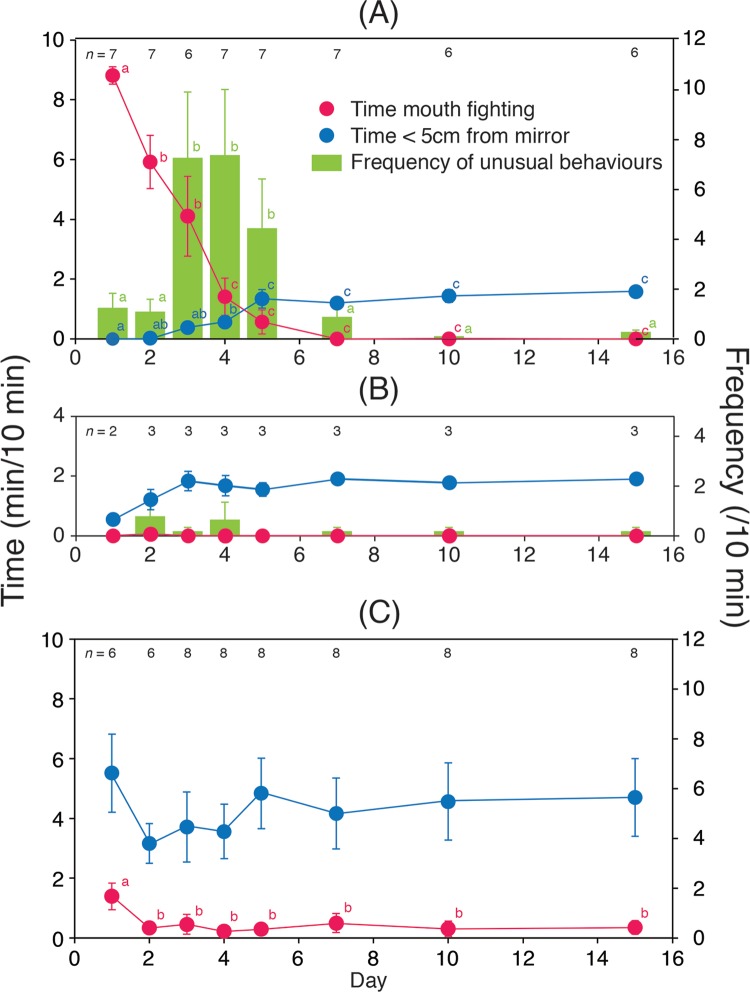
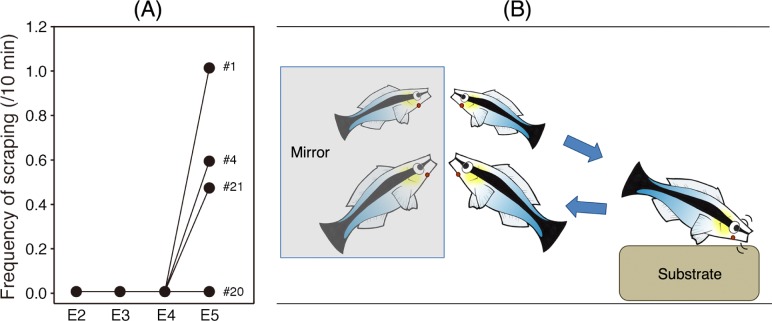
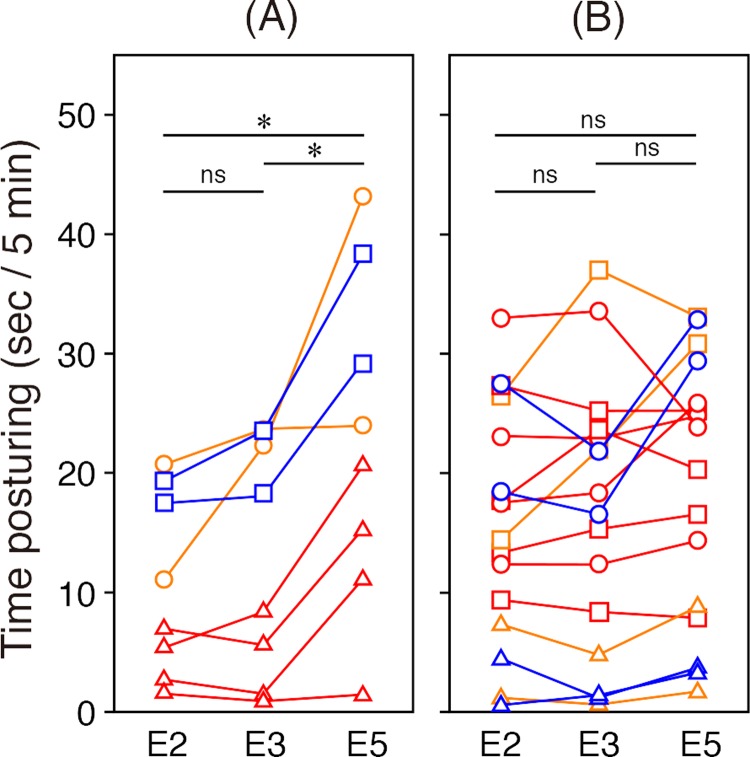
The ability to perceive and recognise a reflected mirror image as self (mirror self-recognition, MSR) is considered a hallmark of cognition across species. Although MSR has been reported in mammals and birds, it is not known to occur in any other major taxon. Potentially limiting our ability to test for MSR in other taxa is that the established assay, the mark test, requires that animals display contingency testing and self-directed behaviour. These behaviours may be difficult for humans to interpret in taxonomically divergent animals, especially those that lack the dexterity (or limbs) required to touch a mark. Here, we show that a fish, the cleaner wrasse Labroides dimidiatus, shows behaviour that may reasonably be interpreted as passing through all phases of the mark test: (i) social reactions towards the reflection, (ii) repeated idiosyncratic behaviours towards the mirror, and (iii) frequent observation of their reflection. When subsequently provided with a coloured tag in a modified mark test, fish attempt to remove the mark by scraping their body in the presence of a mirror but show no response towards transparent marks or to coloured marks in the absence of a mirror. This remarkable finding presents a challenge to our interpretation of the mark test—do we accept that these behavioural responses, which are taken as evidence of self-recognition in other species during the mark test, lead to the conclusion that fish are self-aware? Or do we rather decide that these behavioural patterns have a basis in a cognitive process other than self-recognition and that fish do not pass the mark test? If the former, what does this mean for our understanding of animal intelligence? If the latter, what does this mean for our application and interpretation of the mark test as a metric for animal cognitive abilities?
EDITOR’S NOTE: This Short Report received both positive and negative reviews by experts. The Academic Editor has written an accompanying Primer that we are publishing alongside this article (https://doi.org/10.1371/journal.pbio.3000112). The linked Primer presents a complementary expert perspective; it discusses how the current study should be interpreted in the context of evidence for and against self-awareness in a wide range of animals.
感知和识别镜像中的自我(镜像自我识别,MSR)被认为是跨物种认知的标志。尽管已经在哺乳动物和鸟类中报告了 MSR,但在其他主要分类群中尚未发现。可能限制我们在其他分类群中测试 MSR 的能力的是,已建立的标记测试需要动物表现出趋同测试和自我导向行为。这些行为对于人类来说可能难以在分类学上不同的动物中进行解释,尤其是那些缺乏触摸标记所需的灵巧性(或肢体)的动物。在这里,我们表明,一种鱼类,清洁濑鱼 Labroides dimidiatus,表现出的行为可以合理地解释为通过了标记测试的所有阶段:(i)对反射的社交反应,(ii)对镜子的反复特立独行的行为,以及(iii)经常观察自己的倒影。当随后在修改后的标记测试中提供带有颜色标记的标签时,鱼会尝试在镜子存在的情况下通过刮擦身体来去除标记,但对透明标记或没有镜子时的有色标记没有反应。这一显著发现对我们对标记测试的解释提出了挑战——我们是否接受这些行为反应,这些反应在标记测试中被视为其他物种自我识别的证据,从而得出鱼类具有自我意识的结论?或者我们是否认为这些行为模式基于除自我识别之外的认知过程,并且鱼类没有通过标记测试?如果是前者,这对我们理解动物智力意味着什么?如果是后者,这对我们将标记测试作为衡量动物认知能力的指标的应用和解释意味着什么?
这篇简短报告得到了专家的正反两方面评价。学术编辑为此撰写了一篇伴随的简介,我们将与这篇文章一起发表(https://doi.org/10.1371/journal.pbio.3000112)。链接的简介提供了一个互补的专家视角;它讨论了在广泛的动物中自我意识的证据和反对意见的背景下,应该如何解释当前的研究。