Programa de Pós-Graduação em Reabilitação e Desempenho Funcional, Departamento de Fisioterapia, Universidade Federal dos Vales do Jequitinhonha e Mucuri, Diamantina, Minas Gerais, Brasil.
Laboratório de Inflamação e Metabolismo - LIM, CIPq Saúde, Universidade Federal dos Vales do Jequitinhonha e Mucuri, Diamantina, Minas Gerais, Brasil.
PLoS One. 2019 Feb 7;14(2):e0211327. doi: 10.1371/journal.pone.0211327. eCollection 2019.
Preliminary studies have showed that the Incremental Shuttle Walking Test (ISWT) is a maximal test, however comparison between ISWT with the cardiopulmonary exercise test (CEPT) has not yet performed in the healthy woman population. Furthermore, there is no regression equation available in the current literature to predict oxygen peak consumption (VO2 peak). Thus, this study aimed to compare the ISWT with CEPT and to develop an equation to predict peak oxygen uptake (VO2 peak) in healthy women participants.
First, the VO2 peak, respiratory exchange ratio (R peak), heart rate max (HR max) and percentage of predicted HR max (% predicted HR max) were evaluated in the CEPT and ISWT (n = 40). Then, an equation was developed to predict the VO2 peak (n = 54) and its validation was performed (n = 20).
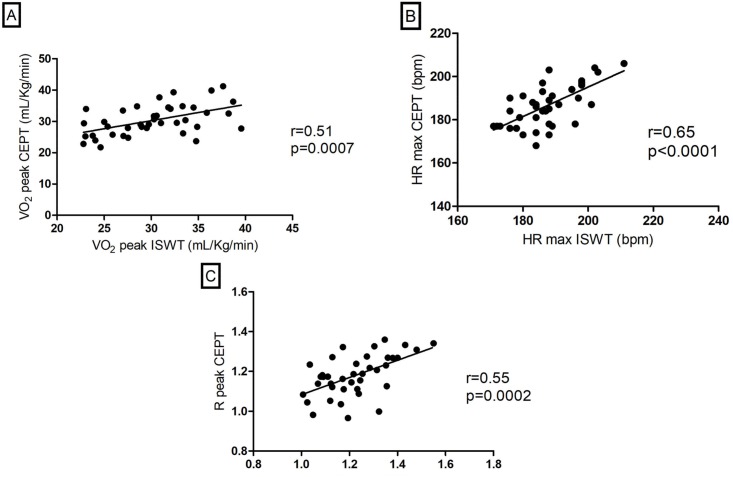
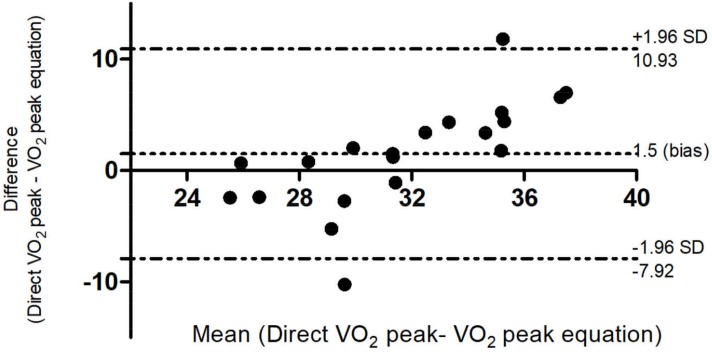
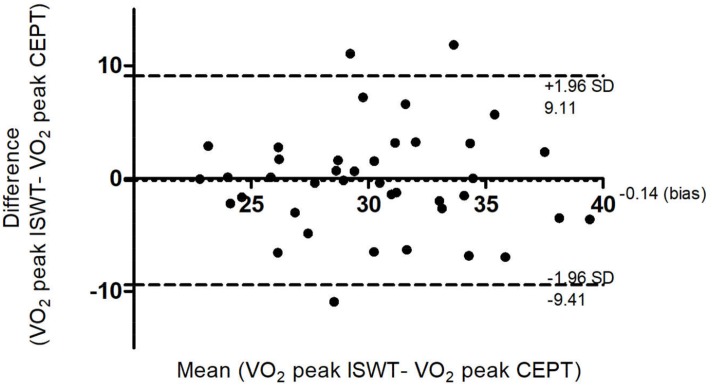
There were no significant differences between the ISWT and CEPT of VO2 peak, HR max and % predicted HR max values (P>0.05), except for R peak measure in the ISWT (1.22 ± 0.13) and CEPT (1.18 ± 0.1) (P = 0.022). Therefore, both tests showed a moderate positive correlation of VO2 peak (r = 0.51; P = 0.0007), HR max (r = 0.65; P<0.0001) and R peak (r = 0.55; P = 0.0002) and the Bland-Altman analysis showed agreement of VO2 peak (bias = -0.14). The distance walked on ISWT and age explained 36.3% (R2 Adjusted = 0.363) of the variance in VO2 peak. The equation developed was VO2 peak (predicted) = 19.793 + (0.02 x distance walked)-(0.236 x age). There was no statistically significant difference between the VO2 peak measured directly and the predicted, and the Bland-Altman analysis showed agreement (bias = 1.5 ml/kg/min).
ISWT is a maximal test showing similar results compared to the CEPT, and the predicted equation was valid and applicable for VO2 peak assessing in young adult healthy women.
初步研究表明,递增穿梭步行测试(ISWT)是一项最大测试,但尚未在健康女性人群中对 ISWT 与心肺运动测试(CEPT)进行比较。此外,目前的文献中尚无预测峰值耗氧量(VO2 峰值)的回归方程。因此,本研究旨在比较 ISWT 与 CEPT,并开发一个预测健康女性参与者峰值摄氧量(VO2 峰值)的方程。
首先,在 CEPT 和 ISWT 中评估了 VO2 峰值、呼吸交换比(R 峰值)、最大心率(HR 峰值)和最大预测心率的百分比(% 预测 HR 峰值)(n = 40)。然后,开发了一个预测 VO2 峰值的方程(n = 54)并进行了验证(n = 20)。
ISWT 和 CEPT 的 VO2 峰值、HR 峰值和%预测 HR 峰值值之间没有显著差异(P>0.05),除了 ISWT 的 R 峰值测量(1.22 ± 0.13)和 CEPT(1.18 ± 0.1)(P = 0.022)。因此,两种测试都显示 VO2 峰值(r = 0.51;P = 0.0007)、HR 峰值(r = 0.65;P<0.0001)和 R 峰值(r = 0.55;P = 0.0002)有中度正相关,Bland-Altman 分析显示 VO2 峰值有一致性(偏差= -0.14)。ISWT 上行走的距离和年龄解释了 VO2 峰值的 36.3%(调整 R2 = 0.363)。开发的方程为 VO2 峰值(预测)= 19.793 +(0.02 x 行走距离)-(0.236 x 年龄)。直接测量的 VO2 峰值与预测值之间无统计学差异,Bland-Altman 分析显示一致性(偏差= 1.5 ml/kg/min)。
ISWT 是一项最大测试,与 CEPT 相比结果相似,预测方程有效且适用于评估年轻健康女性的 VO2 峰值。