Jin Haiqiang, Hao Hongjun, Nan Ding, Luo Jingjing, Wang Lei, Gao Feng, Huang Yining
Department of Neurology, Peking University First Hospital.
Department of Neurology, Rockets General Hospital of People's Liberty Army, Beijing, China.
Medicine (Baltimore). 2019 Feb;98(6):e14229. doi: 10.1097/MD.0000000000014229.
Detection of aquaporin-4 (AQP4) antibody in cerebrospinal fluid (CSF) was not suggested for the diagnosis of neuromyelitis opica spectrum disorders (NMOSD). However, some patients with NMOSD have only AQP4 antibody positive in CSF but not in serum with unknown cause. Besides, it is rarely reported that NMOSD complicated with renal clear cell carcinoma. So, the relationship between AQP4-Ab, NMOSD and malignant tumors warrants an investigation.
A 31-year-old female presented in our hospital with chief complaints of urinary retention and weakness in bilateral lower extremities for more than 10 days.
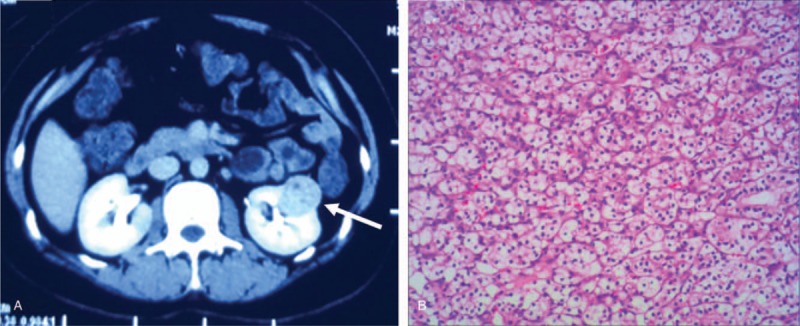
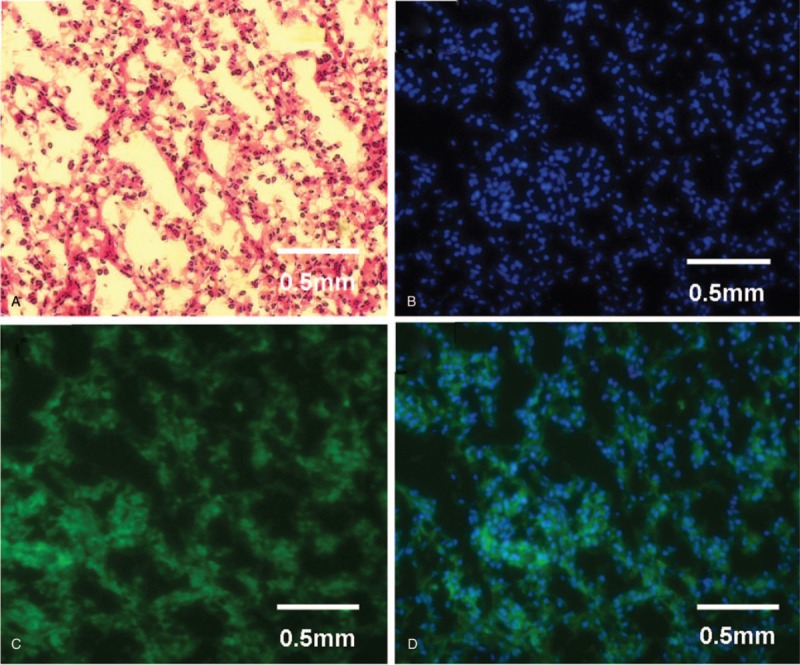
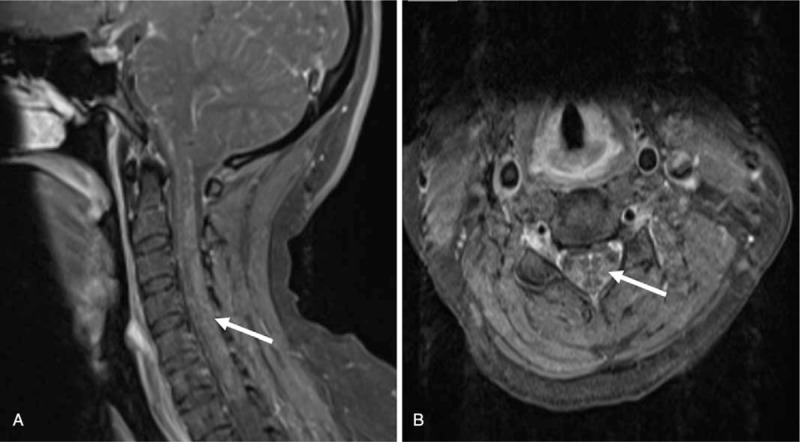
The patient was diagnosed as NMOSD by neuroimaging and laboratory examination, with AQP4 antibody positive only in CSF. Besides, asymptomatic clear cell carcinoma was also found in left kidney.
The patient underwent 2-month immunosuppressive therapy for NMOSD at first, including intravenous administration of immunoglobulin (IVIG) and methylprednisone, with oral drugs of predisone and tacrolimus. After that, Partial nephrectomy of left kidney was performed.
The patient demonstrated almost complete remission for NMOSD after immunosuppressive therapy, and the renal tumor was cured by partial nephrectomy.
This case indicates that neuromyelitis optica (NMO)-IgG positive only in CSF could have potential association with the etiology of NMOSD, and renal clear cell carcinoma could be found complicated with NMOSD coincidently. Besides, it is necessary to examine NMO-IgG in CSF for patients suspicious with NMOSD, even when the serum test is negative, especially for those with complicated malignant tumors.
脑脊液(CSF)中检测水通道蛋白4(AQP4)抗体不建议用于视神经脊髓炎谱系障碍(NMOSD)的诊断。然而,一些NMOSD患者脑脊液中AQP4抗体呈阳性而血清中呈阴性,原因不明。此外,NMOSD合并肾透明细胞癌的情况鲜有报道。因此,AQP4抗体、NMOSD与恶性肿瘤之间的关系值得研究。
一名31岁女性因排尿困难和双下肢无力10余天就诊于我院。
经神经影像学和实验室检查,该患者被诊断为NMOSD,仅脑脊液中AQP4抗体呈阳性。此外,左肾还发现了无症状透明细胞癌。
患者首先接受了为期2个月的NMOSD免疫抑制治疗,包括静脉注射免疫球蛋白(IVIG)和甲泼尼龙,口服泼尼松和他克莫司。之后,进行了左肾部分切除术。
免疫抑制治疗后,患者的NMOSD几乎完全缓解,肾肿瘤通过部分肾切除术治愈。
该病例表明,仅脑脊液中视神经脊髓炎(NMO)-IgG阳性可能与NMOSD的病因存在潜在关联,肾透明细胞癌可能与NMOSD同时发生。此外,对于疑似NMOSD的患者,即使血清检测为阴性,尤其是那些合并恶性肿瘤的患者,有必要检测脑脊液中的NMO-IgG。