Hong Seung Soo, Choi Ui Yoon, Ma Sang Hyuk, Lee Soo Young, Han Seung Beom, Kim Kyung-Hyo, Kang Jin Han, Kim Jong-Hyun
Department of Pediatrics, Graduate School of Medical Science.
Department of Pediatrics, College of Medicine, The Catholic University of Korea, Seoul.
Medicine (Baltimore). 2019 Feb;98(6):e14364. doi: 10.1097/MD.0000000000014364.
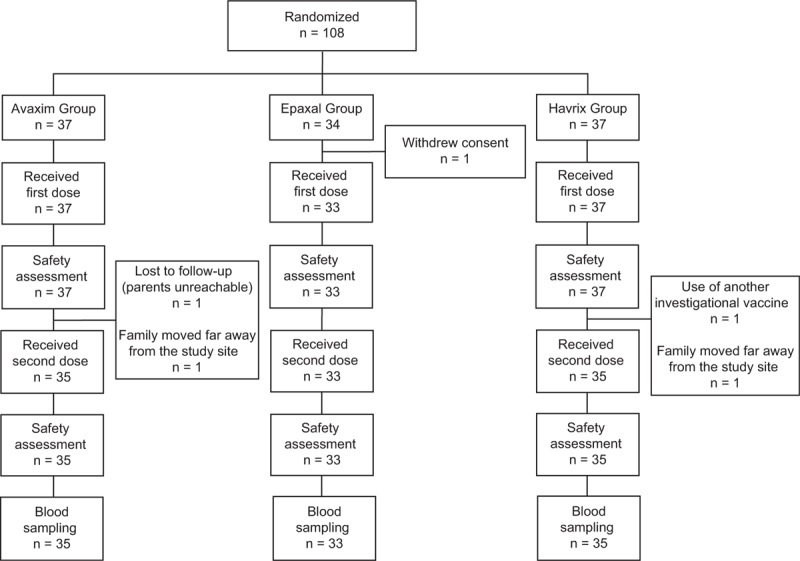
Several approved inactivated hepatitis A (HA) vaccines are available in Korea. These have been shown to be immunogenic and safe in European children; however, their immunogenicity and safety have not been investigated among Korean children. We aimed to compare the immunogenicity and safety of the most commonly used HA vaccines in ethnic Korean children aged 12 to 18 months.In this open-label, randomized, prospective, multicenter study, 108 children were enrolled and randomized to receive a pediatric form of Avaxim, Epaxal, or Havrix. The 2nd dose was administered after an interval of 6 months. Anti-HA virus (HAV) immunoglobulin (Ig) G was measured to assess geometric mean concentrations (GMCs) and seropositvity rates (≥20 mIU/mL anti-HAV IgG). To assess safety, local solicited adverse events (AEs), systemic solicited AEs, unsolicited AEs, and serious AEs (SAEs) were graded.Among the 108 participants enrolled, 37, 34, and 37 received Avaxim, Epaxal, and Havrix, respectively. After administration of 2 doses, the seropositivity rates in the Avaxim, Epaxal, and Havrix groups were all 100% (95% confidence intervals [CIs]: 99.0-100, 98.9-100, and 99.0-100, respectively; P < .001). The anti-HAV GMCs in the Avaxim, Epaxal, and Havrix groups were 5868.4 (95% CI: 4237.2-8126.6), 1962.1 (95% CI: 1298.0-2965.9), and 2232.9 mIU/mL (95% CI: 1428.4-3490.4), respectively, after administration of 2 doses (P < .001). There were no significant differences in the proportions of participants reporting local solicited AEs, systemic solicited AEs, unsolicited AEs, and SAEs among the 3 vaccine groups after the 1st and 2nd doses. All local solicited and unsolicited AEs were grade 1 or 2. Grade 3 systemic solicited AE occurred in 5.4% and 2.9% of the participants in the Havrix group after the 1st and 2nd doses, respectively. SAEs after the 1st and 2nd doses were reported in 2 participants and 1 participant, respectively, but none was assessed as being related to vaccination.The results indicate that these vaccines were safe and immunogenic in ethnic Korean children. The results have contributed to the establishing of an HA vaccination policy in Korea and will be informative to countries that plan to initiate vaccination programs against HAV.
韩国有几种已获批的甲型肝炎(HA)灭活疫苗。这些疫苗在欧洲儿童中已显示出免疫原性且安全;然而,其在韩国儿童中的免疫原性和安全性尚未得到研究。我们旨在比较12至18个月大的韩国儿童中最常用的HA疫苗的免疫原性和安全性。
在这项开放标签、随机、前瞻性、多中心研究中,108名儿童入组并随机接受儿童剂型的安尔宝(Avaxim)、爱宝维(Epaxal)或维康立(Havrix)。第二剂在间隔6个月后接种。检测抗HA病毒(HAV)免疫球蛋白(Ig)G以评估几何平均浓度(GMCs)和血清阳性率(抗HAV IgG≥20 mIU/mL)。为评估安全性,对局部主动不良事件(AEs)、全身主动AEs、非主动AEs和严重AEs(SAEs)进行分级。
在入组的108名参与者中,分别有37名、34名和37名接受了安尔宝、爱宝维和维康立。接种两剂后,安尔宝、爱宝维和维康立组的血清阳性率均为100%(95%置信区间[CIs]:分别为99.0 - 100、98.9 - 100和99.0 - 100;P <.001)。接种两剂后,安尔宝、爱宝维和维康立组的抗HAV GMCs分别为5868.4(95% CI:4237.2 - 8126.6)、1962.1(95% CI:1298.0 - 2965.9)和2232.9 mIU/mL(95% CI:1428.4 - 3490.4)(P <.001)。在第一剂和第二剂接种后,三个疫苗组中报告局部主动AEs、全身主动AEs、非主动AEs和SAEs的参与者比例无显著差异。所有局部主动和非主动AEs均为1级或2级。维康立组分别有5.4%和2.9%的参与者在第一剂和第二剂接种后出现3级全身主动AE。第一剂和第二剂接种后分别有2名和1名参与者报告了SAEs,但均未评估为与疫苗接种有关。
结果表明,这些疫苗在韩国儿童中是安全且具有免疫原性的。这些结果有助于韩国制定HA疫苗接种政策,并将为计划启动针对HAV的疫苗接种项目的国家提供参考。