Department of Veterinary Biosciences, The Ohio State University , Columbus, OH , USA.
Front Immunol. 2014 Sep 16;5:446. doi: 10.3389/fimmu.2014.00446. eCollection 2014.
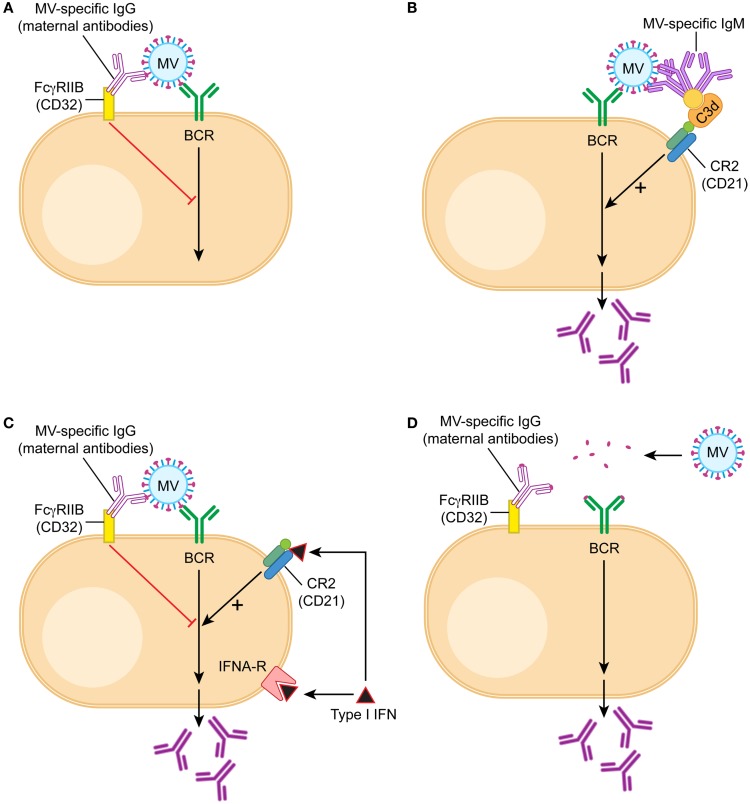
Neonates have an immature immune system, which cannot adequately protect against infectious diseases. Early in life, immune protection is accomplished by maternal antibodies transferred from mother to offspring. However, decaying maternal antibodies inhibit vaccination as is exemplified by the inhibition of seroconversion after measles vaccination. This phenomenon has been described in both human and veterinary medicine and is independent of the type of vaccine being used. This review will discuss the use of animal models for vaccine research. I will review clinical solutions for inhibition of vaccination by maternal antibodies, and the testing and development of potentially effective vaccines. These are based on new mechanistic insight about the inhibitory mechanism of maternal antibodies. Maternal antibodies inhibit the generation of antibodies whereas the T cell response is usually unaffected. B cell inhibition is mediated through a cross-link between B cell receptor (BCR) with the Fcγ-receptor IIB by a vaccine-antibody complex. In animal experiments, this inhibition can be partially overcome by injection of a vaccine-specific monoclonal IgM antibody. IgM stimulates the B cell directly through cross-linking the BCR via complement protein C3d and antigen to the complement receptor 2 (CR2) signaling complex. In addition, it was shown that interferon alpha binds to the CD21 chain of CR2 as well as the interferon receptor and that this dual receptor usage drives B cell responses in the presence of maternal antibodies. In lieu of immunizing the infant, the concept of maternal immunization as a strategy to protect neonates has been proposed. This approach would still not solve the question of how to immunize in the presence of maternal antibodies but would defer the time of infection to an age where infection might not have such a detrimental outcome as in neonates. I will review successful examples and potential challenges of implementing this concept.
新生儿的免疫系统尚未发育成熟,无法充分抵御传染病的侵袭。在生命早期,免疫保护是通过母体抗体从母亲转移到后代来实现的。然而,母体抗体的衰减会抑制疫苗接种,麻疹疫苗接种后血清转化率的抑制就是一个例证。这种现象在人类和兽医医学中都有描述,并且与所使用的疫苗类型无关。本综述将讨论使用动物模型进行疫苗研究。我将回顾抑制疫苗接种的临床解决方案,以及潜在有效疫苗的测试和开发。这些方案基于对母体抗体抑制机制的新机制见解。母体抗体抑制抗体的产生,而 T 细胞反应通常不受影响。B 细胞抑制是通过疫苗抗体复合物在 B 细胞受体 (BCR) 与 Fcγ 受体 IIB 之间形成交联来介导的。在动物实验中,这种抑制可以通过注射疫苗特异性单克隆 IgM 抗体来部分克服。IgM 通过补体蛋白 C3d 和抗原与补体受体 2 (CR2) 信号复合物交联直接刺激 B 细胞。此外,已经表明干扰素 α 结合到 CR2 的 CD21 链以及干扰素受体,并且这种双重受体使用在存在母体抗体的情况下驱动 B 细胞反应。代替给婴儿接种疫苗,已经提出了母体免疫作为保护新生儿的策略。这种方法仍不能解决在存在母体抗体的情况下如何进行免疫接种的问题,但会将感染时间推迟到一个年龄,在这个年龄,感染的后果可能不会像新生儿那样严重。我将回顾实施这一概念的成功案例和潜在挑战。