Department of General Practice and Health Services Research, University Hospital Heidelberg, Im Neuenheimer Feld 130.3, D-69120, Heidelberg, Germany.
Academy of Health Professions Heidelberg, Nursing School, Wieblinger Weg 19, D-69123, Heidelberg, Germany.
BMC Med Educ. 2019 Feb 7;19(1):48. doi: 10.1186/s12909-019-1478-1.
To meet the patients' needs and to provide adequate health care, students need to be prepared for interprofessional collaborative practice during their undergraduate education. On interprofessional training wards (IPTW) undergraduates of various health care professions potentially develop a mutual understanding and improve their interprofessional competencies in clinical practice. To enhance collaboration of 6th-year medical students and nursing trainees in the third year of their vocational training an IPTW (Heidelberger Interprofessionelle Ausbildungsstation - HIPSTA) was implemented at the University Hospital Heidelberg, Germany. On HIPSTA future physicians and nurses take care of the patients self responsibly and in close interprofessional collaboration, supervised by facilitators of both professions. Although there are positive experiences with IPTWs internationally, little is known about the impact of IPTW on the acquisition of interprofessional competencies. For future interprofessional training and implementation of IPTWs evaluation of interprofessional learning and collaborative practice on Germany's first IPTW is of high relevance.
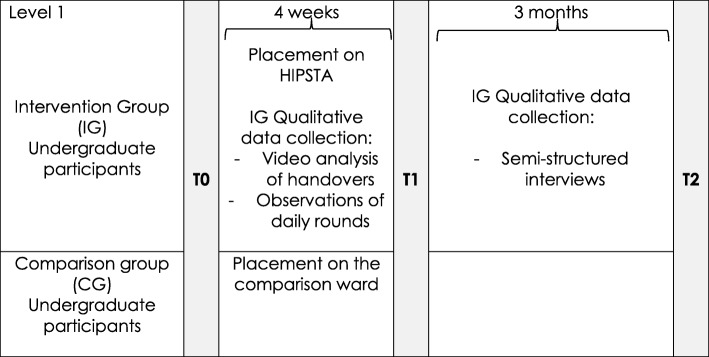
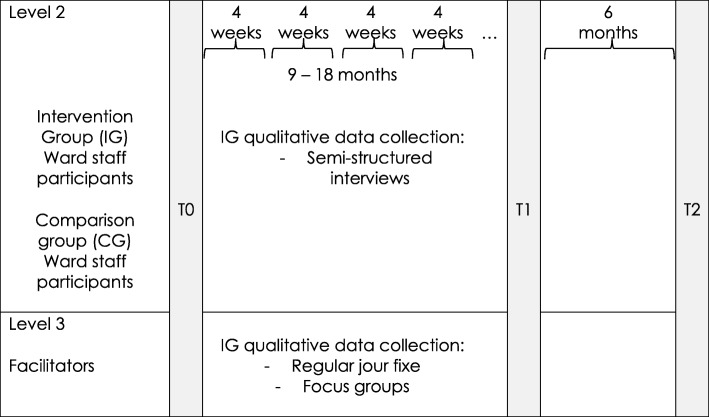
To evaluate the acquisition of interprofessional competencies the study follows a mixed-methods approach. Quantitative data is collected from undergraduate participants, staff participants and facilitators on HIPSTA (intervention group) and undergraduate participants and staff participants on a comparable 'conventional' ward without special interprofessional training (comparison group) immediately pre and post HIPSTA and, as follow-up, after three to six months (T0, T1, T2), using three questionnaires, namely the University of the West of England Interprofessional Questionnaire (UWE-IP), the Interprofessional Socialization and Valuing Scale (ISVS) and the Assessment of Interprofessional Team Collaboration Scale (AITCS). Qualitative data is gathered in form of interviews and focus groups based on semi structured guidelines, video recordings of handovers and overt non-participant observations of daily rounds. Quantitative data will be analysed in a longitudinal comparison, presented descriptively and tested with an analysis of variance. Qualitative data will be analysed deductively and inductively.
The results of the evaluation will give insight in undergraduates', staff's and facilitators' experiences and their self-perception of competency development. In addition the results will help identify benefits, challenges and areas for modification when implementing and establishing similar interprofessional training wards.
为了满足患者的需求并提供充分的医疗保健,学生在本科教育阶段就需要为跨专业协作实践做好准备。在跨专业培训病房(IPTW)中,各种医疗保健专业的本科生有机会在临床实践中相互理解并提高他们的跨专业能力。为了加强第六年医学生和护理实习生在职业培训第三年的合作,德国海德堡大学医院实施了跨专业培训病房(Heidelberger Interprofessionelle Ausbildungsstation - HIPSTA)。在 HIPSTA,未来的医生和护士负责照顾患者,并在双方专业人员的协助下密切协作。尽管国际上有关于跨专业培训病房的积极经验,但对于跨专业培训病房对跨专业能力获取的影响知之甚少。对于未来的跨专业培训和跨专业培训病房的实施,对德国第一个跨专业培训病房的跨专业学习和协作实践进行评估具有重要意义。
为了评估跨专业能力的获取,本研究采用混合方法。从 HIPSTA 的本科参与者、工作人员参与者和辅导员(干预组)以及可比的“常规”病房(没有特殊跨专业培训)的本科参与者和工作人员参与者收集定量数据,使用三个问卷,即西英格兰大学跨专业问卷(UWE-IP)、跨专业社会化和价值观量表(ISVS)和跨专业团队协作评估量表(AITCS),立即在 HIPSTA 之前和之后(T0、T1、T2)收集,并在三到六个月后(T2)进行后续调查。定性数据是通过半结构化指南的访谈和焦点小组收集的,基于交接的视频记录和日常轮班的公开非参与观察。定量数据将进行纵向比较分析,以描述性方式呈现,并通过方差分析进行测试。定性数据将进行演绎和归纳分析。
评估结果将深入了解本科生、工作人员和辅导员的经验以及他们对能力发展的自我认知。此外,结果将有助于确定在实施和建立类似跨专业培训病房时的收益、挑战和改进领域。