Department of Hematology, Seoul St. Mary's Hospital, College of Medicine, The Catholic University of Korea, 222 Banpodae-ro, Seocho-gu, Seoul, 06591, Korea.
Leukemia Research Institute, The Catholic University of Korea, Seoul, Korea.
J Immunother Cancer. 2019 Feb 7;7(1):35. doi: 10.1186/s40425-018-0491-y.
The aim of this study is to evaluate the prognostic impact of myeloid-derived suppressor cells (MDSCs) in multiple myeloma (MM) in the context of autologous stem cell transplantation (ASCT).
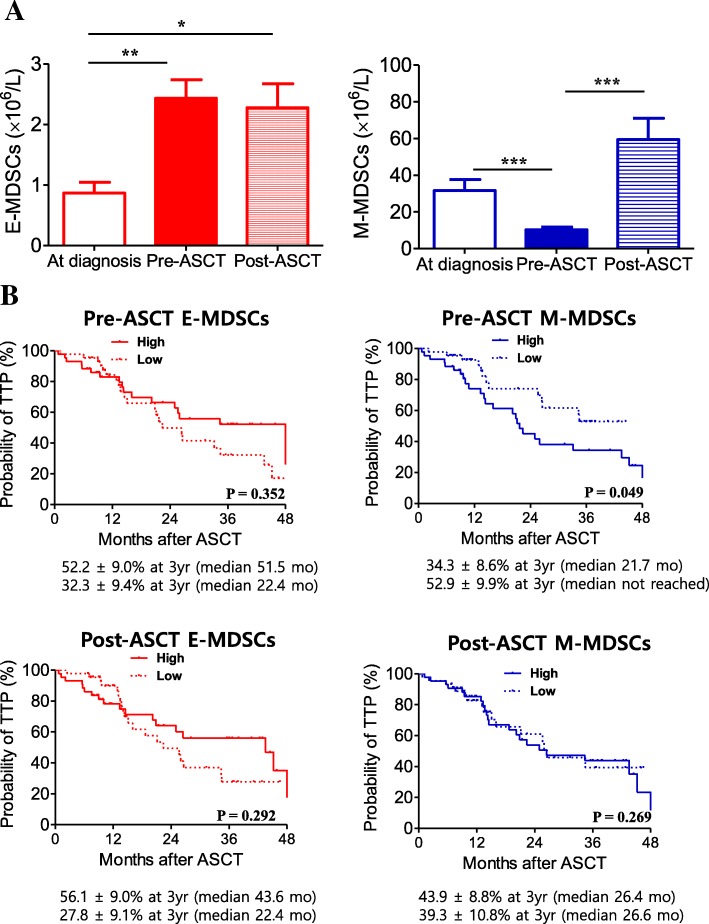
Peripheral blood samples were collected for measuring monocytic (M-) MDSCs (CD14HLA-DR) and early-stage (E-) MDSCs (LinHLA-DRCD33CD11b) before and after ASCT. Clinical outcomes following ASCT differed according to the frequency of each MDSC phenotype.
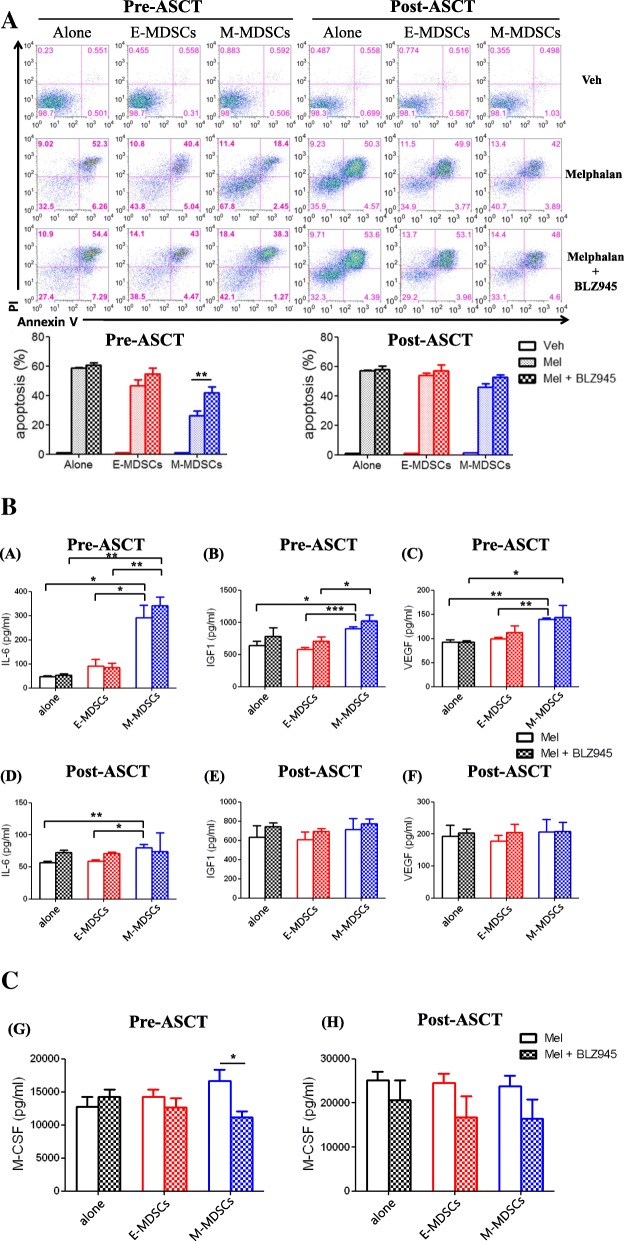
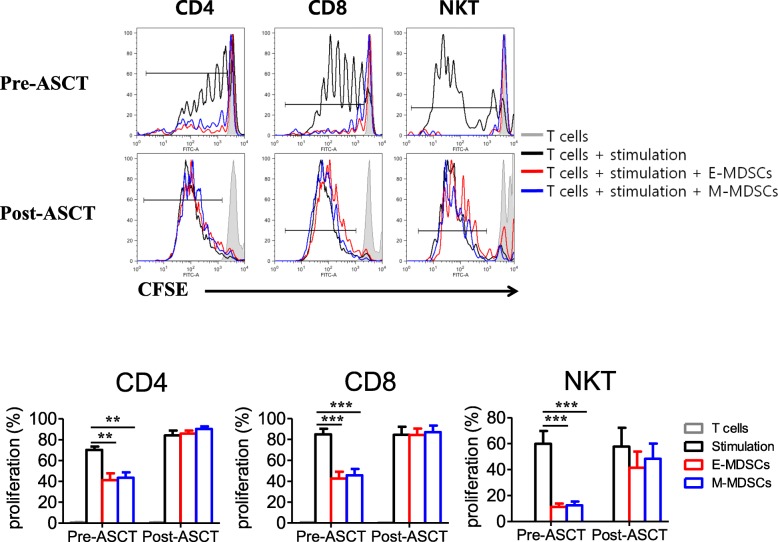
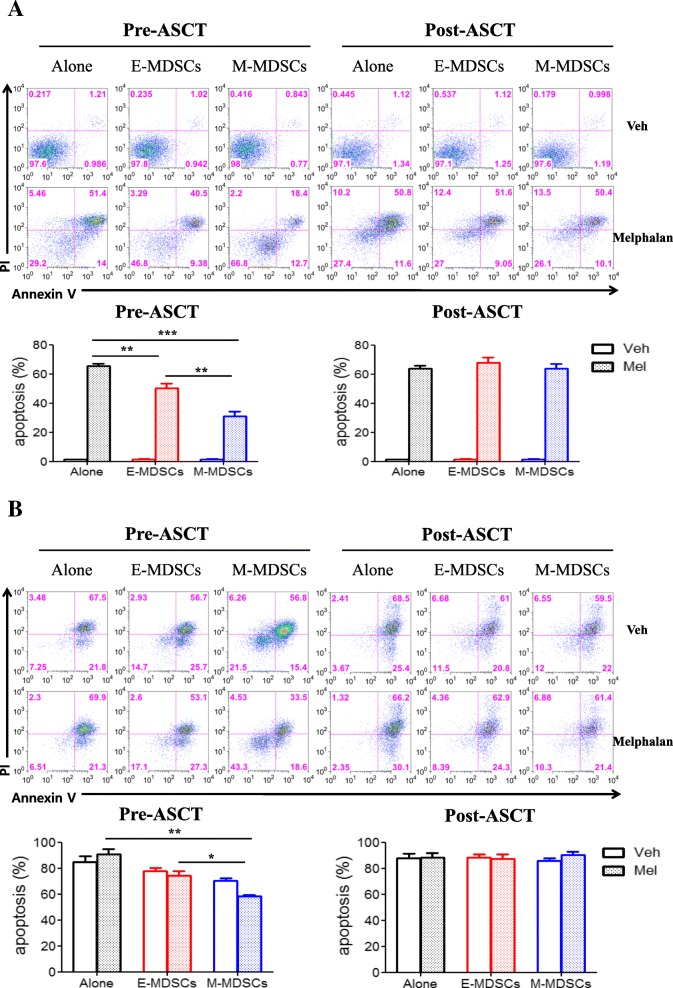
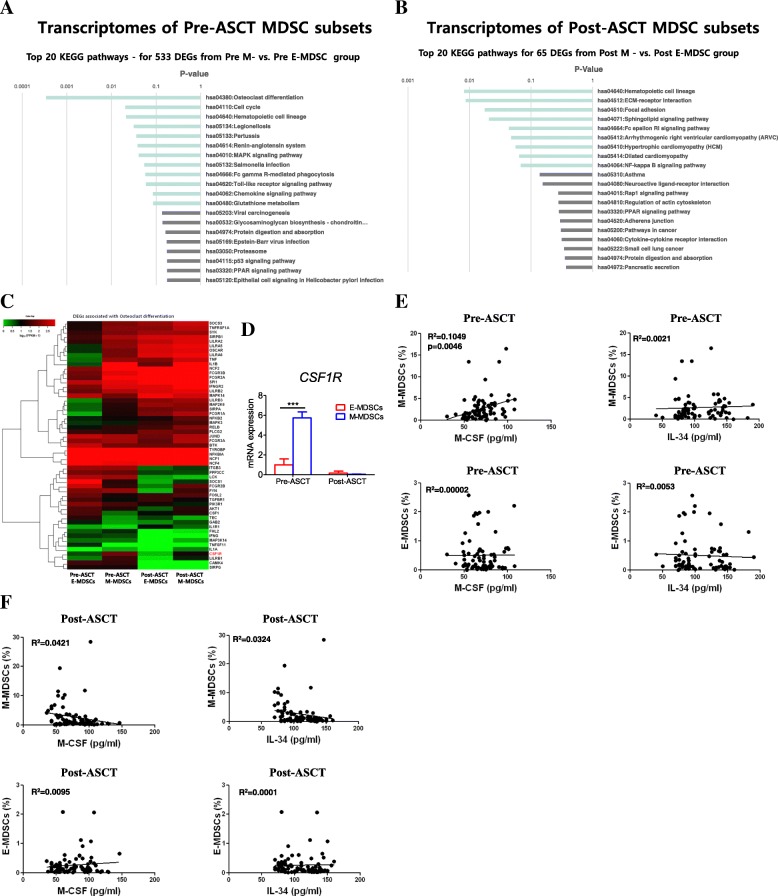
In the pre-ASCT analyses, lower M-MDSCs (<median) but not E-MDSCs were associated with a longer time to progression (TTP), whereas both MDSC phenotypes post-ASCT did not have a role in TTP. Both MDSC phenotypes pre-ASCT but not post-ASCT similarly suppressed in vitro autologous T and natural killer T cell proliferation. Importantly, pre-ASCT M-MDSCs more strongly inhibited the in vitro cytotoxic effect of melphalan compared with pre-ASCT E-MDSCs. Transcriptome analysis of each isolated MDSC subtype showed that expression of osteoclastic differentiation factors, particularly colony-stimulating factor 1 receptor (CSF1R), was significantly increased in M-MDSCs pre-ASCT. Finally, blockade of CSF1R substantially recovered the melphalan-induced cytotoxicity reduced by pre-ASCT M-MDSCs.
Our data demonstrate that pre-ASCT M-MDSCs are correlated with poor clinical outcomes after ASCT through reduced cytotoxicity of melphalan. We propose that targeting CSF1R on these cells may improve the results of ASCT in MM.
本研究旨在评估髓系来源抑制细胞(MDSCs)在自体造血干细胞移植(ASCT)背景下对多发性骨髓瘤(MM)的预后影响。
在 ASCT 前后采集外周血样,用于测量单核细胞(M-)MDSCs(CD14HLA-DR)和早期(E-)MDSCs(LinHLA-DRCD33CD11b)。ASCT 后根据每种 MDSC 表型的频率不同,临床结局也不同。
在 ASCT 前分析中,较低的 M-MDSCs(<中位数)但不是 E-MDSCs 与进展时间(TTP)较长相关,而 ASCT 后两种 MDSC 表型在 TTP 中均无作用。ASCT 前但不是 ASCT 后两种 MDSC 表型同样抑制了自体 T 和自然杀伤 T 细胞的体外增殖。重要的是,与 ASCT 前的 E-MDSCs 相比,ASCT 前的 M-MDSCs 更强地抑制了体外马法兰的细胞毒性。对每种分离的 MDSC 亚型进行转录组分析表明,破骨细胞分化因子,特别是集落刺激因子 1 受体(CSF1R)的表达在 ASCT 前的 M-MDSCs 中显著增加。最后,CSF1R 的阻断可显著恢复 ASCT 前 M-MDSCs 降低的马法兰诱导的细胞毒性。
我们的数据表明,ASCT 前的 M-MDSCs 通过降低马法兰的细胞毒性与 ASCT 后不良的临床结局相关。我们提出,针对这些细胞上的 CSF1R 可能会改善 MM 患者 ASCT 的结果。