Gu Xi, Chai Renjie, Guo Luo, Dong Biao, Li Wenyan, Shu Yilai, Huang Xinsheng, Li Huawei
Department of Otorhinolaryngology-Head and Neck Surgery, Zhongshan Hospital, Fudan University, Shanghai, China.
Department of Otolaryngology-Head and Neck Surgery, The First Affiliated Hospital of Fujian Medical University, Fuzhou, China.
Front Cell Neurosci. 2019 Jan 24;13:8. doi: 10.3389/fncel.2019.00008. eCollection 2019.
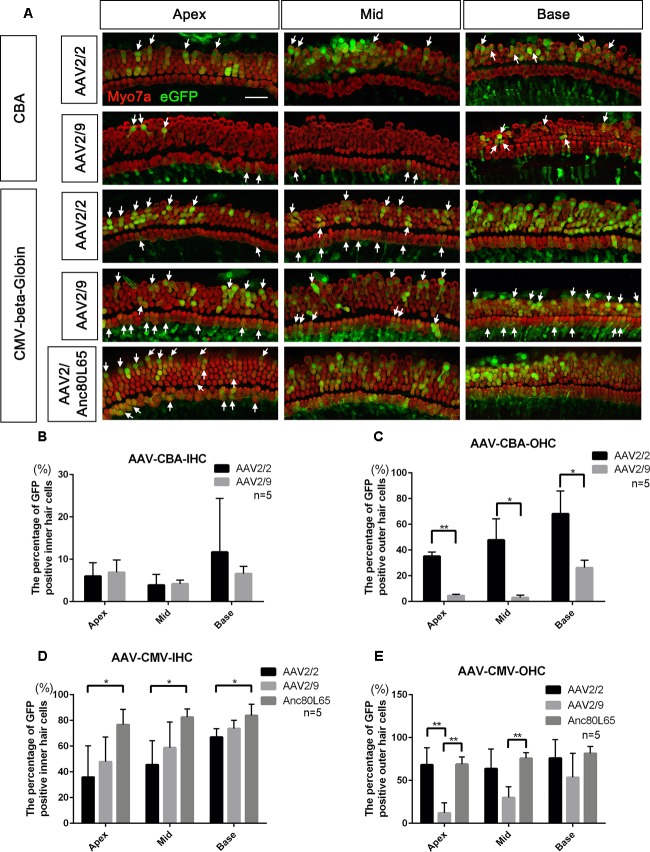
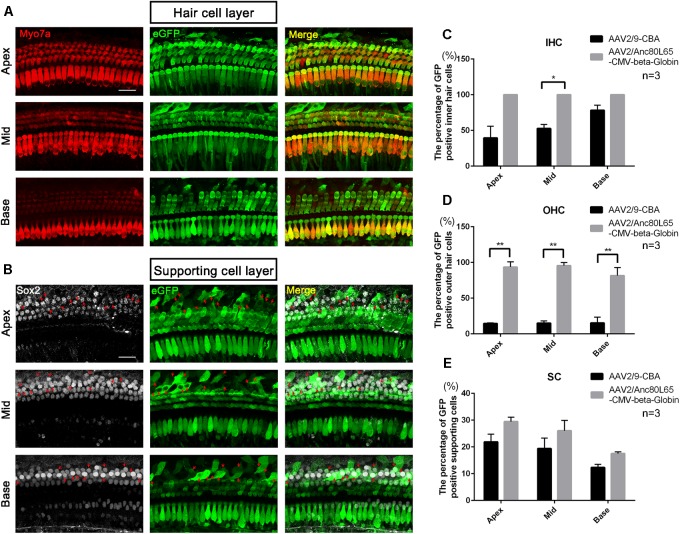
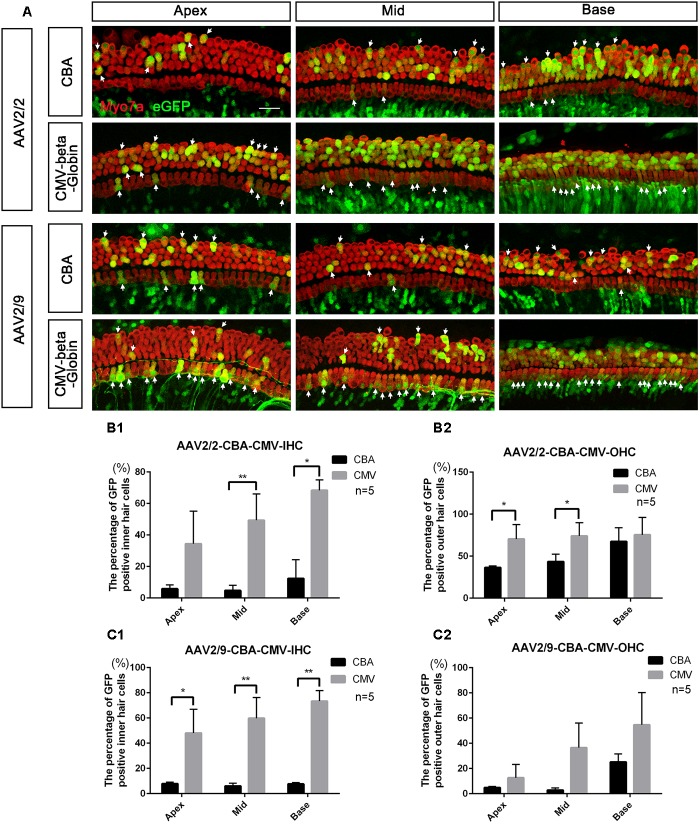
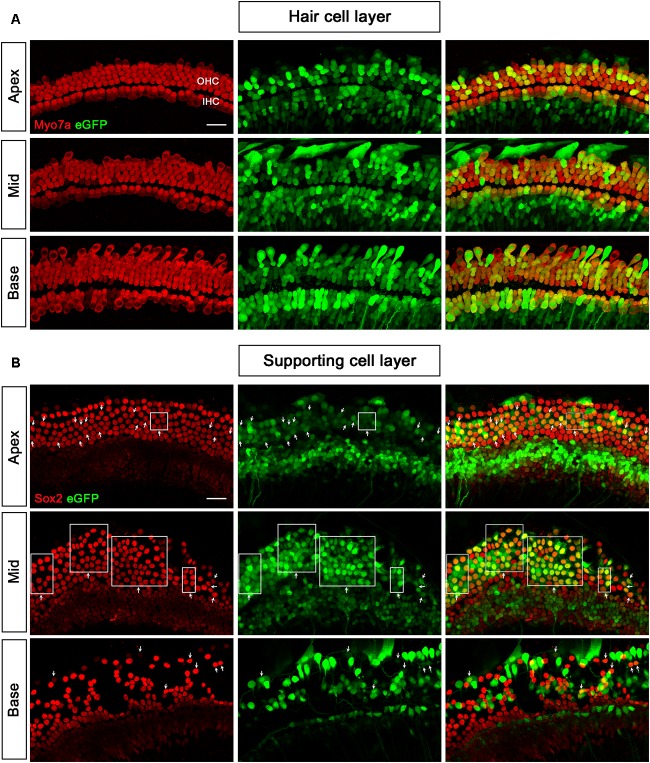
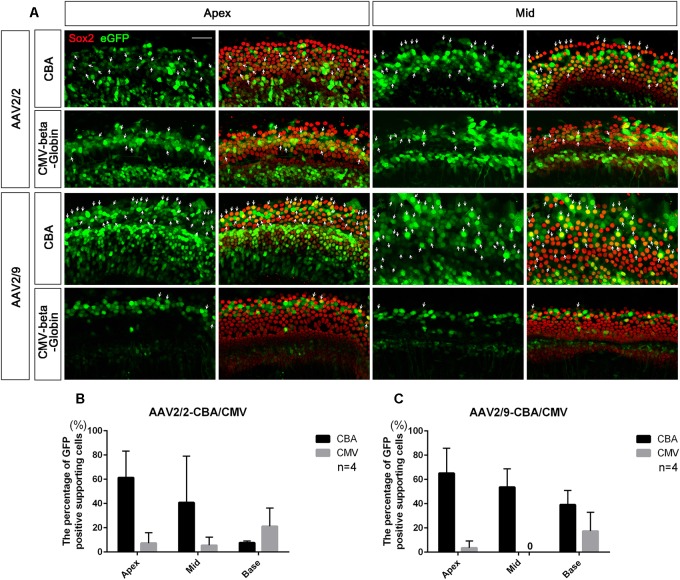
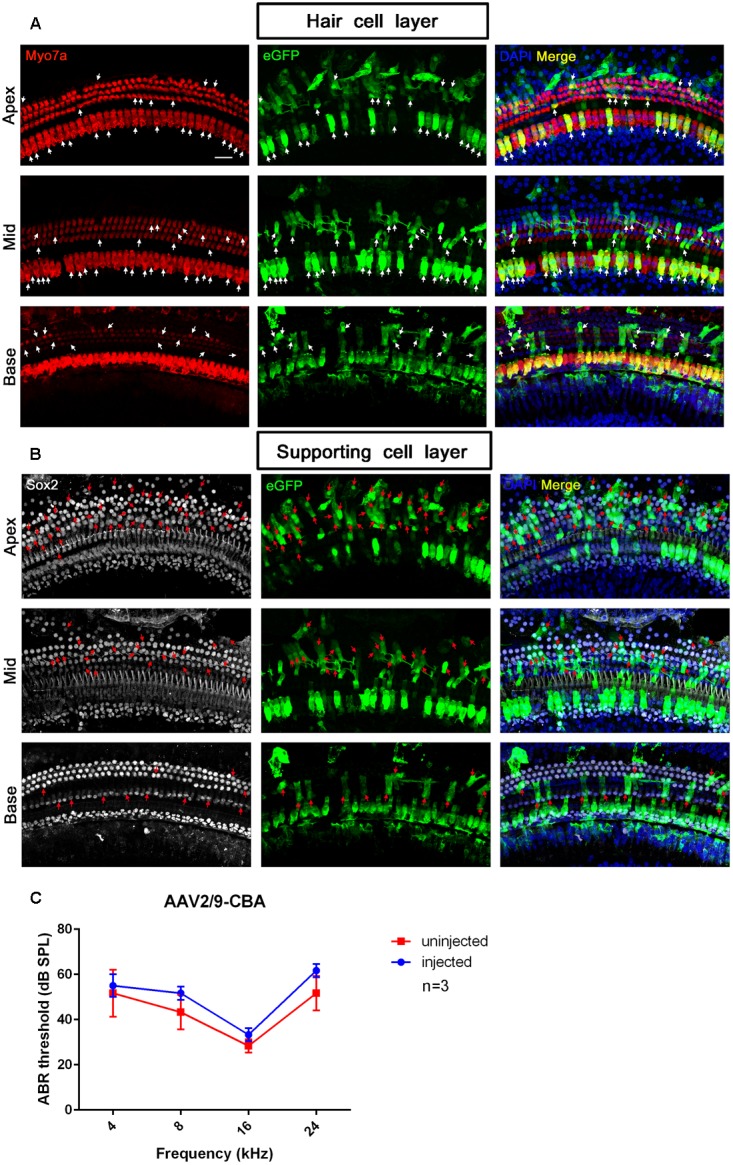
Adeno-associated virus (AAV) is the preferred vector for gene therapy of hereditary deafness, and different viral serotypes, promoters and transduction pathways can influence the targeting of AAV to different types of cells and the expression levels of numerous exogenous genes. To determine the transduction and expression patterns of AAV with different serotypes or promoters in hair cells and supporting cells in the neonatal mouse cochlea, we examined the expression of enhanced green fluorescent protein (eGFP) for five different types of AAV vectors [serotypes 2, 9, and Anc80L65 with promoter cytomegalovirus (CMV)-beta-Globin and serotypes 2 and 9 with promoter chicken beta-actin (CBA)] in cochlear explant cultures and we tested the transduction of AAV2/2-CBA, AAV2/9-CBA, and AAV2/Anc80L65-CMV by microinjection into the scala media of the cochlea. We found that each AAV vector had its own transduction and expression characteristics in hair cells and supporting cells in different regions of the cochlea. There was a tonotopic gradient for the transduction of AAV2/2-CBA, AAV2/9-CBA, AAV2/2-CMV, and AAV2/9-CMV in outer hair cells (OHCs), with more OHCs expressing eGFP at the base of the cochlea than at the apex. AAV2/2-CBA and AAV2/Anc80L65-CMV induced more supporting cells expressing eGFP at the apex than in the base. We found that AAV vectors with different promoters had different expression efficacies in hair cells and supporting cells of the auditory epithelium. The CMV-beta-Globin promoter could drive the expression of the delivered construct more efficiently in hair cells, while the CBA promoter was more efficient in supporting cells. The and experiments both demonstrated that AAV2/Anc80L65-CMV was a very promising vector for gene therapy of deafness because of its high transduction rates in hair cells. These results might be useful for selecting the appropriate vectors for gene delivery into different types of inner ear cells and thus improving the effectiveness of gene therapy.
腺相关病毒(AAV)是遗传性耳聋基因治疗的首选载体,不同的病毒血清型、启动子和转导途径会影响AAV对不同类型细胞的靶向性以及众多外源基因的表达水平。为了确定不同血清型或启动子的AAV在新生小鼠耳蜗毛细胞和支持细胞中的转导和表达模式,我们检测了五种不同类型AAV载体[血清型2、9和Anc80L65,启动子为巨细胞病毒(CMV)-β-珠蛋白,以及血清型2和9,启动子为鸡β-肌动蛋白(CBA)]在耳蜗外植体培养物中增强绿色荧光蛋白(eGFP)的表达,并通过向耳蜗中阶显微注射来测试AAV2/2-CBA、AAV2/9-CBA和AAV2/Anc80L65-CMV的转导情况。我们发现每种AAV载体在耳蜗不同区域的毛细胞和支持细胞中都有其自身的转导和表达特征。在外侧毛细胞(OHC)中,AAV2/2-CBA、AAV2/9-CBA、AAV2/2-CMV和AAV2/9-CMV的转导存在音调梯度,耳蜗底部表达eGFP的OHC比顶部更多。AAV2/2-CBA和AAV2/Anc80L65-CMV诱导顶部表达eGFP的支持细胞比底部更多。我们发现具有不同启动子的AAV载体在听觉上皮的毛细胞和支持细胞中有不同的表达效率。CMV-β-珠蛋白启动子能在毛细胞中更有效地驱动导入构建体的表达,而CBA启动子在支持细胞中更有效。 和 实验均表明,由于AAV2/Anc80L65-CMV在毛细胞中的高转导率,它是一种非常有前景的耳聋基因治疗载体。这些结果可能有助于选择合适的载体将基因导入不同类型的内耳细胞,从而提高基因治疗的有效性。