Irving Institute for Clinical and Translational Research Columbia University, Columbia University Vagelos College of Physicians and Surgeons, Columbia University, 622 West 168 Street, PH-10, New York, NY, 10032, USA.
Public Health Solutions, National Institute for Health and Welfare, Helsinki, Finland.
Cardiovasc Drugs Ther. 2019 Feb;33(1):69-76. doi: 10.1007/s10557-019-06852-6.
This post-hoc analysis examined whether age modified the efficacy and safety of alirocumab, a PCSK9 inhibitor, in patients with heterozygous familial hypercholesterolemia (HeFH), using pooled data from four 78-week placebo-controlled phase 3 trials (ODYSSEY FH I, FH II, LONG TERM, and HIGH FH).
Data from 1257 patients with HeFH on maximally tolerated statin ± other lipid-lowering therapies were analyzed by an alirocumab dose regimen and by age subgroups (18 to < 45, 45 to < 55, 55 to < 65, and ≥ 65 years). In the FH I and II trials, patients received 75 mg subcutaneously every 2 weeks (Q2W), with dose increase to 150 mg Q2W at week 12 if week 8 low-density lipoprotein cholesterol (LDL-C) was ≥ 70 mg/dl. In HIGH FH and LONG TERM, patients received 150 mg alirocumab Q2W.
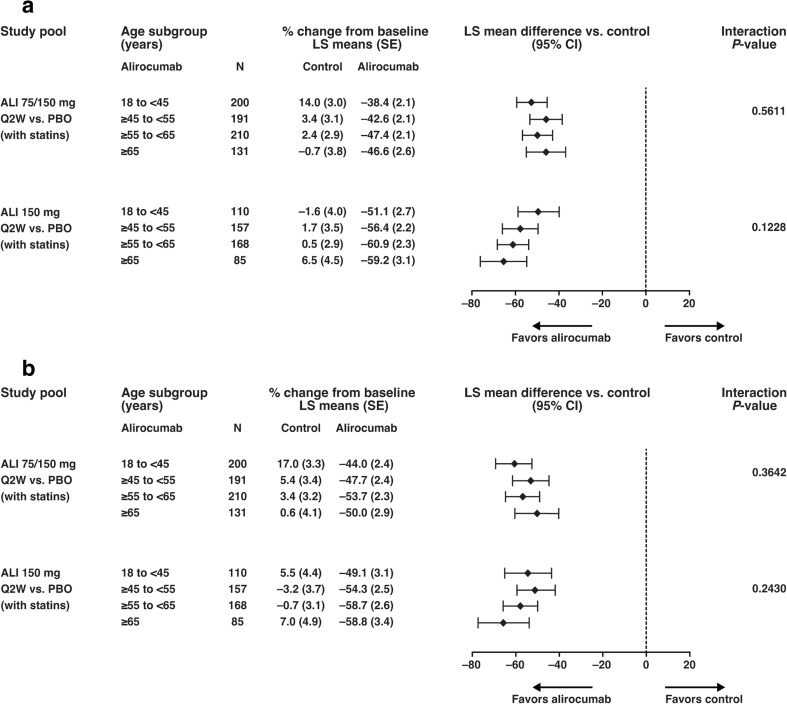
Baseline characteristics were similar between treatment groups across all age groups; the proportion of males decreased whereas the proportion of patients with coronary heart disease, diabetes, hypertension, and declining renal function increased with increasing age. Mean LDL-C reductions at week 24 were consistent across age groups (50.6-61.0% and 51.1-65.8% vs. placebo for the 75/150 and 150 mg alirocumab dose regimens, respectively; both non-significant interaction P-values). Treatment-emergent adverse events occurred in similar frequency in alirocumab- and placebo-treated patients regardless of age, except for injection-site reactions, which were more common in alirocumab than placebo but declined in frequency with age.
Alirocumab treatment resulted in significant LDL-C reductions at weeks 12 and 24 and was generally well tolerated in patients with HeFH across all age groups studied.
本事后分析使用四项 78 周安慰剂对照 3 期试验(ODYSSEY FH I、FH II、LONG TERM 和 HIGH FH)的汇总数据,评估年龄是否改变了 PCSK9 抑制剂阿利西尤单抗在杂合子家族性高胆固醇血症(HeFH)患者中的疗效和安全性。
对最大耐受他汀类药物±其他降脂治疗的 1257 例 HeFH 患者的数据,按阿利西尤单抗剂量方案和年龄亚组(18 岁至<45 岁、45 岁至<55 岁、55 岁至<65 岁和≥65 岁)进行分析。在 FH I 和 II 试验中,患者每 2 周接受皮下注射 75mg(Q2W),如果第 8 周时低密度脂蛋白胆固醇(LDL-C)≥70mg/dl,则在第 12 周增加剂量至 150mg Q2W。在 HIGH FH 和 LONG TERM 中,患者接受 150mg 阿利西尤单抗 Q2W。
各年龄组之间,治疗组的基线特征相似;男性比例下降,而患有冠心病、糖尿病、高血压和肾功能下降的患者比例随年龄增加而增加。第 24 周时 LDL-C 降低的平均幅度在各年龄组之间一致(75/150 和 150mg 阿利西尤单抗剂量方案分别为 50.6%-61.0%和 51.1%-65.8%,与安慰剂相比,均无显著交互 P 值)。阿利西尤单抗治疗组和安慰剂治疗组的治疗期间出现的不良反应发生率相似,除注射部位反应外,阿利西尤单抗治疗组比安慰剂组更常见,但随年龄增加而频率降低。
在所有研究的年龄组中,阿利西尤单抗治疗均导致 LDL-C 在第 12 周和第 24 周显著降低,且总体耐受性良好。