Laboratory of Biochemical Neuroendocrinology, Montreal Clinical Research Institute (IRCM, affiliated to the University of Montreal), Montreal, QC, Canada.
Endocr Rev. 2022 May 12;43(3):558-582. doi: 10.1210/endrev/bnab035.
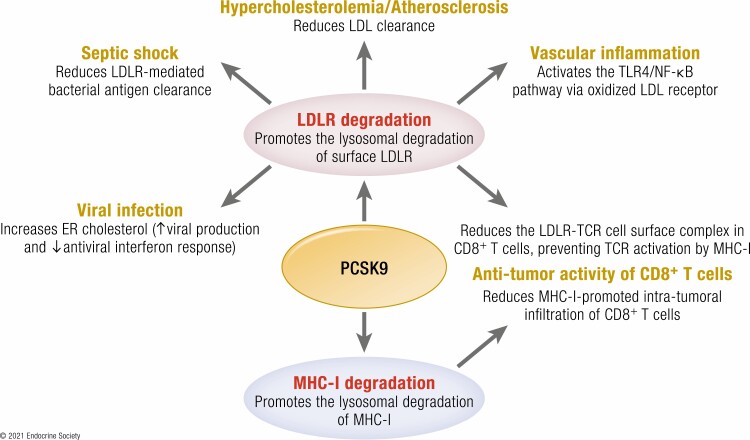
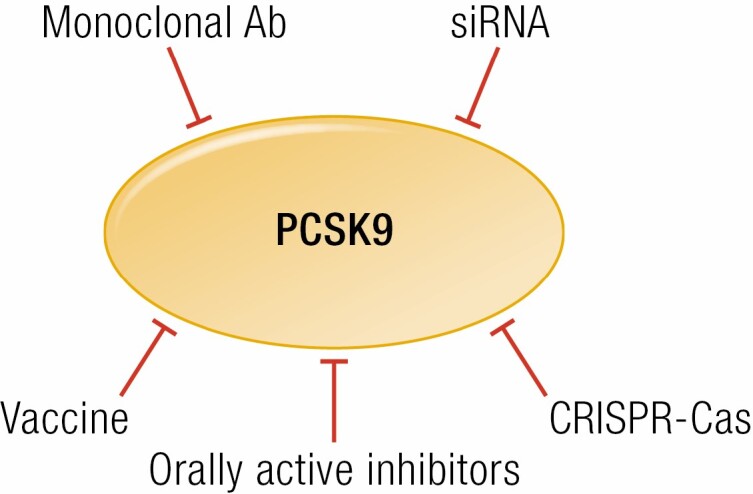
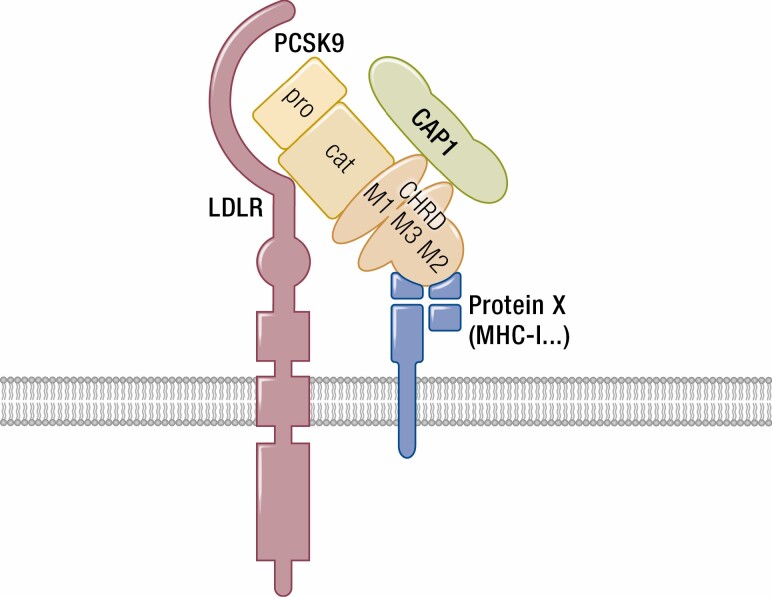
This article reviews the discovery of PCSK9, its structure-function characteristics, and its presently known and proposed novel biological functions. The major critical function of PCSK9 deduced from human and mouse studies, as well as cellular and structural analyses, is its role in increasing the levels of circulating low-density lipoprotein (LDL)-cholesterol (LDLc), via its ability to enhance the sorting and escort of the cell surface LDL receptor (LDLR) to lysosomes. This implicates the binding of the catalytic domain of PCSK9 to the EGF-A domain of the LDLR. This also requires the presence of the C-terminal Cys/His-rich domain, its binding to the secreted cytosolic cyclase associated protein 1, and possibly another membrane-bound "protein X". Curiously, in PCSK9-deficient mice, an alternative to the downregulation of the surface levels of the LDLR by PCSK9 is taking place in the liver of female mice in a 17β-estradiol-dependent manner by still an unknown mechanism. Recent studies have extended our understanding of the biological functions of PCSK9, namely its implication in septic shock, vascular inflammation, viral infections (Dengue; SARS-CoV-2) or immune checkpoint modulation in cancer via the regulation of the cell surface levels of the T-cell receptor and MHC-I, which govern the antitumoral activity of CD8+ T cells. Because PCSK9 inhibition may be advantageous in these processes, the availability of injectable safe PCSK9 inhibitors that reduces by 50% to 60% LDLc above the effect of statins is highly valuable. Indeed, injectable PCSK9 monoclonal antibody or small interfering RNA could be added to current immunotherapies in cancer/metastasis.
本文回顾了 PCSK9 的发现、其结构-功能特性以及目前已知和提出的新的生物学功能。从人类和小鼠研究、细胞和结构分析中推断出 PCSK9 的主要关键功能是通过增强细胞表面 LDL 受体(LDLR)的分拣和护送作用来增加循环低密度脂蛋白(LDL)-胆固醇(LDLc)的水平。这暗示了 PCSK9 的催化结构域与 LDLR 的 EGF-A 结构域结合。这还需要存在富含半胱氨酸/组氨酸的 C 端结构域,其与分泌胞质环化酶相关蛋白 1 结合,并且可能还与另一个膜结合的“蛋白 X”结合。奇怪的是,在缺乏 PCSK9 的小鼠中,一种替代 PCSK9 下调 LDLR 表面水平的方式是通过仍未知的机制,以雌激素依赖性方式在雌性小鼠的肝脏中发生。最近的研究扩展了我们对 PCSK9 生物学功能的理解,即它在败血症休克、血管炎症、病毒感染(登革热;SARS-CoV-2)或通过调节 T 细胞受体和 MHC-I 的细胞表面水平来调节免疫检查点在癌症中的作用。由于 PCSK9 抑制可能在这些过程中有益,因此提供安全的可注射 PCSK9 抑制剂非常有价值,这种抑制剂可使 LDLc 降低 50%至 60%,超过他汀类药物的作用。实际上,可注射的 PCSK9 单克隆抗体或小干扰 RNA 可以添加到癌症/转移的当前免疫疗法中。