South China Sea Environmental Monitoring Center, State Oceanic Administration, Guangzhou, P.R. China.
Food and Drug Administration, Linqing, Shandong Province, P.R. China.
Microbiologyopen. 2019 Aug;8(8):e00803. doi: 10.1002/mbo3.803. Epub 2019 Feb 7.
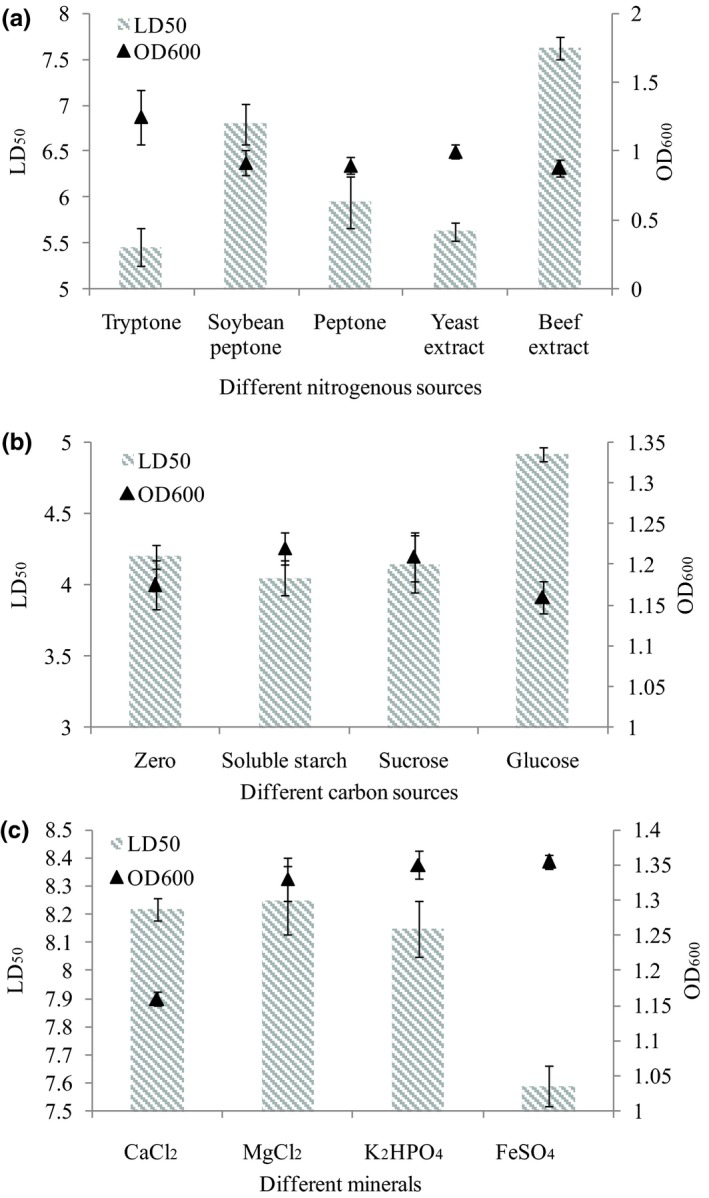
Bacteria play an important role in preventing algal blooms and reducing their harm to the environment. To improve the algicidal activity of Pseudoalteromonas SP48 which had an inhibition effect on dinoflagellate Alexandrium tamarense, its growth medium and fermentation conditions were optimized for this bacterium. In this study, we used two steps to establish the optimum conditions. First, the proper proportion of medium was selected based on an orthogonal design. Then, the fermentation conditions were further optimized through uniform design in an enlarged 5L bioreactor. To test the algicidal ability of Pseudoalteromonas SP48 under the optimum conditions, algal cell morphology was observed by transmission electron microscopy (TEM). After the orthogonal design, we found that the optimum medium was [0.7% (m/v) tryptone, 0.2% (m/v) soluble starch, 0.2% (m/v) sucrose, 0.1% (m/v) FeSO , and 1.2% (m/v) K HPO ] for Pseudoalteromonas SP48 growth. Based on these results, optimum fermentation conditions were further explored in a 5L fermentation cylinder using a uniform design; the influence of variables such as incubation time, carbon type, and rotation speed were tested. The optimal fermentation conditions were fermentation time (42 hr), tryptone (1.1%), seeding volume (1.4 × 10 cells), and rotation speed (250 r/min). Under these established optimum conditions, the biomass of strain SP48 increased by 79.2% and its lethal dose 50% (LD ) decreased by 54.0%, respectively. The TEM results showed that compared with the control group, the cell wall and cell membrane of A. tamarense were significantly damaged, and the structure and shape of the organelles were destroyed by algicidal bacteria of Pseudoalteromonas SP48. Overall, our results demonstrate that the optimized culture conditions could significantly enhance the algicidal activity of Pseudoalteromonas SP48 against a harmful dinoflagellate, such as A. tamarense. It will effectively provide a scientific foundation for both production of algicidal substances and HABs control.
细菌在防止藻类大量繁殖和减少其对环境的危害方面发挥着重要作用。为了提高对甲藻有抑制作用的假交替单胞菌 SP48 的杀藻活性,优化了该菌的生长培养基和发酵条件。本研究采用两步法建立最佳条件。首先,根据正交设计选择合适的培养基比例。然后,通过在扩大的 5L 生物反应器中进行均匀设计进一步优化发酵条件。为了测试假交替单胞菌 SP48 在最佳条件下的杀藻能力,通过透射电子显微镜(TEM)观察藻细胞形态。经过正交设计,我们发现假交替单胞菌 SP48 的最佳培养基为[0.7%(m/v)胰蛋白胨、0.2%(m/v)可溶性淀粉、0.2%(m/v)蔗糖、0.1%(m/v)FeSO 、1.2%(m/v)KH PO ]。基于这些结果,在 5L 发酵罐中使用均匀设计进一步探索最佳发酵条件;测试了培养时间、碳源和转速等变量的影响。最佳发酵条件为发酵时间(42 小时)、胰蛋白胨(1.1%)、接种量(1.4×10 细胞)和转速(250r/min)。在这些建立的最佳条件下,菌株 SP48 的生物量增加了 79.2%,其半数致死剂量(LD )降低了 54.0%。TEM 结果表明,与对照组相比,假交替单胞菌 SP48 的细胞壁和细胞膜受到明显损伤,细胞器的结构和形状被破坏。总的来说,我们的结果表明,优化的培养条件可以显著提高假交替单胞菌 SP48 对有害甲藻(如塔玛亚历山大藻)的杀藻活性。这将为杀藻物质的生产和赤潮的防治提供科学依据。