Departamento de Radioterapia, Hospital Sirio-Libanês, São Paulo, SP, Brasil.
Serviço de Radioterapia - Departamento de Oncologia da Universidade de São Paulo, Instituto do Câncer do Estado de São Paulo (ICESP), São Paulo, SP, Brasil.
Int Braz J Urol. 2019 Mar-Apr;45(2):288-298. doi: 10.1590/S1677-5538.IBJU.2018.0142.
Brachytherapy (BT) with iodine-125 seeds placement is a consolidated treatment for prostate cancer. The objective of this study was to assess the clinical outcomes in patients with prostate cancer who underwent low-dose-rate (LDR) -BT alone in a single Brazilian institution.
Patients treated with iodine-125 BT were retrospectively assessed after at least 5 years of follow-up. Patients who received combination therapy (External beam radiation therapy-EBRT and BT) and salvage BT were not included.
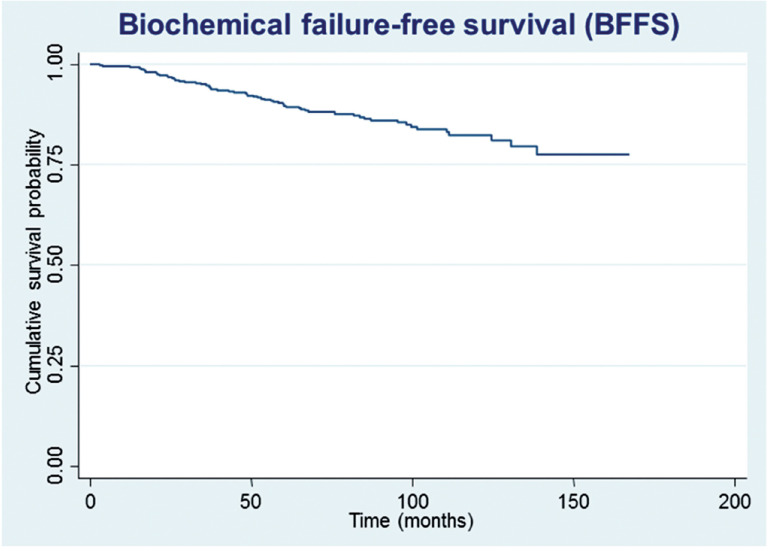
406 men were included in the study (65.5% low-risk, 30% intermediate-risk, and 4.5% high-risk patients). After a median follow-up of 87.5 months, 61 (15.0%) patients developed biochemical recurrence. The actuarial biochemical failure-free survival (BFFS) at 5 and 10 years were 90.6% and 82.2%, respectively. A PSA nadir ≥ 1 ng / mL was associated with a higher risk of biochemical failure (HR = 5.81; 95% CI: 3.39 to 9.94; p ≤ 0.001). The actuarial metastasis-free survival (MFS) at 5 and 10 years were 98.3% and 94%, respectively. The actuarial overall survival (OS) at 5 and 10 years were 96.2% and 85.1%, respectively. Acute and late grade 2 and 3 gastrointestinal toxicities were observed in 5.6%, 0.5%, 4.6% and 0.5% of cases, respectively. For genitourinary the observed acute and late grade 2 and 3 toxicities rates were 57.3%, 3.6%, 28% and 3.1%, respectively. No grade 4 and 5 were observed.
BT was effective as a definitive treatment modality for prostate cancer, and its endpoints and toxicities were comparable to those of the main series in the literature.
碘-125 种子近距离放射治疗(BT)是前列腺癌的一种综合治疗方法。本研究的目的是评估在巴西的一家单机构中仅接受低剂量率(LDR)-BT 治疗的前列腺癌患者的临床结局。
对至少随访 5 年的接受碘-125 BT 治疗的患者进行回顾性评估。未包括接受联合治疗(外照射放射治疗[EBRT]和 BT)和挽救性 BT 的患者。
本研究共纳入 406 例男性患者(低危患者占 65.5%,中危患者占 30%,高危患者占 4.5%)。中位随访 87.5 个月后,有 61 例(15.0%)患者发生生化复发。5 年和 10 年时的生化无失败生存(BFFS)分别为 90.6%和 82.2%。前列腺特异性抗原(PSA)最低值≥1ng/ml 与生化失败风险增加相关(HR=5.81;95%CI:3.39-9.94;p≤0.001)。5 年和 10 年时的无转移生存(MFS)分别为 98.3%和 94%。5 年和 10 年时的总生存(OS)分别为 96.2%和 85.1%。分别有 5.6%、0.5%、4.6%和 0.5%的患者发生急性和晚期 2 级和 3 级胃肠道毒性,分别有 57.3%、3.6%、28%和 3.1%的患者发生急性和晚期 2 级和 3 级泌尿生殖系统毒性,无 4 级和 5 级毒性。
BT 作为前列腺癌的一种确定性治疗方法是有效的,其终点和毒性与文献中的主要系列相当。