Histocompatibility, Immunogenetics & Disease Profiling Laboratory, Stanford Blood Center, Palo Alto, CA, USA.
Center for Genetics, Children's Hospital Oakland Research Institute, Oakland, CA, USA.
Hum Immunol. 2019 Sep;80(9):633-643. doi: 10.1016/j.humimm.2019.01.010. Epub 2019 Feb 5.
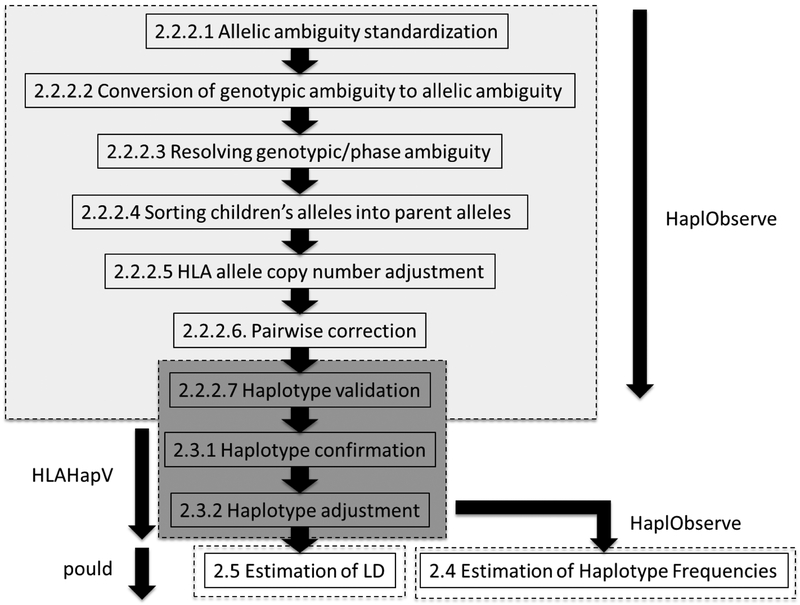
The highly polymorphic classical human leukocyte antigen (HLA) genes display strong linkage disequilibrium (LD) that results in conserved multi-locus haplotypes. For unrelated individuals in defined populations, HLA haplotype frequencies can be estimated using the expectation-maximization (EM) method. Haplotypes can also be constructed using HLA allele segregation from nuclear families. It is straightforward to identify many HLA genotyping inconsistencies by visually reviewing HLA allele segregation in family members. It is also possible to identify potential crossover events when two or more children are available in a nuclear family. This process of visual inspection can be unwieldy, and we developed the "HaplObserve" program to standardize the process and automatically build haplotypes using family-based HLA allele segregation. HaplObserve facilitates systematically building haplotypes, and reporting potential crossover events. HLA Haplotype Validator (HLAHapV) is a program originally developed to impute chromosomal phase from genotype data using reference haplotype data. We updated and adapted HLAHapV to systematically compare observed and estimated haplotypes. We also used HLAHapV to identify haplotypes when uninformative HLA genotypes are present in families. Finally, we developed "pould", an R package that calculates haplotype frequencies, and estimates standard measures of global (locus-level) LD from both observed and estimated haplotypes.
高度多态性的经典人类白细胞抗原 (HLA) 基因显示出强烈的连锁不平衡 (LD),导致保守的多基因座单体型。对于定义人群中的无关个体,可以使用期望最大化 (EM) 方法估计 HLA 单倍型频率。也可以使用核家庭中的 HLA 等位基因分离来构建单体型。通过直观地检查家庭成员中的 HLA 等位基因分离,可以很容易地识别出许多 HLA 基因分型不一致的情况。当核家庭中有两个或更多孩子时,也有可能识别潜在的交叉事件。这种视觉检查过程可能很繁琐,因此我们开发了“HaplObserve”程序来标准化该过程,并使用基于家庭的 HLA 等位基因分离自动构建单体型。HaplObserve 有助于系统地构建单体型,并报告潜在的交叉事件。HLA 单体型验证器 (HLAHapV) 是一个最初用于使用参考单体型数据从基因型数据推断染色体相位的程序。我们更新并改编了 HLAHapV,以系统地比较观察到的和估计的单体型。我们还使用 HLAHapV 在家族中存在无信息 HLA 基因型时识别单体型。最后,我们开发了“pould”,这是一个 R 包,用于计算单体型频率,并从观察到的和估计的单体型中估计全局 (基因座水平) LD 的标准度量。