Swansea University Medical School, ILS1 Building, Swansea University, Singleton Park, Swansea SA2 8PP, Wales, UK.
Molecules. 2019 Feb 7;24(3):597. doi: 10.3390/molecules24030597.
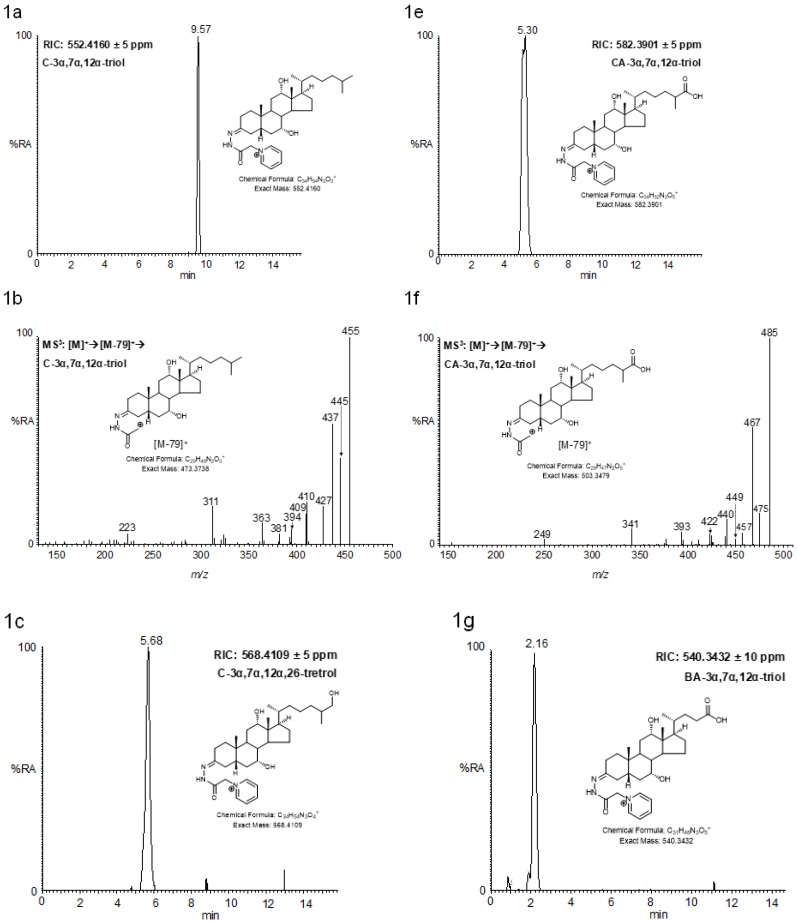
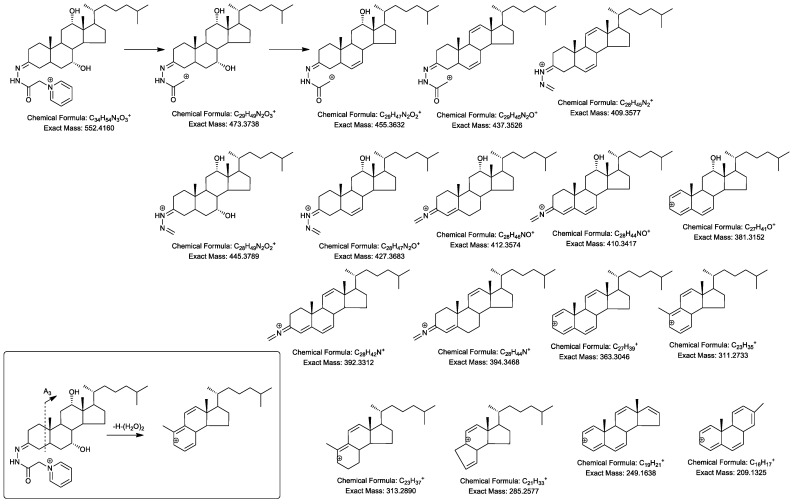
Enzyme-assisted derivatization for sterol analysis (EADSA) is a technology designed to enhance sensitivity and specificity for sterol analysis using electrospray ionization⁻mass spectrometry. To date it has only been exploited on sterols with a 3β-hydroxy-5-ene or 3β-hydroxy-5α-hydrogen structure, using bacterial cholesterol oxidase enzyme to convert the 3β-hydroxy group to a 3-oxo group for subsequent derivatization with the positively charged Girard hydrazine reagents, or on substrates with a native oxo group. Here we describe an extension of the technology by substituting 3α-hydroxysteroid dehydrogenase (3α-HSD) for cholesterol oxidase, making the method applicable to sterols with a 3α-hydroxy-5β-hydrogen structure. The 3α-HSD enzyme works efficiently on bile alcohols and bile acids with this stereochemistry. However, as found by others, derivatization of the resultant 3-oxo group with a hydrazine reagent does not go to completion in the absence of a conjugating double bond in the sterol structure. Nevertheless, Girard P derivatives of bile alcohols and C acids give an intense molecular ion ([M]⁺) upon electrospray ionization and informative fragmentation spectra. The method shows promise for analysis of bile alcohols and 3α-hydroxy-5β-C-acids, enhancing the range of sterols that can be analyzed at high sensitivity in sterolomic studies.
酶辅助衍生化分析甾醇(EADSA)是一种旨在提高电喷雾电离-质谱法分析甾醇的灵敏度和特异性的技术。迄今为止,它仅被用于具有 3β-羟基-5-烯或 3β-羟基-5α-氢结构的甾醇,使用细菌胆固醇氧化酶将 3β-羟基转化为 3-酮基,以便随后用带正电荷的吉拉德肼试剂进行衍生化,或者用于具有天然氧代基团的底物。在这里,我们通过用 3α-羟甾醇脱氢酶(3α-HSD)替代胆固醇氧化酶来扩展该技术,使该方法适用于具有 3α-羟基-5β-氢结构的甾醇。3α-HSD 酶在具有这种立体化学的胆汁醇和胆汁酸上有效工作。然而,正如其他人所发现的,在甾醇结构中没有共轭双键的情况下,用肼试剂衍生化所得的 3-酮基不会完全进行。尽管如此,吉拉德 P 衍生物的胆汁醇和 C 酸在电喷雾电离时会给出强烈的分子离子([M]+),并给出信息丰富的碎片光谱。该方法有望用于胆汁醇和 3α-羟基-5β-C-酸的分析,增强了在甾醇组学研究中以高灵敏度分析甾醇的范围。