Division of General Internal Medicine, Massachusetts General Hospital, Boston, MA, USA; Medical Practice Evaluation Center, Department of Medicine, Massachusetts General Hospital, Boston, MA, USA.
Elizabeth Glaser Pediatric AIDS Foundation, Geneva, Switzerland; Division of Infectious Disease, University of Pennsylvania, Philadelphia, PA, USA.
Lancet HIV. 2019 Mar;6(3):e182-e190. doi: 10.1016/S2352-3018(18)30328-X. Epub 2019 Feb 5.
New point-of-care (POC) assays for early infant HIV diagnosis are costlier than conventional total nucleic acid assays, but could increase access to testing, shorten time to results, and expedite initiation of antiretroviral therapy. We aimed to assess the clinical benefits and cost-effectiveness of incorporating these POC assays into early infant diagnosis programmes in Zimbabwe.
We used the Cost Effectiveness of Preventing AIDS Complications (CEPAC)-Pediatric model to examine the clinical benefits, costs, and cost-effectiveness of replacing conventional assays for early infant HIV diagnosis with POC assays at age 6 weeks in Zimbabwe. We simulated two strategies for early infant HIV diagnosis: conventional and POC. Modelled assays differed in sensitivity; specificity; time to, and probability of, return of results; and cost. Model outcomes included survival, life expectancy, and mean lifetime per-person treatment cost, which were reported separately for all HIV-exposed infants and all infants with HIV. We calculated incremental cost-effectiveness ratios with discounted (3% per year) costs and life expectancy from a health-care system perspective for all HIV-exposed infants. We judged incremental cost-effectiveness ratios of $1010 (Zimbabwe's annual gross domestic product per person) or less per year of life saved to be cost-effective.
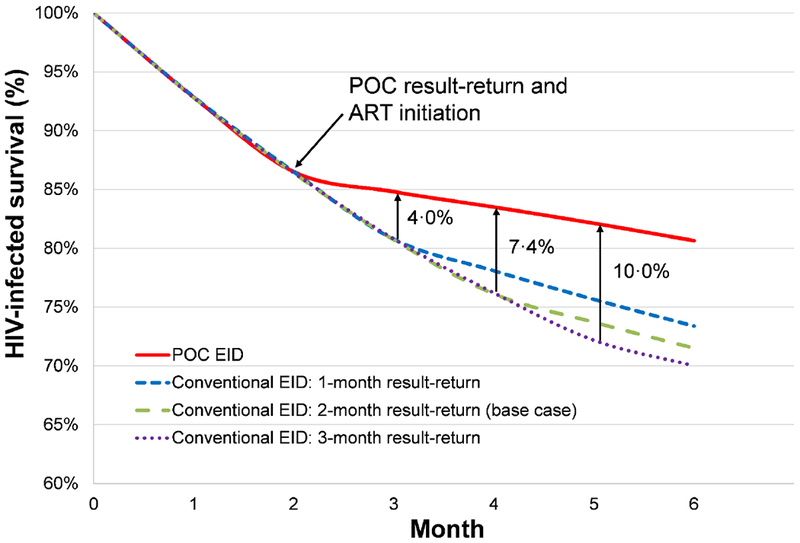
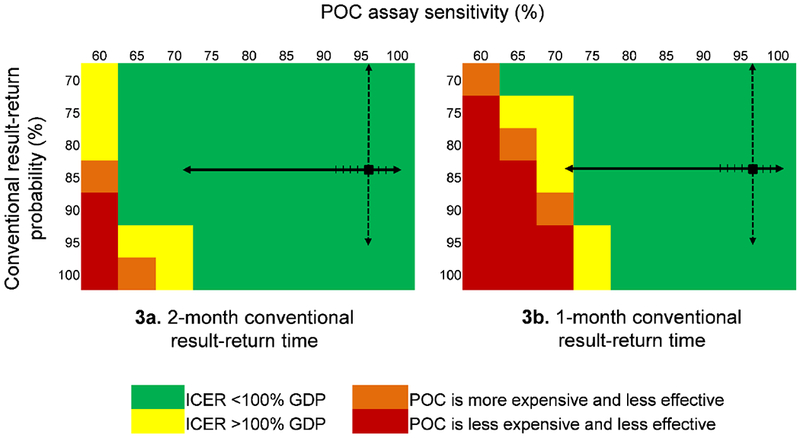
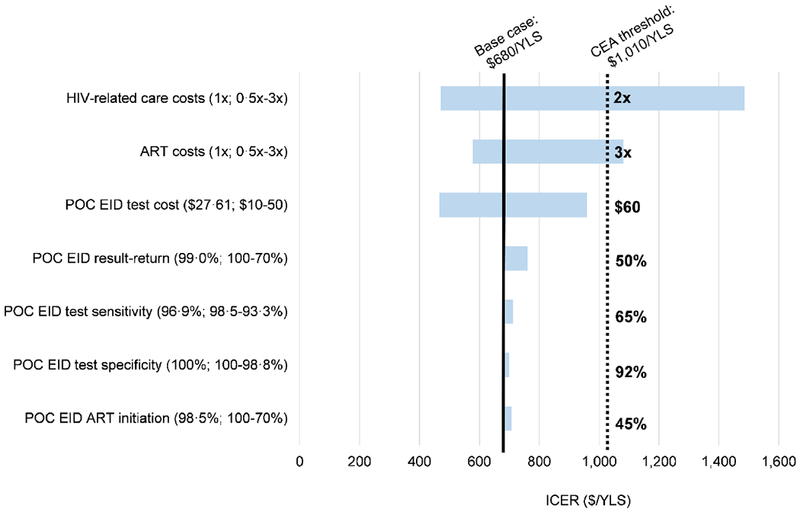
When conventional assays were used for early infant diagnosis, projected undiscounted life expectancy was 22·7 years for infants with HIV and 62·5 years for all HIV-exposed infants, at a cost of $610 per HIV-exposed infant. Use of POC assays for early infant HIV diagnosis improved projected undiscounted life expectancy to 25·5 years among infants with HIV and 62·6 years among HIV-exposed infants at a cost of $690 per HIV-exposed infant. At age 12 weeks, survival among all infants with HIV was 76·1% with the conventional testing strategy and 83·5% with the POC testing strategy. The incremental cost-effectiveness ratio of POC assays versus conventional assays for early infant diagnosis was $680 per year of life saved. When conventional assay characteristics remained constant, this ratio remained under the cost-effectiveness threshold as long as the specificity and sensitivity of the POC assay were greater than 92% and 65%, respectively. Our results were robust to plausible variations in POC assay cost, the probability of ART initiation, and probability of return of the results of POC testing.
Compared with conventional assays, POC assays for early infant HIV diagnosis in Zimbabwe will improve survival, extend life expectancy, and be cost-effective for HIV-exposed infants.
Elizabeth Glaser Pediatric AIDS Foundation, US National Institute of Allergy and Infectious Diseases, Eunice Kennedy Shriver National Institute of Child Health and Human Development, and Unitaid.
新的即时检测(POC)检测方法在婴儿早期艾滋病毒诊断方面比传统的总核酸检测方法更为昂贵,但可能会增加检测机会,缩短检测结果时间,并加速抗逆转录病毒治疗的启动。我们旨在评估在津巴布韦将这些 POC 检测方法纳入婴儿早期诊断计划的临床效益和成本效益。
我们使用预防艾滋病并发症的成本效益(CEPAC)-儿科模型,以评估在津巴布韦,6 周龄时用 POC 检测替代传统的婴儿早期 HIV 诊断检测方法的临床效益、成本和成本效益。我们模拟了两种婴儿早期 HIV 诊断策略:传统和 POC。模拟检测方法在敏感性、特异性、结果回报的时间和概率以及成本方面有所不同。模型结果包括生存、预期寿命和每个个体的平均终生治疗成本,分别为所有艾滋病毒暴露婴儿和所有感染 HIV 的婴儿报告。我们从卫生保健系统的角度计算了增量成本效益比,采用了(每年 3%)贴现成本和预期寿命。我们认为,每年每节省 1010 美元(津巴布韦人均国内生产总值)或更多的增量成本效益比是有成本效益的。
当使用传统检测方法进行婴儿早期诊断时,预计未贴现的预期寿命为感染 HIV 的婴儿为 22.7 年,所有 HIV 暴露婴儿为 62.5 年,每个 HIV 暴露婴儿的成本为 610 美元。使用 POC 检测方法进行婴儿早期 HIV 诊断可将感染 HIV 的婴儿的预期未贴现寿命提高至 25.5 年,将所有 HIV 暴露婴儿的预期寿命提高至 62.6 年,每个 HIV 暴露婴儿的成本为 690 美元。在 12 周龄时,所有感染 HIV 的婴儿的存活率分别为常规检测策略的 76.1%和 POC 检测策略的 83.5%。与传统检测相比,POC 检测方法的增量成本效益比为每年每节省 680 美元。只要 POC 检测的特异性和敏感性分别大于 92%和 65%,在传统检测特性保持不变的情况下,该比值仍低于成本效益阈值。我们的结果对 POC 检测成本、ART 启动概率和 POC 检测结果回报概率的合理变化具有稳健性。
与传统检测相比,津巴布韦的 POC 检测方法可提高婴儿早期 HIV 诊断的生存率,延长预期寿命,对 HIV 暴露婴儿具有成本效益。
伊丽莎白·格拉泽儿科艾滋病基金会、美国国家过敏和传染病研究所、美国国立儿童健康与人类发展研究所和联合国艾滋病规划署。