Ciaranello Andrea L, Myer Landon, Kelly Kathleen, Christensen Sarah, Daskilewicz Kristen, Doherty Katie, Bekker Linda-Gail, Hou Taige, Wood Robin, Francke Jordan A, Wools-Kaloustian Kara, Freedberg Kenneth A, Walensky Rochelle P
Division of Infectious Diseases, Department of Medicine, Massachusetts General Hospital, Boston, Massachusetts, United States of America; Medical Practice Evaluation Center, Department of Medicine, Massachusetts General Hospital, Boston, Massachusetts, United States of America.
School of Public Health and Family Medicine, Division of Epidemiology and Biostatistics, University of Cape Town, Cape Town, South Africa.
PLoS One. 2015 Mar 10;10(3):e0117751. doi: 10.1371/journal.pone.0117751. eCollection 2015.
Many prevention of mother-to-child HIV transmission (PMTCT) programs currently prioritize antiretroviral therapy (ART) for women with advanced HIV. Point-of-care (POC) CD4 assays may expedite the selection of three-drug ART instead of zidovudine, but are costlier than traditional laboratory assays.
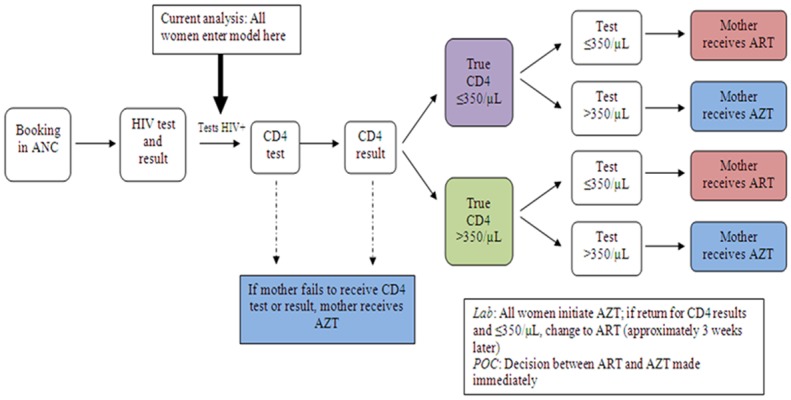
We used validated models of HIV infection to simulate pregnant, HIV-infected women (mean age 26 years, gestational age 26 weeks) in a general antenatal clinic in South Africa, and their infants. We examined two strategies for CD4 testing after HIV diagnosis: laboratory (test rate: 96%, result-return rate: 87%, cost: $14) and POC (test rate: 99%, result-return rate: 95%, cost: $26). We modeled South African PMTCT guidelines during the study period (WHO "Option A"): antenatal zidovudine (CD4 ≤350/μL) or ART (CD4>350/μL). Outcomes included MTCT risk at weaning (age 6 months), maternal and pediatric life expectancy (LE), maternal and pediatric lifetime healthcare costs (2013 USD), and cost-effectiveness ($/life-year saved).
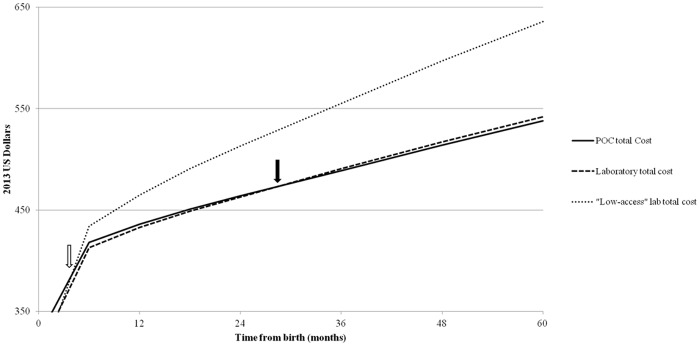
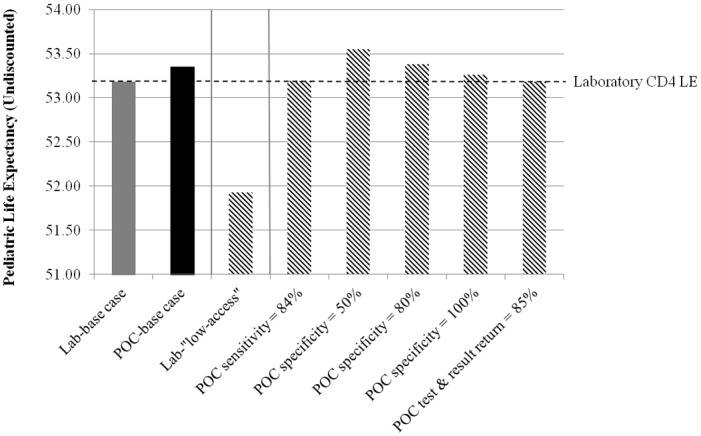
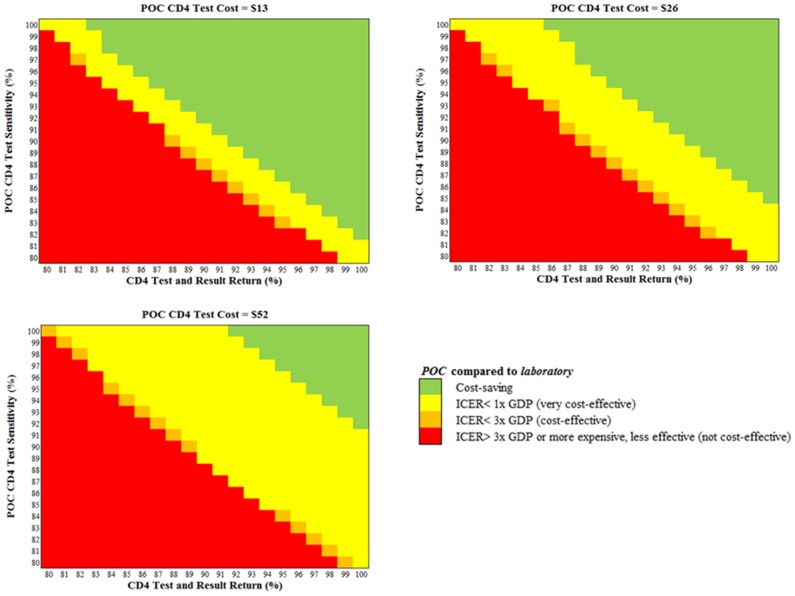
In the base case, laboratory led to projected MTCT risks of 5.7%, undiscounted pediatric LE of 53.2 years, and undiscounted PMTCT plus pediatric lifetime costs of $1,070/infant. POC led to lower modeled MTCT risk (5.3%), greater pediatric LE (53.4 years) and lower PMTCT plus pediatric lifetime costs ($1,040/infant). Maternal outcomes following laboratory were similar to POC (LE: 21.2 years; lifetime costs: $23,860/person). Compared to laboratory, POC improved clinical outcomes and reduced healthcare costs.
In antenatal clinics implementing Option A, the higher initial cost of a one-time POC CD4 assay will be offset by cost-savings from prevention of pediatric HIV infection.
许多预防母婴传播艾滋病毒(PMTCT)项目目前将抗逆转录病毒疗法(ART)优先用于患有晚期艾滋病毒的女性。即时检测(POC)CD4检测可能会加快选择三联药物抗逆转录病毒疗法而非齐多夫定的速度,但比传统实验室检测成本更高。
我们使用经过验证的艾滋病毒感染模型,对南非一家普通产前诊所的怀孕艾滋病毒感染女性(平均年龄26岁,孕周26周)及其婴儿进行模拟。我们研究了艾滋病毒诊断后两种CD4检测策略:实验室检测(检测率:96%,结果返回率:87%,成本:14美元)和即时检测(检测率:99%,结果返回率:95%,成本:26美元)。我们对研究期间的南非预防母婴传播艾滋病毒指南(世卫组织“选项A”)进行建模:产前使用齐多夫定(CD4≤350/μL)或抗逆转录病毒疗法(CD4>350/μL)。结果包括断奶时(6个月龄)的母婴传播风险、母婴预期寿命(LE)、母婴终身医疗保健成本(2013年美元)以及成本效益(美元/挽救的生命年)。
在基础案例中,实验室检测预计母婴传播风险为5.7%,未贴现的儿童预期寿命为53.2岁,未贴现的预防母婴传播艾滋病毒加儿童终身成本为1070美元/婴儿。即时检测导致模拟的母婴传播风险更低(5.3%),儿童预期寿命更长(53.4岁),预防母婴传播艾滋病毒加儿童终身成本更低(1040美元/婴儿)。实验室检测后的母亲结果与即时检测相似(预期寿命:21.2岁;终身成本:23860美元/人)。与实验室检测相比,即时检测改善了临床结果并降低了医疗保健成本。
在实施选项A的产前诊所中,一次性即时检测CD4检测的较高初始成本将被预防儿童艾滋病毒感染节省的成本所抵消。