York Structural Biology Laboratory, Department of Chemistry, University of York, York YO10 5DD, United Kingdom.
Laboratory of Structural Biology Research, National Institute of Arthritis Musculoskeletal and Skin Diseases, National Institutes of Health, Bethesda, MD 20892.
Proc Natl Acad Sci U S A. 2019 Feb 26;116(9):3556-3561. doi: 10.1073/pnas.1813204116. Epub 2019 Feb 8.
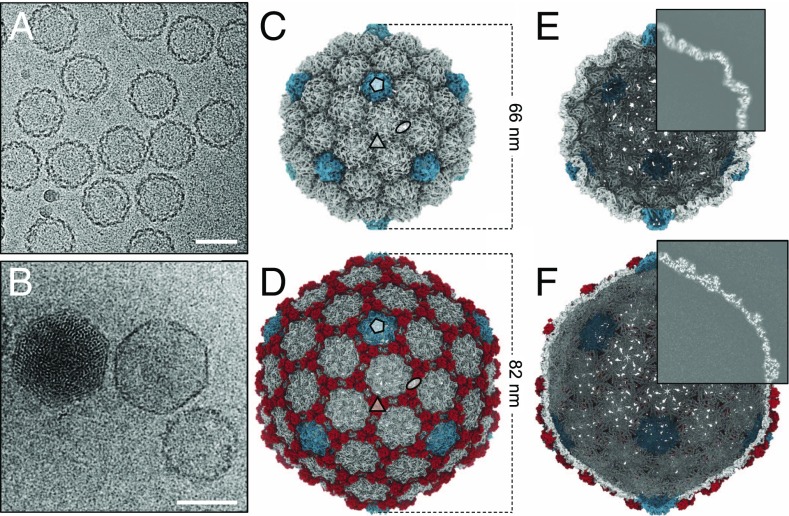
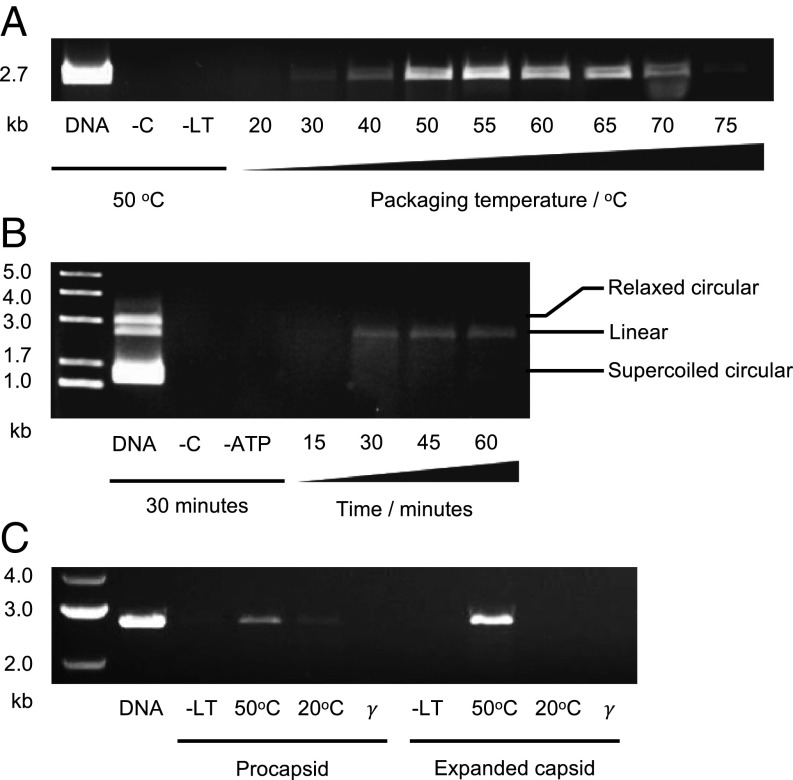
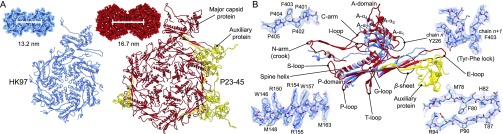
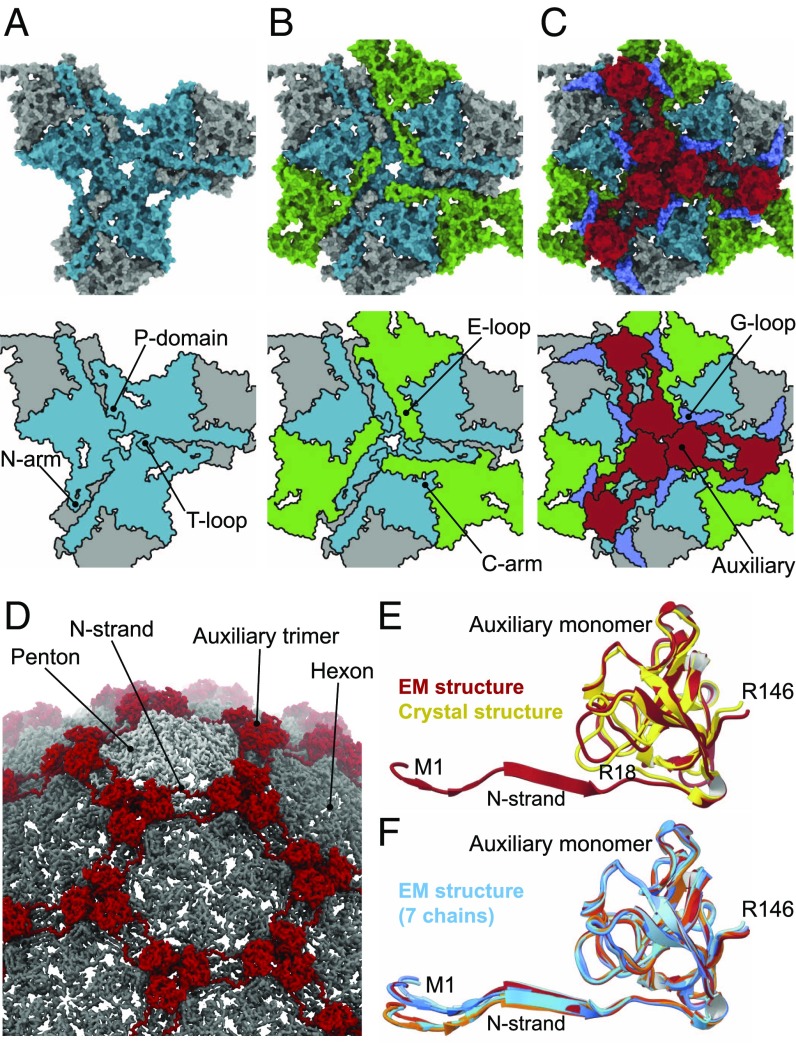
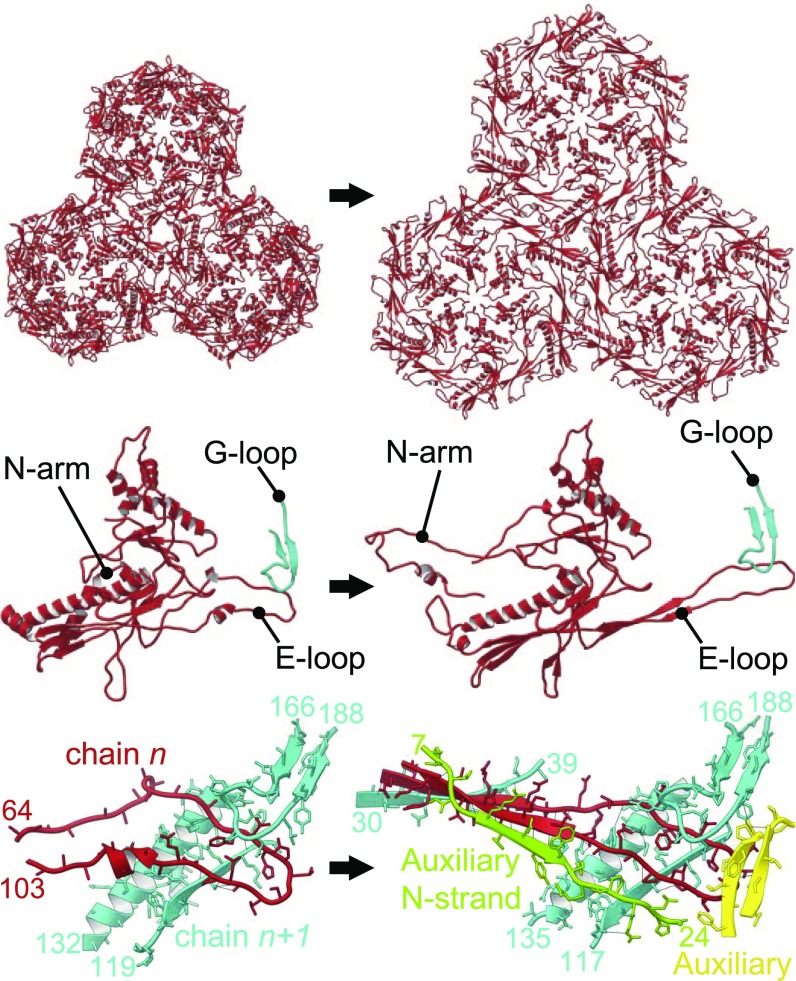
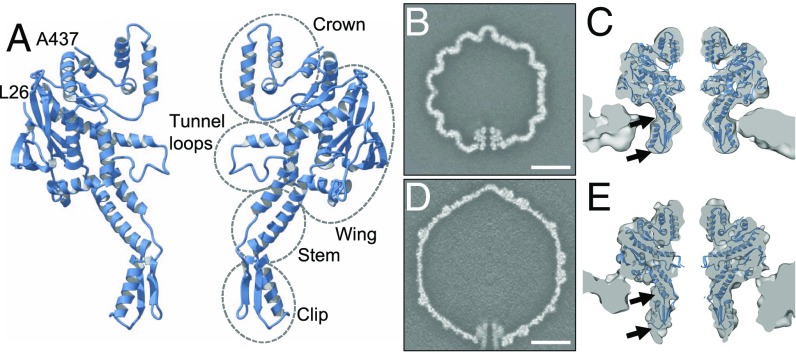
Double-stranded DNA viruses, including bacteriophages and herpesviruses, package their genomes into preformed capsids, using ATP-driven motors. Seeking to advance structural and mechanistic understanding, we established in vitro packaging for a thermostable bacteriophage, P23-45 of Both the unexpanded procapsid and the expanded mature capsid can package DNA in the presence of packaging ATPase over the 20 °C to 70 °C temperature range, with optimum activity at 50 °C to 65 °C. Cryo-EM reconstructions for the mature and immature capsids at 3.7-Å and 4.4-Å resolution, respectively, reveal conformational changes during capsid expansion. Capsomer interactions in the expanded capsid are reinforced by formation of intersubunit β-sheets with N-terminal segments of auxiliary protein trimers. Unexpectedly, the capsid has T=7 quasi-symmetry, despite the P23-45 genome being twice as large as those of known T=7 phages, in which the DNA is compacted to near-crystalline density. Our data explain this anomaly, showing how the canonical HK97 fold has adapted to double the volume of the capsid, while maintaining its structural integrity. Reconstructions of the procapsid and the expanded capsid defined the structure of the single vertex containing the portal protein. Together with a 1.95-Å resolution crystal structure of the portal protein and DNA packaging assays, these reconstructions indicate that capsid expansion affects the conformation of the portal protein, while still allowing DNA to be packaged. These observations suggest a mechanism by which structural events inside the capsid can be communicated to the outside.
双链 DNA 病毒,包括噬菌体和疱疹病毒,使用 ATP 驱动的马达将其基因组包装到预先形成的衣壳中。为了推进结构和机制理解,我们建立了一种热稳定噬菌体 P23-45 的体外包装方法。在包装 ATP 酶的存在下,未扩展的原衣壳和扩展的成熟衣壳都可以在 20°C 至 70°C 的温度范围内包装 DNA,最佳活性温度为 50°C 至 65°C。分别以 3.7-Å 和 4.4-Å 的分辨率对成熟和不成熟衣壳进行冷冻电镜重建,揭示了衣壳扩张过程中的构象变化。在扩展的衣壳中,衣壳蛋白之间的相互作用通过形成与辅助蛋白三聚体 N 端片段的亚基间 β-片层得到加强。出乎意料的是,尽管 P23-45 基因组是已知 T=7 噬菌体的两倍大,其中 DNA 被压缩到近乎结晶密度,但衣壳具有 T=7 拟准对称性。我们的数据解释了这种异常现象,展示了 HK97 折叠结构如何适应衣壳体积增加两倍的情况,同时保持其结构完整性。原衣壳和扩展衣壳的重建定义了包含门户蛋白的单一顶点的结构。结合门户蛋白的 1.95-Å 分辨率晶体结构和 DNA 包装测定,这些重建表明衣壳扩展会影响门户蛋白的构象,同时仍允许 DNA 包装。这些观察结果表明了一种机制,通过该机制,衣壳内的结构事件可以与外部进行通讯。