Xu Rui-Gang, Jenkins Huw T, Chechik Maria, Blagova Elena V, Lopatina Anna, Klimuk Evgeny, Minakhin Leonid, Severinov Konstantin, Greive Sandra J, Antson Alfred A
York Structural Biology Laboratory, Department of Chemistry, University of York, York YO10 5DD, UK.
Institute of Molecular Genetics, Russian Academy of Sciences, Moscow 123182, Russia.
Nucleic Acids Res. 2017 Apr 7;45(6):3580-3590. doi: 10.1093/nar/gkw1354.
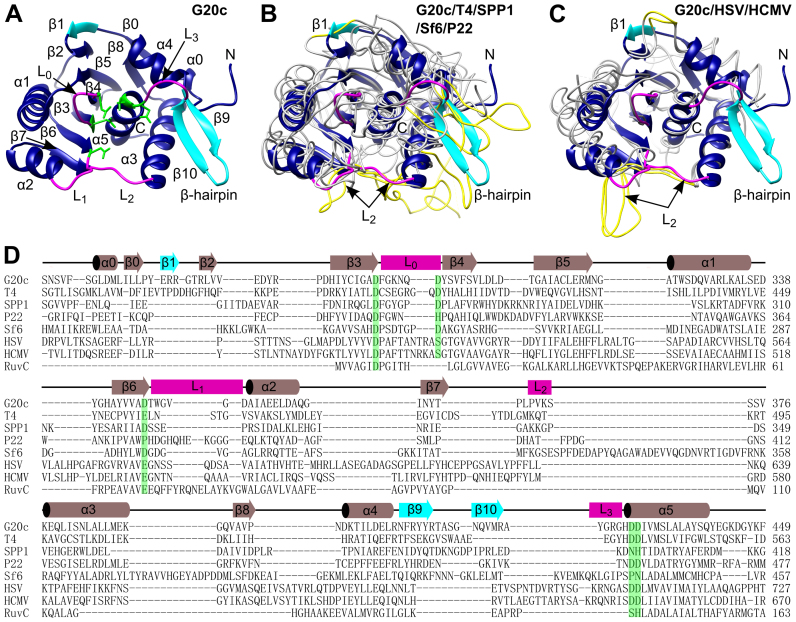
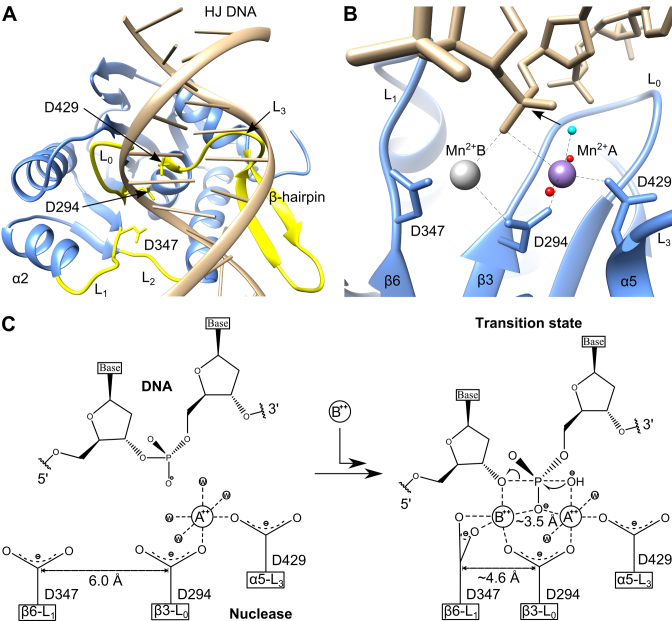
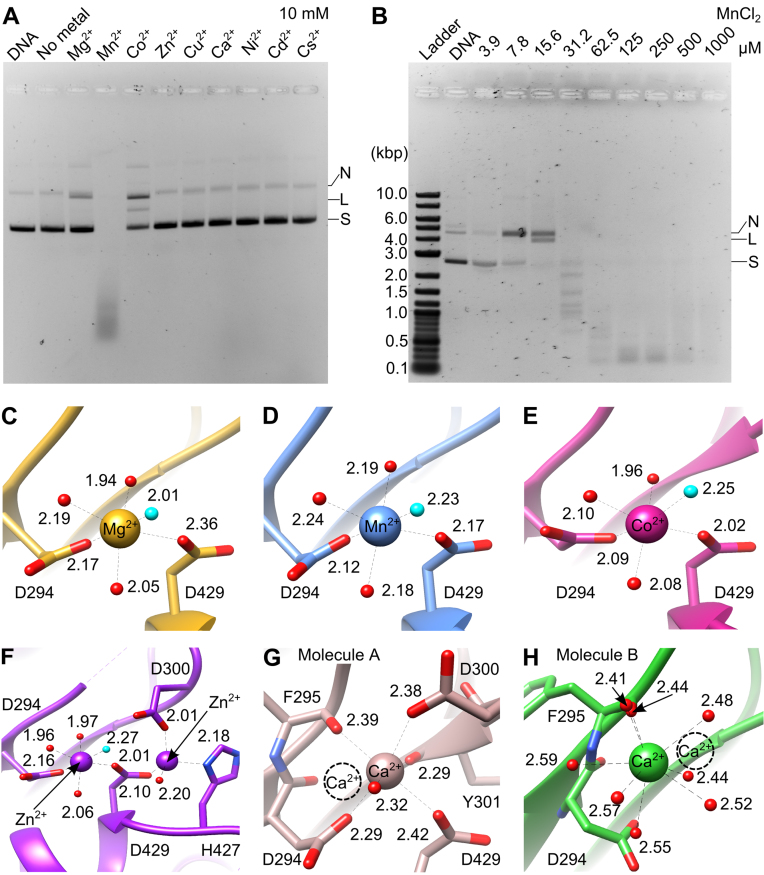
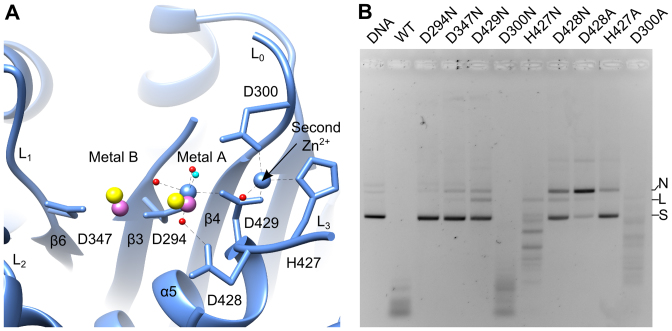
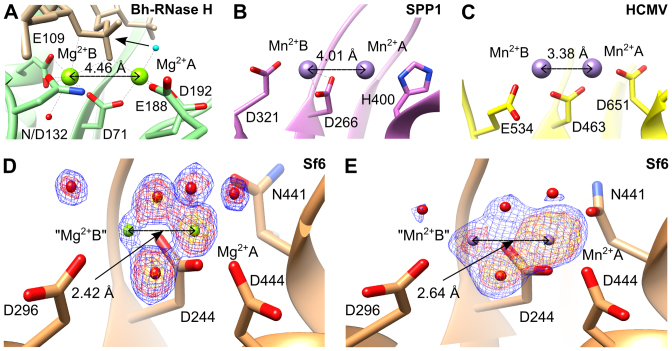
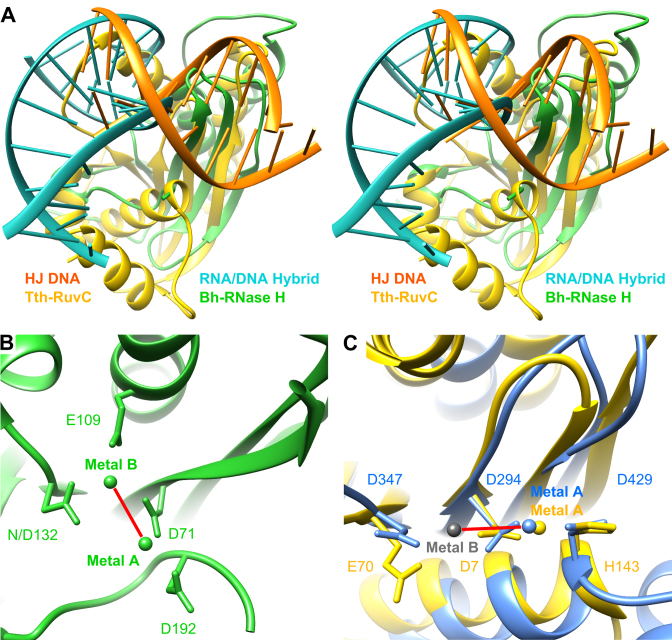
Bacteriophages and large dsDNA viruses encode sophisticated machinery to translocate their DNA into a preformed empty capsid. An essential part of this machine, the large terminase protein, processes viral DNA into constituent units utilizing its nuclease activity. Crystal structures of the large terminase nuclease from the thermophilic bacteriophage G20c show that it is most similar to the RuvC family of the RNase H-like endonucleases. Like RuvC proteins, the nuclease requires either Mn2+, Mg2+ or Co2+ ions for activity, but is inactive with Zn2+ and Ca2+. High resolution crystal structures of complexes with different metals reveal that in the absence of DNA, only one catalytic metal ion is accommodated in the active site. Binding of the second metal ion may be facilitated by conformational variability, which enables the two catalytic aspartic acids to be brought closer to each other. Structural comparison indicates that in common with the RuvC family, the location of the two catalytic metals differs from other members of the RNase H family. In contrast to a recently proposed mechanism, the available data do not support binding of the two metals at an ultra-short interatomic distance. Thus we postulate that viral terminases cleave DNA by the canonical RuvC-like mechanism.
噬菌体和大型双链DNA病毒编码复杂的机制,将其DNA转运到预先形成的空衣壳中。该机制的一个重要组成部分,即大型末端酶蛋白,利用其核酸酶活性将病毒DNA加工成组成单元。嗜热噬菌体G20c的大型末端酶核酸酶的晶体结构表明,它与RNase H样内切核酸酶的RuvC家族最为相似。与RuvC蛋白一样,该核酸酶的活性需要Mn2+、Mg2+或Co2+离子,但对Zn2+和Ca2+无活性。与不同金属形成的复合物的高分辨率晶体结构表明,在没有DNA的情况下,活性位点中仅容纳一个催化金属离子。第二个金属离子的结合可能通过构象变异性来促进,这使得两个催化天冬氨酸彼此更靠近。结构比较表明,与RuvC家族一样,两种催化金属的位置与RNase H家族的其他成员不同。与最近提出的机制相反,现有数据不支持两种金属以超短原子间距离结合。因此,我们推测病毒末端酶通过典型的RuvC样机制切割DNA。