Brakohiapa Edmund K, Botwe Benard O, Sarkodie Benjamin D
University of Ghana School of Medicine and Dentistry, Korle Bu, Accra, Ghana.
Department of Radiography, School of Biomedical & Allied Health Sciences, University of Ghana, Accra, Ghana.
J Med Radiat Sci. 2019 Jun;66(2):81-90. doi: 10.1002/jmrs.320. Epub 2019 Feb 8.
In Ghana, trans-abdominal ultrasonography is the main sonographic method of prostatic volume evaluation. The examinations are done when the patient's bladder is full. However, the delay and the discomforting experiences associated with a full bladder have been well documented. In an attempt to investigate other less discomforting options, this study was undertaken to determine if sonographic transabdominal prostatic evaluations performed at urinary bladder volumes of 50-99 mL differ significantly to evaluations done at volumes of 100-199, 200-299 and 300-399 mL.
A prostatic study of adult patients was undertaken in Accra, from 2014 to 2015. Using an ultrasound machine, 79 sets of prostatic measurements were recorded at a urinary bladder volume of 50-99 mL (V1 as our reference volume), and at least one of three other urinary bladder volumes (V2 = 100-199 mL, V3 = 200-299 mL and V4 = 300-399 mL), in 66 males. Twelve of the participants had multiple sets of prostate volume measurements. SPSS was used to analyse the data. T-test, Bland-Altman plots and linear regression were used to compare and test for the existence of proportional biases in measurements.
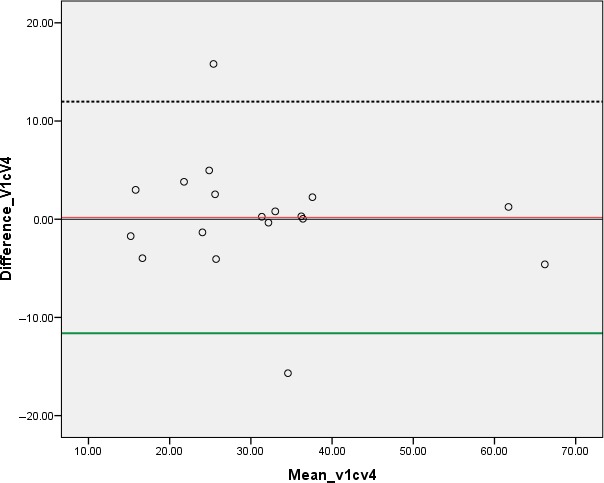
There was a statistically significant difference in prostatic volumes recorded at V1 and V2 (P = 0.017). However, the prostatic volume differences recorded for V1/V3, and V1/V4 groups of data were all not statistically significant (P > 0.05). The limits of agreement for the set of measurements spread from approximately -29 to +18 mL for V1/V2, -48 to +36 mL for V1/V3 and -12 to +12 mL for V1/V4 variables. There was no proportional bias in the V1/V2 (P = 0.55) and V1/V4 (P = 0.463) measurements.
Urinary bladder volume of 50-99 mL produces prostatic volume measurements comparable to volumes measured in patients with a full (300-399 mL), or nearly full urinary bladder (200-299 mL). A urinary bladder volume of 50-99 mL may therefore be adequate for scanning the prostate gland, and is likely to be tolerated much better by patients.
在加纳,经腹部超声检查是评估前列腺体积的主要超声检查方法。检查在患者膀胱充盈时进行。然而,膀胱充盈带来的延迟和不适体验已有充分记录。为了探究其他不太令人不适的选择,本研究旨在确定在膀胱容量为50 - 99毫升时进行的经腹前列腺超声评估与在100 - 199毫升、200 - 299毫升和300 - 399毫升时进行的评估是否存在显著差异。
2014年至2015年在阿克拉对成年患者进行了一项前列腺研究。使用超声仪,在66名男性患者的膀胱容量为50 - 99毫升(V1作为我们的参考容量)以及至少另外三个膀胱容量(V2 = 100 - 199毫升、V3 = 200 - 299毫升和V4 = 300 - 399毫升)之一时记录了79组前列腺测量数据。12名参与者有多组前列腺体积测量数据。使用SPSS分析数据。采用t检验、Bland - Altman图和线性回归来比较和检验测量中比例偏差的存在情况。
在V1和V2记录的前列腺体积存在统计学显著差异(P = 0.017)。然而,V1/V3和V1/V4两组数据记录的前列腺体积差异均无统计学意义(P > 0.05)。V1/V2测量值的一致性界限约为 - 29至 + 18毫升,V1/V3为 - 48至 + 36毫升,V1/V4变量为 - 12至 + 12毫升。V1/V2(P = 0.55)和V1/V4(P = 0.463)测量中不存在比例偏差。
膀胱容量为50 - 99毫升时得出的前列腺体积测量值与膀胱完全充盈(300 - 399毫升)或接近完全充盈(200 - 299毫升)的患者所测得的体积相当。因此,膀胱容量为50 - 99毫升可能足以用于扫描前列腺,并且患者可能更容易耐受。