Department of Neuroscience, Cell Biology and Physiology, Wright State University, Dayton, OH 45435, United States.
Department of Biological Sciences, Wright State University, Dayton, OH 45435, United States.
Exp Neurol. 2019 May;315:52-59. doi: 10.1016/j.expneurol.2019.02.002. Epub 2019 Feb 7.
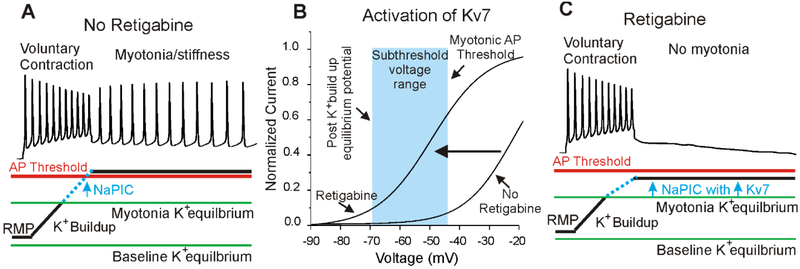
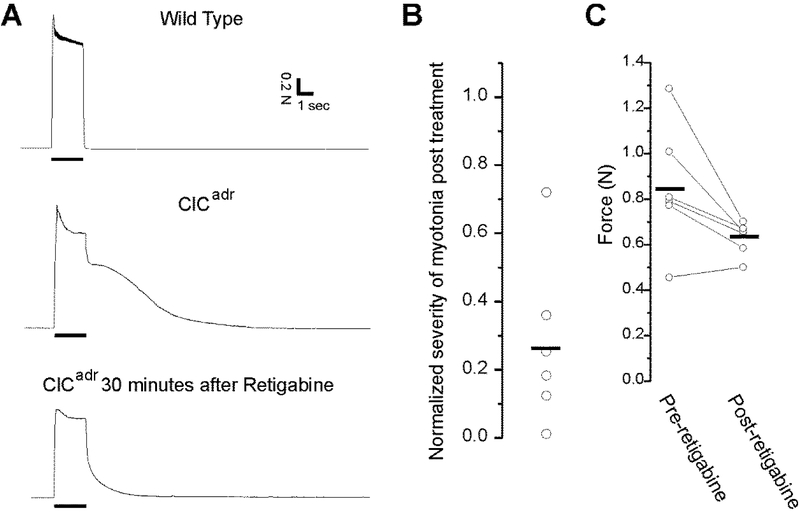
Patients with myotonia congenita suffer from muscle stiffness caused by muscle hyperexcitability. Although loss-of-function mutations in the ClC-1 muscle chloride channel have been known for 25 years to cause myotonia congenita, this discovery has led to little progress on development of therapy. Currently, treatment is primarily focused on reducing hyperexcitability by blocking Na current. However, other approaches such as increasing K currents might also be effective. For example, the K channel activator retigabine, which opens KCNQ channels, is effective in treating epilepsy because it causes hyperpolarization of the resting membrane potential in neurons. In this study, we found that retigabine greatly reduced the duration of myotonia in vitro. Detailed study of its mechanism of action revealed that retigabine had no effect on any of the traditional measures of muscle excitability such as resting potential, input resistance or the properties of single action potentials. Instead it appears to shorten myotonia by activating K current during trains of action potentials. Retigabine also greatly reduced the severity of myotonia in vivo, which was measured using a muscle force transducer. Despite its efficacy in vivo, retigabine did not improve motor performance of mice with myotonia congenita. There are a number of potential explanations for the lack of motor improvement in vivo including central nervous system side effects. Nonetheless, the striking effectiveness of retigabine on muscle itself suggests that activating potassium currents is an effective method to treat disorders of muscle hyperexcitability.
先天性肌强直患者由于肌肉兴奋性过高而导致肌肉僵硬。尽管 ClC-1 肌肉氯离子通道的失活功能突变已被发现 25 年,导致先天性肌强直,但这一发现并没有为治疗方法的发展带来多少进展。目前,治疗主要集中在通过阻断 Na 电流来降低兴奋性。然而,其他方法,如增加 K 电流,也可能是有效的。例如,K 通道激活剂 retigabine 可打开 KCNQ 通道,因其可使神经元的静息膜电位超极化,故对治疗癫痫有效。在这项研究中,我们发现 retigabine 可大大缩短体外肌强直的持续时间。对其作用机制的详细研究表明,retigabine 对静息电位、输入电阻或单个动作电位的特性等传统的肌肉兴奋性测量指标均没有影响。相反,它似乎通过在动作电位串中激活 K 电流来缩短肌强直。Retigabine 还大大减轻了体内肌强直的严重程度,这是通过肌肉力传感器来测量的。尽管它在体内有效,但 retigabine 并未改善先天性肌强直小鼠的运动性能。体内运动改善的缺乏有许多潜在的解释,包括中枢神经系统的副作用。尽管如此,retigabine 对肌肉本身的惊人疗效表明,激活钾电流是治疗肌肉兴奋性过高疾病的有效方法。