Pan Sudip, Jana Gourhari, Merino Gabriel, Chattaraj Pratim K
Institute of Advanced Synthesis School of Chemistry and Molecular Engineering Jiangsu National Synergetic Innovation Center for Advanced Materials Nanjing Tech University Nanjing 211816 China.
Department of Chemistry and Centre for Theoretical Studies Indian Institute of Technology Kharagpur Kharagpur 721302 India.
ChemistryOpen. 2019 Jan 29;8(2):173-187. doi: 10.1002/open.201800257. eCollection 2019 Feb.
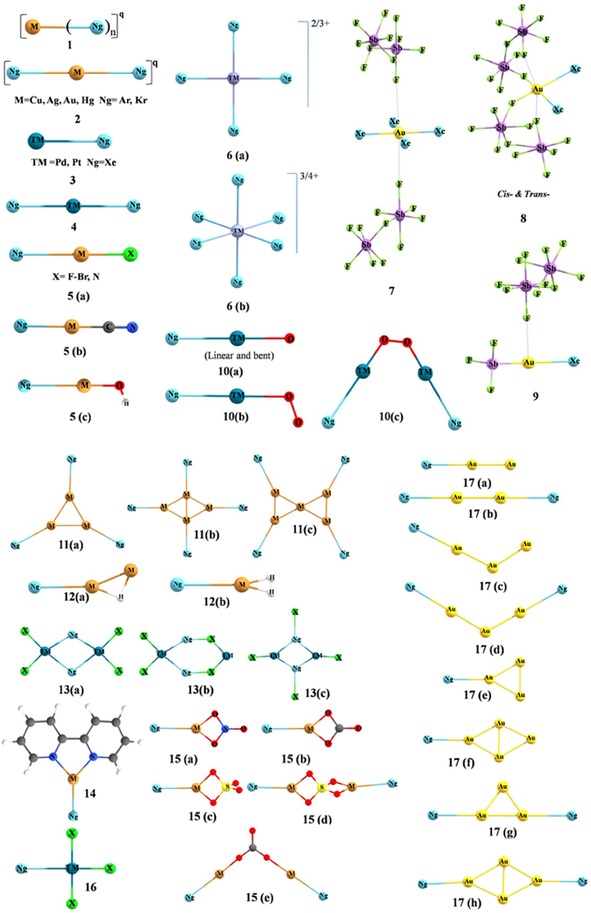
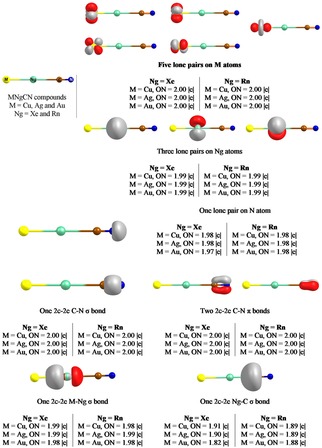
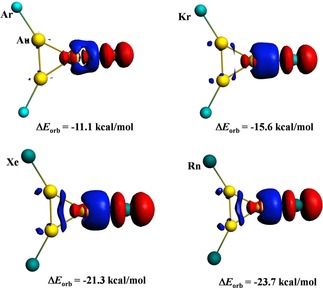
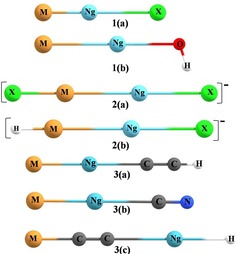
This Review presents the current status of the noble gas (Ng)-noble metal chemistry, which began in 1977 with the detection of AuNe through mass spectroscopy and then grew from 2000 onwards; currently, the field is in a somewhat matured state. On one side, modern quantum chemistry is very effective in providing important insights into the structure, stability, and barrier for the decomposition of Ng compounds and, as a result, a plethora of viable Ng compounds have been predicted. On the other hand. experimental achievement also goes beyond microscopic detection and characterization through spectroscopic techniques and crystal structures at ambient temperature; for example, (AuXe)(SbF ) have also been obtained. The bonding between two noble elements of the periodic table can even reach the covalent limit. The relativistic effect makes gold a very special candidate to form a strong bond with Ng in comparison to copper and silver. Insertion compounds, which are metastable in nature, depending on their kinetic stability, display an even more fascinating bonding situation. The degree of covalency in Ng-M (M=noble metal) bonds of insertion compounds is far larger than that in non-insertion compounds. In fact, in MNgCN (M=Cu, Ag, Au) molecules, the M-Ng and Ng-C bonds might be represented as classical 2c-2e σ bonds. Therefore, noble metals, particularly gold, provide the opportunity for experimental chemists to obtain sufficiently stable complexes with Ng at room temperature in order to characterize them by using experimental techniques and, with the intriguing bonding situation, to explore them with various computational tools from a theoretical perspective. This field is relatively young and, in the coming years, a lot of advancement is expected experimentally as well as theoretically.
本综述介绍了稀有气体(Ng)-贵金属化学的现状,该领域始于1977年通过质谱检测到AuNe,随后从2000年起不断发展;目前,该领域已处于某种成熟状态。一方面,现代量子化学在深入了解Ng化合物的结构、稳定性和分解能垒方面非常有效,因此预测了大量可行的Ng化合物。另一方面,实验成果也超越了在室温下通过光谱技术和晶体结构进行的微观检测和表征;例如,还获得了(AuXe)(SbF ) 。元素周期表中两种稀有元素之间的键合甚至可以达到共价极限。相对论效应使金成为与Ng形成强键的非常特殊的候选者,与铜和银相比。插入化合物本质上是亚稳态的,取决于它们的动力学稳定性,呈现出更加引人入胜的键合情况。插入化合物的Ng-M(M = 贵金属)键中的共价程度远大于非插入化合物。事实上,在MNgCN(M = Cu、Ag、Au)分子中,M-Ng键和Ng-C键可能表示为经典的2c-2e σ键。因此,贵金属,特别是金,为实验化学家提供了在室温下获得与Ng足够稳定的配合物的机会,以便使用实验技术对其进行表征,并通过各种计算工具从理论角度探索其引人入胜的键合情况。这个领域相对年轻,在未来几年,预计在实验和理论方面都会有很大进展。