Chen Shun-Hua, Chao Angel, Tsai Chia-Lung, Sue Shih-Che, Lin Chiao-Yun, Lee Yi-Zong, Hung Yi-Lin, Chao An-Shine, Cheng Ann-Joy, Wang Hsin-Shih, Wang Tzu-Hao
Graduate Institute of Biomedical Sciences, Chang Gung University, Taoyuan, Taiwan.
Department of Obstetrics and Gynecology, Chang Gung Memorial Hospital Linkou Medical Center and Chang Gung University, Taoyuan, Taiwan.
Mol Ther Methods Clin Dev. 2018 Dec 20;13:99-111. doi: 10.1016/j.omtm.2018.12.005. eCollection 2019 Jun 14.
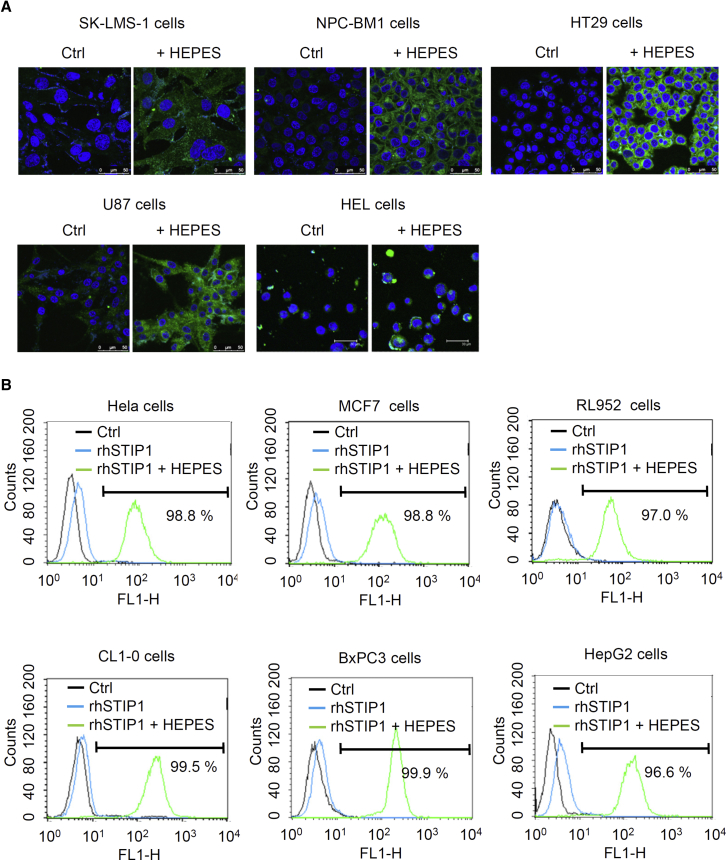
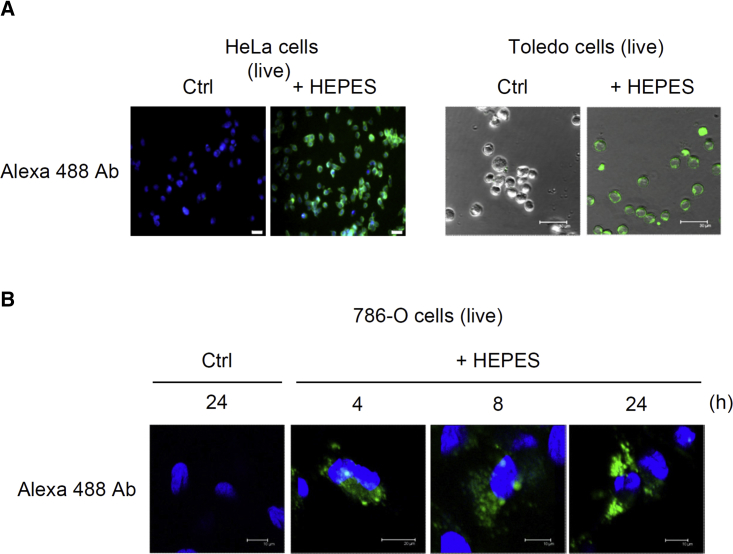
The delivery of active proteins into cells (protein transfection) for biological purposes offers considerable potential for clinical applications. Herein we demonstrate that, with a readily available, inexpensive organic agent, the 4-(2-hydroxyethyl)-1-piperazineethanesulfonic acid (HEPES) method can be used for simple and efficient protein transfection. By mixing proteins with a pure HEPES solution before they are applied to live cells, proteins with various molecular weights (including antibodies, recombinant proteins, and peptides) were successfully delivered into the cytoplasm of different cell types. The protein transfection efficiency of the HEPES method was not inferior to that of commercially available systems that are both more expensive and time consuming. Studies using endocytotic inhibitors and endosomal markers have revealed that cells internalize HEPES-protein mixtures through endocytosis. Results that HEPES-protein mixtures exhibited a low diffusion coefficient suggest that HEPES might neutralize the charges of proteins and, thus, facilitate their cellular internalization. Upon internalization, the cytosolic antibodies caused the degradation of targeted proteins in TRIM21-expressing cells. In summary, the HEPES method is efficient for protein transfection and has potential for myriad clinical applications.
出于生物学目的将活性蛋白导入细胞(蛋白质转染)在临床应用方面具有巨大潜力。在此我们证明,使用一种现成的、廉价的有机试剂,即4-(2-羟乙基)-1-哌嗪乙磺酸(HEPES)方法,可用于简单且高效的蛋白质转染。在将蛋白质应用于活细胞之前,通过将蛋白质与纯HEPES溶液混合,各种分子量的蛋白质(包括抗体、重组蛋白和肽)成功地被递送至不同细胞类型的细胞质中。HEPES方法的蛋白质转染效率不低于那些既更昂贵又耗时的市售系统。使用内吞抑制剂和内体标记物的研究表明,细胞通过内吞作用摄取HEPES-蛋白质混合物。HEPES-蛋白质混合物表现出低扩散系数的结果表明,HEPES可能中和蛋白质的电荷,从而促进其细胞内化。内化后,胞质抗体导致表达TRIM21的细胞中靶向蛋白的降解。总之,HEPES方法在蛋白质转染方面是有效的,并且在众多临床应用中具有潜力。