Blood Cancer Research Group, Mater Research, University of Queensland, Translational Research Institute, Brisbane, QLD, Australia.
Princess Alexandra Hospital Southside Clinical Unit, Faculty of Medicine, University of Queensland, Translational Research Institute, Brisbane, QLD, Australia.
Br J Haematol. 2019 Apr;185(1):25-41. doi: 10.1111/bjh.15778. Epub 2019 Feb 10.
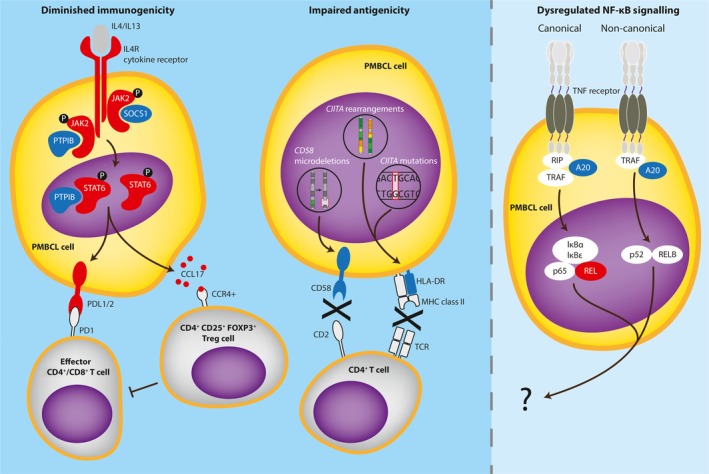
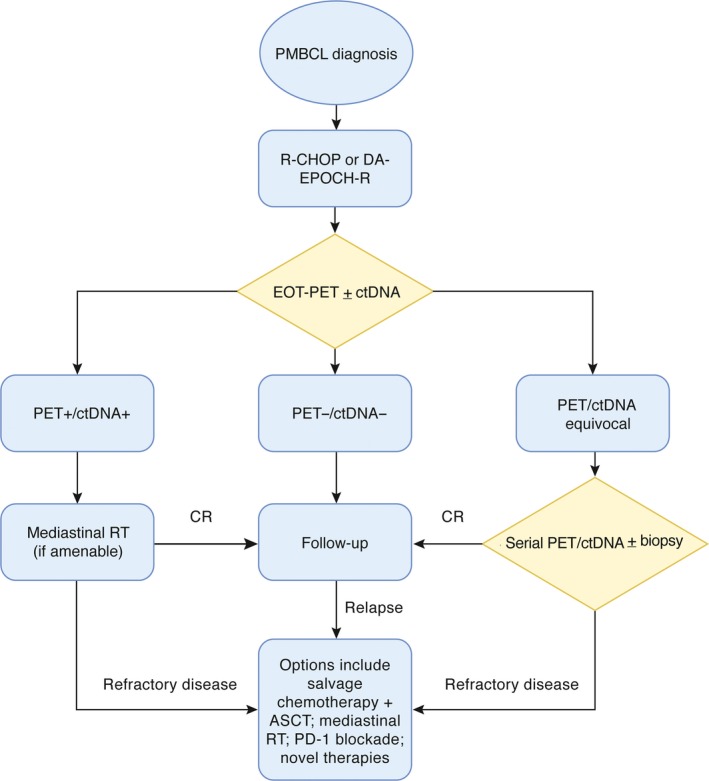
Primary mediastinal B-cell lymphoma (PMBCL) is a distinct disease closely related to classical nodular sclerosing Hodgkin lymphoma. Conventional diagnostic paradigms utilising clinical, morphological and immunophenotypical features can be challenging due to overlapping features with other B-cell lymphomas. Reliable diagnostic and prognostic biomarkers that are applicable to the conventional diagnostic laboratory are largely lacking. Nuclear factor kappa B (NF-κB) and Janus kinase/signal transducers and activators of transcription (JAK-STAT) signalling pathways are characteristically dysregulated in PMBCL and implicated in several aspects of disease pathogenesis, and the latter pathway in host immune evasion. The tumour microenvironment is manipulated by PMBCL tumours to avoid T-cell mediated destruction via strategies that include loss of tumour cell antigenicity, T-cell exhaustion and activation of suppressive T-regulatory cells. R-CHOP (rituximab, cyclophosphamide, doxorubicin, vincristine, prednisolone) and DA-EPOCH-R (dose-adjusted etoposide, prednisolone, vincristine, cyclophosphamide, doxorubicin, rituximab) are the most common first-line immunochemotherapy regimens. End of treatment positron emission tomography scans are the recommended imaging modality and are being evaluated to stratify patients for radiotherapy. Relapsed/refractory disease has a relatively poor outcome despite salvage immunochemotherapy and subsequent autologous stem cell transplantation. Novel therapies are therefore being developed for treatment-resistant disease, targeting aberrant cellular signalling and immune evasion.
原发性纵隔 B 细胞淋巴瘤(PMBCL)是一种与经典结节性硬化型霍奇金淋巴瘤密切相关的独特疾病。由于与其他 B 细胞淋巴瘤存在重叠特征,利用临床、形态学和免疫表型特征的传统诊断范式可能具有挑战性。目前缺乏适用于常规诊断实验室的可靠诊断和预后生物标志物。核因子 kappa B(NF-κB)和 Janus 激酶/信号转导和转录激活因子(JAK-STAT)信号通路在 PMBCL 中特征性失调,并涉及疾病发病机制的几个方面,后者途径涉及宿主免疫逃逸。肿瘤微环境被 PMBCL 肿瘤操纵,以避免 T 细胞介导的破坏,其策略包括肿瘤细胞抗原性丧失、T 细胞衰竭和抑制性 T 调节细胞的激活。R-CHOP(利妥昔单抗、环磷酰胺、多柔比星、长春新碱、泼尼松龙)和 DA-EPOCH-R(剂量调整依托泊苷、泼尼松龙、长春新碱、环磷酰胺、多柔比星、利妥昔单抗)是最常见的一线免疫化疗方案。治疗结束时的正电子发射断层扫描(PET)扫描是推荐的成像方式,正在进行评估,以对接受放疗的患者进行分层。尽管进行了挽救性免疫化疗和随后的自体干细胞移植,但复发/难治性疾病的预后仍然较差。因此,正在为治疗抵抗性疾病开发新型疗法,靶向异常细胞信号和免疫逃逸。