Division of Reproductive Health, Centers for Disease Control and Prevention, Atlanta, Georgia, and Oak Ridge Institute for Science and Education (ORISE), Oak Ridge, Tennessee.
Obstet Gynecol. 2019 Mar;133(3):533-540. doi: 10.1097/AOG.0000000000003135.
To estimate the absolute and relative risk of venous thromboembolism (VTE) among women who initiate depot medroxyprogesterone acetate (DMPA) immediately postpartum compared with those who do not initiate hormonal contraception.
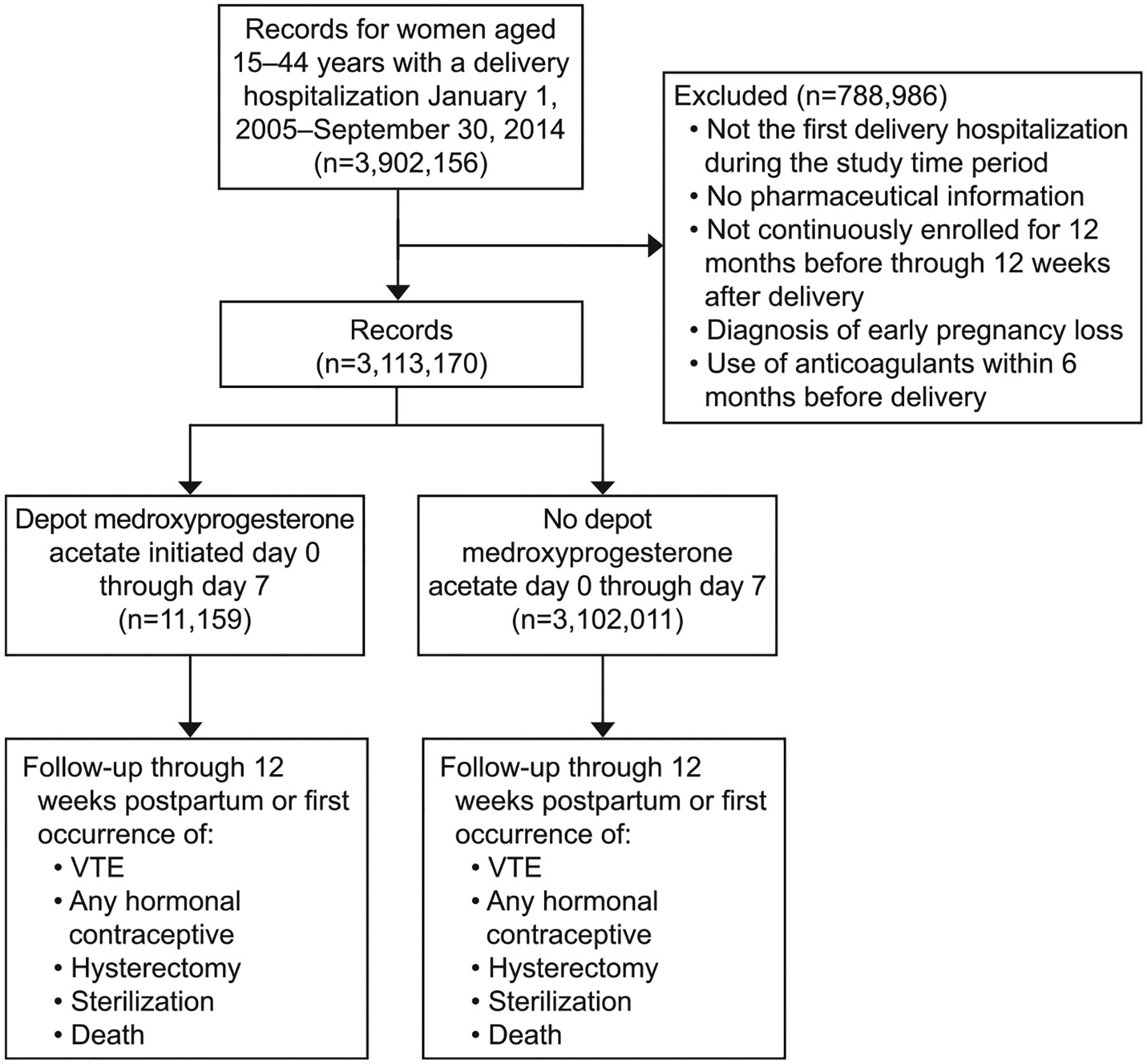
The IBM MarketScan Commercial Claims and Encounters databases were used to identify delivery hospitalizations among women aged 15-44 years during 2005 through 2014. Diagnosis, procedure, and drug codes were used to identify contraception, VTE, and potential confounding chronic or pregnancy-related conditions. Women who initiated DMPA during days 0 through 7 postpartum were compared with women who did not initiate hormonal contraception during days 0 through 7 postpartum. Women were followed from date of delivery through 12 weeks postpartum for the occurrence of VTE, with censoring at hormonal contraception initiation or prescription, hysterectomy, sterilization, or inpatient death. The incidence rate of VTE and 95% CIs were calculated within each group and the incidence rate ratio was calculated comparing the two groups.
The unadjusted VTE incidence rate through 12 weeks postpartum was 0.42/10,000 women-days in the immediate postpartum DMPA group (34 events among 11,159 women contributing 805,999 days of follow-up) and 0.15/10,000 women-days in the control group (3,107 events among 3,102,011 women contributing 206,180,811 days of follow-up). The incidence rate ratio for VTE was 2.87 (95% CI 2.05-4.03) among women in the immediate postpartum DMPA group compared with women in the control group, adjusting for age alone. After adjusting for age and pregnancy-related and chronic conditions, the adjusted incidence rate ratio for VTE was 1.94 (95% CI 1.38-2.72) among women in the immediate postpartum DMPA group compared with women in the control group.
Initiation of DMPA immediately postpartum is associated with a low incidence but an increased relative risk of VTE compared with nonuse of hormonal contraception.
评估产后立即开始使用 depot 美雄醇醋酸酯(DMPA)的女性与未开始使用激素避孕的女性相比,静脉血栓栓塞症(VTE)的绝对风险和相对风险。
利用 IBM MarketScan 商业索赔和就诊数据库,在 2005 年至 2014 年期间,确定年龄在 15-44 岁的女性分娩住院情况。采用诊断、手术和药物代码来确定避孕、VTE 和潜在混杂的慢性或妊娠相关疾病。产后 0-7 天内开始使用 DMPA 的女性与产后 0-7 天内未开始使用激素避孕的女性进行比较。从分娩日开始,对女性进行为期 12 周的随访,以确定 VTE 的发生情况,在开始使用激素避孕、进行子宫切除术、绝育术或住院死亡时进行截尾。在每个组内计算 VTE 的发生率及 95%CI,并计算两组之间的发病率比。
在未调整的情况下,产后 12 周内,即刻产后 DMPA 组的 VTE 发生率为 0.42/10000 妇女天(11159 名妇女中有 34 例事件,随访 805999 天),对照组为 0.15/10000 妇女天(3102011 名妇女中有 3107 例事件,随访 206180811 天)。产后即刻 DMPA 组女性 VTE 的发病率比为 2.87(95%CI 2.05-4.03),而对照组为 1.94(95%CI 1.38-2.72),仅调整年龄。在调整年龄、妊娠相关和慢性疾病后,产后即刻 DMPA 组女性的 VTE 发生率比为 2.87(95%CI 2.05-4.03),而对照组为 1.94(95%CI 1.38-2.72)。
与未使用激素避孕相比,产后立即开始使用 DMPA 与 VTE 的发生率较低但相对风险增加有关。