Research Center for Mountain Development, Institute of Mountain Hazards and Environment, Chinese Academy of Sciences, Chengdu 610041, China.
School of Resources and Environment, University of Chinese Academy of Sciences, Beijing 100049, China.
Int J Environ Res Public Health. 2019 Feb 10;16(3):493. doi: 10.3390/ijerph16030493.
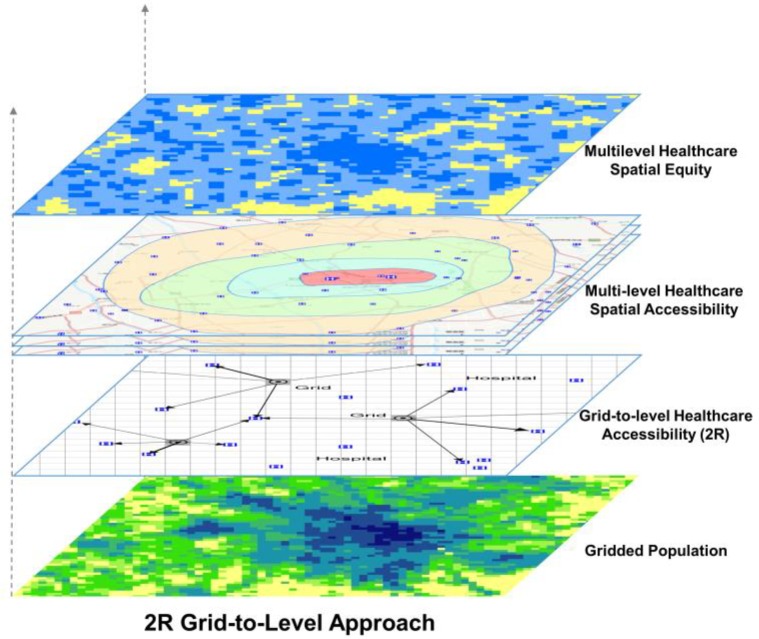
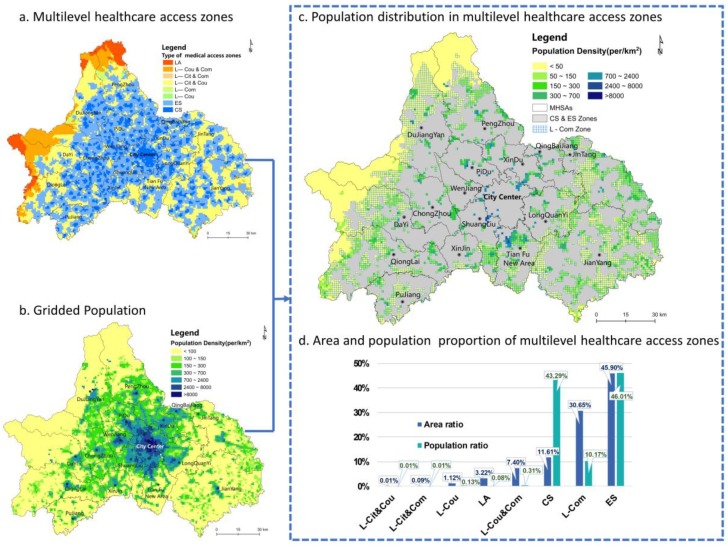
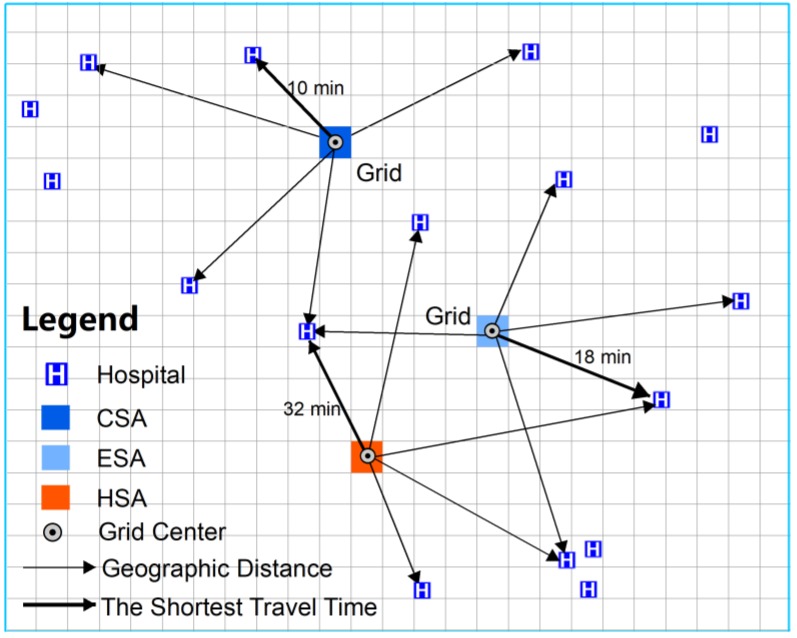
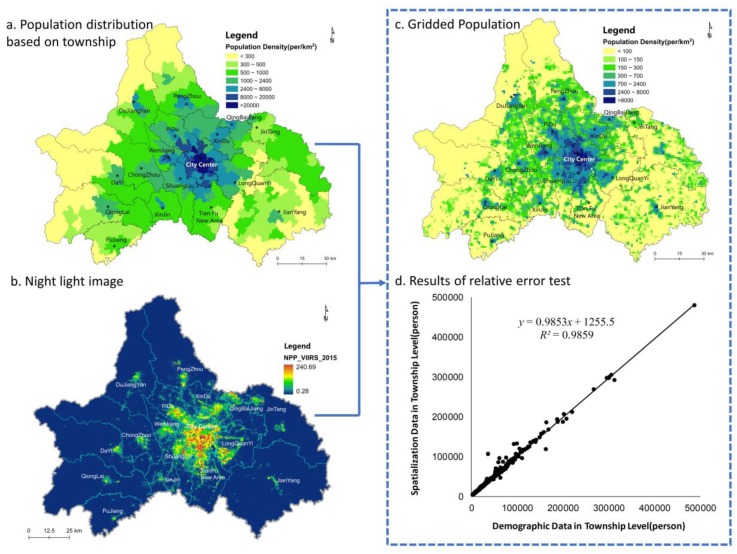
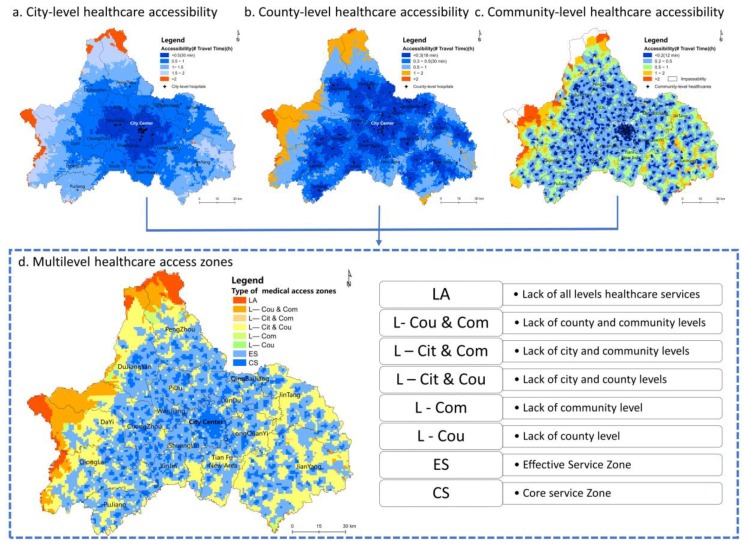
The spatial equity of the healthcare system is an important factor in assessing how the different medical service demands of residents are met by different levels of medical institutions. However, previous studies have not paid sufficient attention to multilevel healthcare accessibility based on both the divergence of hierarchical healthcare supplies and variations in residents' behavioral preferences for different types of healthcare. This study aims to propose a demand-driven "2R grid-to-level" (2R-GTL) method of analyzing the spatial equity in access to a multilevel healthcare system in Chengdu. Gridded populations, real-time travel distances and residents' spatial behavioral preferences were used to generate a dynamic and accurate healthcare accessibility assessment. The results indicate that significant differences exist in the spatial accessibility to different levels of healthcare. Approximately 90% of the total population living in 57% of the total area in the city can access all three levels of healthcare within an acceptable travel distance, whereas multilevel healthcare shortage zones cover 42% of the total area and 12% of the population. A lack of primary healthcare is the most serious problem in these healthcare shortage zones. These results support the systematic monitoring of multilevel healthcare accessibility by decision-makers. The method proposed in this research could be improved by introducing nonspatial factors, private healthcare providers and other cultural contexts and time periods.
医疗体系的空间公平性是评估不同医疗机构满足居民不同医疗服务需求程度的一个重要因素。然而,先前的研究还没有充分关注基于分层医疗供给的差异和居民对不同类型医疗服务的行为偏好变化的多层次医疗可及性。本研究旨在提出一种需求驱动的“2R 网格到层级”(2R-GTL)方法,用于分析成都市多层次医疗体系可达性的空间公平性。网格化人口、实时出行距离和居民的空间行为偏好被用来生成动态和准确的医疗可及性评估。结果表明,不同层级的医疗可及性存在显著差异。大约 90%的城市总人口中,有 57%的人居住在可接受出行距离内,可以获得所有三个层级的医疗服务,而多层次医疗短缺区域覆盖了 42%的总面积和 12%的人口。在这些医疗短缺区域中,初级医疗服务的短缺最为严重。这些结果支持决策者对多层次医疗可及性进行系统监测。本研究提出的方法可以通过引入非空间因素、私立医疗服务提供者以及其他文化背景和时间段进行改进。