Department of Cardiology, Chinese PLA General Hospital, Beijing, People's Republic of China.
Master Program of Medical Science and Clinical Investigation, Harvard Medical School, Boston, MA, USA.
BMC Cardiovasc Disord. 2019 Feb 11;19(1):39. doi: 10.1186/s12872-019-1016-4.
The heterogeneity of risk in patients with diabetes mellitus (DM) is acknowledged in new guidelines promulgating different treatment recommendations for diabetics at low cardiac risk. We performed a retrospective longitudinal follow-up study to evaluate coronary plaque progression and its impact on cardiac events in asymptomatic diabetic patients.
Data of 197 asymptomatic patients (63.1 ± 17 years, 60% males) with DM and suspected coronary artery disease (CAD) who underwent clinically indicated dual-source cardiac computed tomography (CT) were retrospectively analyzed. Patients with DM received standard of care treatment. Patients were classified into two groups based on CT coronary artery calcium scores (CACS): A, CACS> 10; B, CACS≤10. Progression of coronary plaque burden in both groups was evaluated and compared by baseline and follow-up coronary CT angiography (CCTA) using semi-automated plaque analysis and quantification software. Follow-up data were retrospectively gathered from medical records and endpoints of cardiac events were recorded via prospective phone-calls. The impacts of plaque composition and progression on cardiac events were specifically assessed.
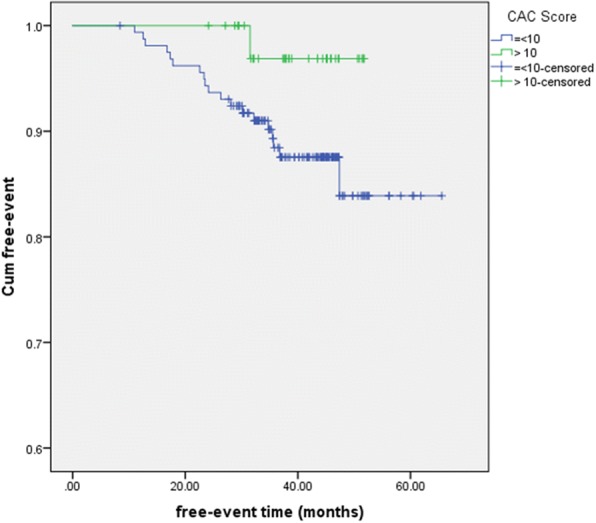
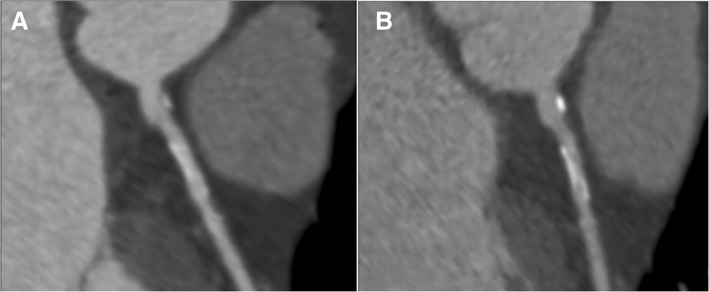
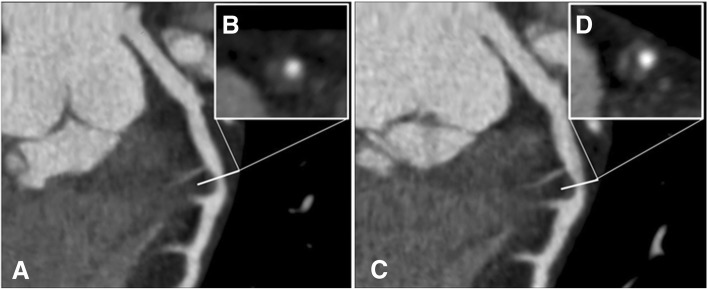
Patients with CACS> 10 showed an increase in dense coronary calcium volume, while patients with CACS≤10 had a more pronounced increase in the volume of low-attenuation "lipid-rich" plaque components between CCTA acquisitions. The composite endpoint occurred in 20 patients (10.2%) after a median follow-up period of 41.8 months. Furthermore, at follow-up CCTA, the presence of CACS> 10 (adjusted odds ratio, 0.701; 95% CI, 0.612-0.836), increase of dense calcium volume (OR, 0.860 95% CI, 0.771-0.960), and lipid volume (OR, 1.013; 95% CI, 1.007-1.020) were all independent predictors of cardiac events.
Asymptomatic patients with DM experienced plaque progression as well as progression to "overt or silent CAD". The relative increase in plaque volume was associated with subsequent cardiac events, and the coronary calcification seemed to be inversely related to the outcome in asymptomatic diabetic patients.
新指南承认糖尿病(DM)患者的风险存在异质性,为低心脏风险的糖尿病患者制定了不同的治疗建议。我们进行了一项回顾性纵向随访研究,以评估无症状糖尿病患者的冠状动脉斑块进展及其对心脏事件的影响。
回顾性分析了 197 例无症状(63.1±17 岁,60%为男性)患有 DM 且疑似冠心病(CAD)的患者的数据,这些患者接受了临床指征明确的双源心脏计算机断层扫描(CT)检查。DM 患者接受了标准的治疗。根据 CT 冠状动脉钙评分(CACS)将患者分为两组:A 组,CACS>10;B 组,CACS≤10。使用半自动斑块分析和定量软件,通过基线和随访的冠状动脉 CT 血管造影(CCTA)评估两组的冠状动脉斑块负担进展情况并进行比较。从病历中回顾性收集随访数据,并通过前瞻性电话记录心脏事件的终点。具体评估了斑块成分和进展对心脏事件的影响。
CACS>10 的患者的致密冠状动脉钙体积增加,而 CACS≤10 的患者在 CCTA 采集期间的低衰减“富含脂质”斑块成分的体积增加更为明显。在中位随访 41.8 个月后,20 例患者(10.2%)发生复合终点事件。此外,在随访 CCTA 中,CACS>10(调整后的优势比,0.701;95%置信区间,0.612-0.836)、致密钙体积增加(OR,0.860;95%置信区间,0.771-0.960)和脂质体积增加(OR,1.013;95%置信区间,1.007-1.020)是心脏事件的独立预测因素。
无症状 DM 患者发生了斑块进展以及“显性或隐匿性 CAD”进展。斑块体积的相对增加与随后的心脏事件相关,而冠状动脉钙化似乎与无症状糖尿病患者的预后呈负相关。