Weber Daniel Gilbert, Brik Alexander, Casjens Swaantje, Burek Katarzyna, Lehnert Martin, Pesch Beate, Taeger Dirk, Brüning Thomas, Johnen Georg
Institute for Prevention and Occupational Medicine of the German Social Accident Insurance, Institute of the Ruhr University Bochum (IPA), Buerkle-de-la-Camp-Platz 1, 44789, Bochum, Germany.
BMC Res Notes. 2019 Feb 11;12(1):77. doi: 10.1186/s13104-019-4113-7.
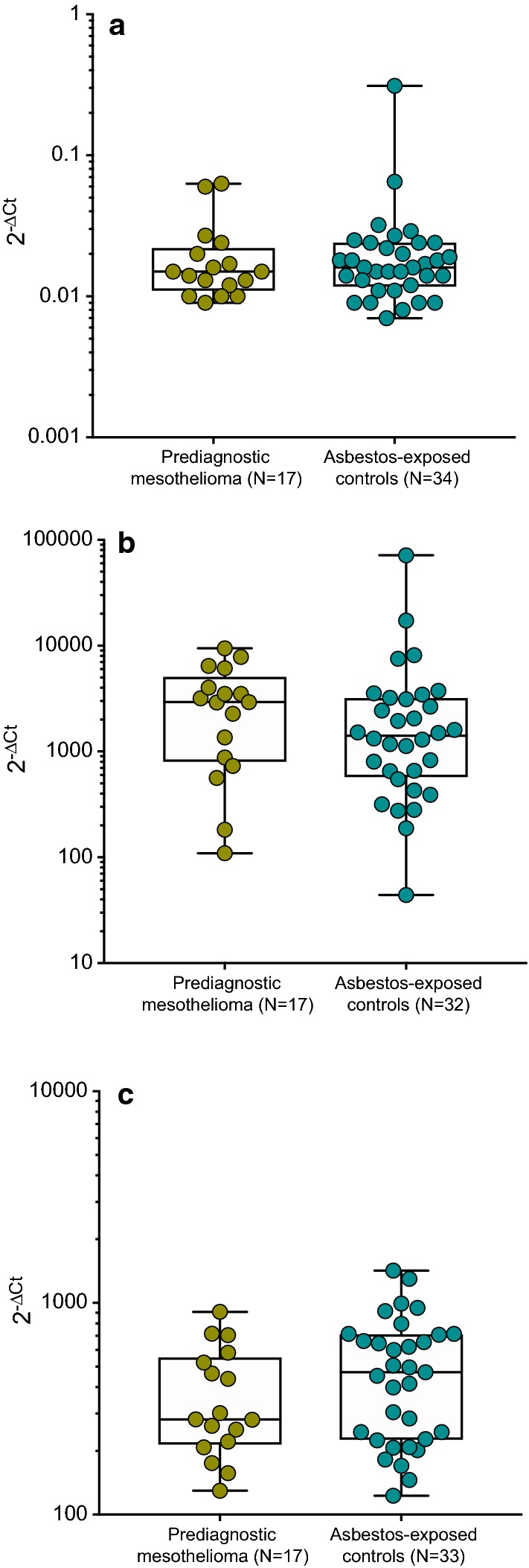
Malignant mesothelioma is an aggressive cancer of the serous membranes. For the detection of the tumor at early stages non- or minimally-invasive biomarkers are needed. The circulating biomarkers miR-132-3p, miR-126-3p, and miR-103a-3p were analyzed in a nested case-control study using plasma samples from 17 prediagnostic mesothelioma cases and 34 matched asbestos-exposed controls without a malignant disease.
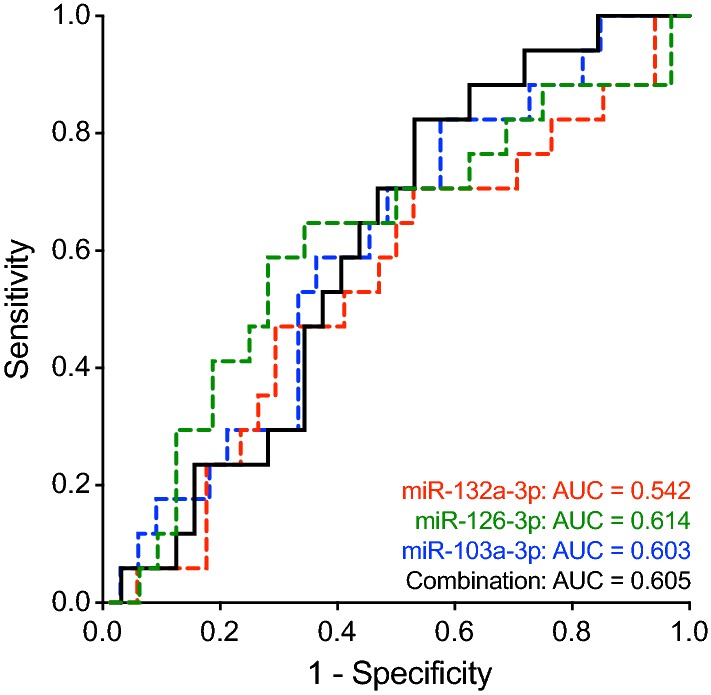
Using prediagnostic plasma samples collected in median 8.9 months prior the clinical diagnosis miR-132-3p, miR-126-3p, and miR-103a-3p revealed 0% sensitivity on a defined specificity of 98%. Thus, the analyzed miRNAs failed to detect the cancer in prediagnostic samples, showing that they are not feasible for the early detection of malignant mesothelioma. However, the miRNAs might still serve as possible markers for prognosis and response to therapy, but this needs to be analyzed in appropriate studies.
恶性间皮瘤是一种侵袭性的浆膜癌。为了在早期阶段检测该肿瘤,需要非侵入性或微创生物标志物。在一项巢式病例对照研究中,使用来自17例诊断前间皮瘤病例和34例匹配的无恶性疾病的石棉暴露对照的血浆样本,分析了循环生物标志物miR-132-3p、miR-126-3p和miR-103a-3p。
使用在临床诊断前中位数8.9个月采集的诊断前血浆样本,miR-132-3p、miR-126-3p和miR-103a-3p在定义的98%特异性下显示出0%的敏感性。因此,分析的miRNA未能在诊断前样本中检测到癌症,表明它们对于恶性间皮瘤的早期检测不可行。然而,这些miRNA仍可能作为预后和治疗反应的潜在标志物,但这需要在适当的研究中进行分析。