Hezel Dianne M, Simpson H Blair
Anxiety Disorders Clinic, New York State Psychiatric Institute, Columbia University, New York, NY, USA.
Department of Psychiatry, Columbia University, New York, NY, USA.
Indian J Psychiatry. 2019 Jan;61(Suppl 1):S85-S92. doi: 10.4103/psychiatry.IndianJPsychiatry_516_18.
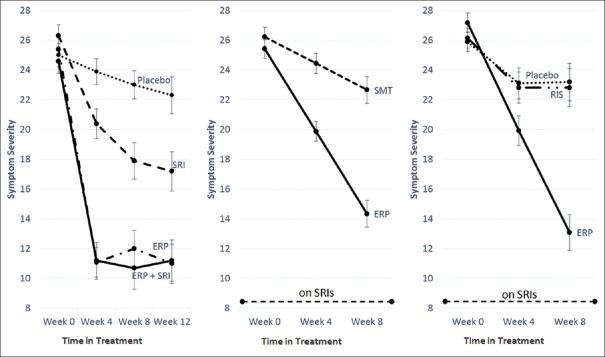
Obsessive-compulsive disorder (OCD) is characterized by distressing thoughts and repetitive behaviors that are interfering, time-consuming, and difficult to control. Although OCD was once thought to be untreatable, the last few decades have seen great success in reducing symptoms with exposure and response prevention (ERP), which is now considered to be the first-line psychotherapy for the disorder. Despite these significant therapeutic advances, there remain a number of challenges in treating OCD. In this review, we will describe the theoretical underpinnings and elements of ERP, examine the evidence for its effectiveness, and discuss new directions for enhancing it as a therapy for OCD.
强迫症(OCD)的特征是令人痛苦的想法和重复行为,这些行为具有干扰性、耗时且难以控制。尽管强迫症曾被认为无法治疗,但在过去几十年里,通过暴露与反应阻止疗法(ERP)减轻症状取得了巨大成功,该疗法现在被视为治疗这种疾病的一线心理治疗方法。尽管有这些重大的治疗进展,但在治疗强迫症方面仍存在一些挑战。在这篇综述中,我们将描述ERP的理论基础和要素,审视其有效性的证据,并讨论将其作为强迫症治疗方法加以改进的新方向。