Huang Feng-Ying, Hsu Ai-Ling, Hsu Li-Ming, Tsai Jaw-Shiun, Huang Chih-Mao, Chao Yi-Ping, Hwang Tzung-Jeng, Wu Changwei W
Department of Education, College of Education, National Taipei University of Education, Taipei, Taiwan.
Department of Radiology, Wan Fang Hospital, Taipei Medical University, Taipei, Taiwan.
Front Hum Neurosci. 2019 Jan 28;12:541. doi: 10.3389/fnhum.2018.00541. eCollection 2018.
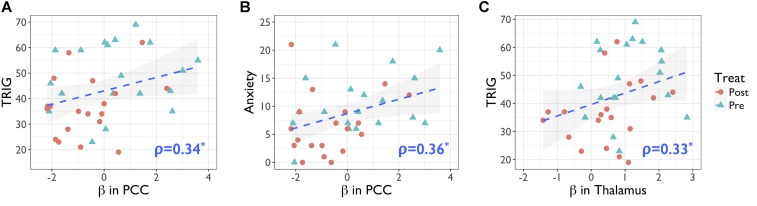
The grief of bereavement is recognized as a severe psychosocial stressor that can trigger a variety of mental and physical disorders, and the long-lasting unresolved grief has a detrimental effect on brain functionality. Literature has documented mindfulness-based cognitive therapy (MBCT) as an efficient treatment for improving well-being, specifically related to the mood and cognition, in a variety of populations. However, little attention has been devoted to neural mechanisms with regard to bereaved individuals' cognition after MBCT intervention. In this study, we recruited 23 bereaved participants who lost a significant relative within 6 months to 4 years to attend 8-week MBCT course. We used self-reporting questionnaires to measure emotion regulation and functional magnetic resonance imaging (fMRI) with the numerical Stroop task to evaluate the MBCT effect on executive control among the bereaved participants. The self-reported questionnaires showed improvements on mindfulness and reductions in grief, difficulties in emotion regulation, anxiety, and depression after the MBCT intervention. The fMRI analysis demonstrated two scenarios: (1) the activity of the fronto-parietal network slightly declined accompanied with significant improvements in the reaction time of incongruent trials; (2) the activities in the posterior cingulate cortex and thalamus were positively associated with the Texas Revised Inventory of Grief, implying emotional interferences on cognitive functions. Results indicated that MBCT facilitated the executive control function by alleviating the emotional interferences over the cognitive functions and suggested that the 8-week MBCT intervention significantly improved both executive control and emotion regulation in bereaved individuals.
丧亲之痛被认为是一种严重的社会心理压力源,可引发各种身心障碍,而长期未解决的悲伤会对大脑功能产生不利影响。文献记载,基于正念的认知疗法(MBCT)是一种有效的治疗方法,可改善各种人群的幸福感,特别是与情绪和认知相关的幸福感。然而,对于MBCT干预后丧亲者认知的神经机制却鲜有关注。在本研究中,我们招募了23名在6个月至4年内失去重要亲属的丧亲参与者,参加为期8周的MBCT课程。我们使用自我报告问卷来测量情绪调节,并通过数字Stroop任务使用功能磁共振成像(fMRI)来评估MBCT对丧亲参与者执行控制的影响。自我报告问卷显示,MBCT干预后,正念有所改善,悲伤、情绪调节困难、焦虑和抑郁有所减轻。fMRI分析显示了两种情况:(1)额顶网络的活动略有下降,同时不一致试验的反应时间有显著改善;(2)后扣带回皮质和丘脑的活动与《德克萨斯修订悲伤量表》呈正相关,这意味着情绪对认知功能有干扰。结果表明,MBCT通过减轻情绪对认知功能的干扰促进了执行控制功能,并表明为期8周的MBCT干预显著改善了丧亲者的执行控制和情绪调节能力。